Home
Class 12
PHYSICS
From a water tap, liquid comes out from ...

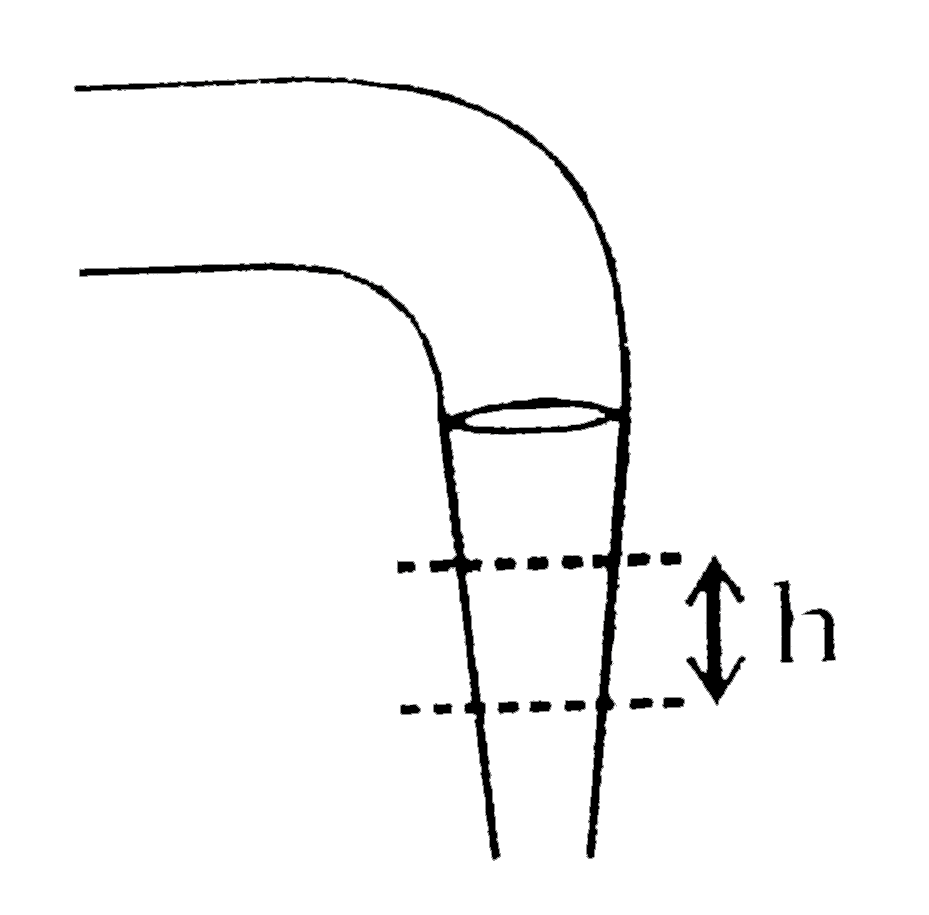
From a water tap, liquid comes out from cylinder. As water moves down, radius of that cylinder decreases. Consider, a very small element of height h and radius R (due to small height radius is assumed to be constant)

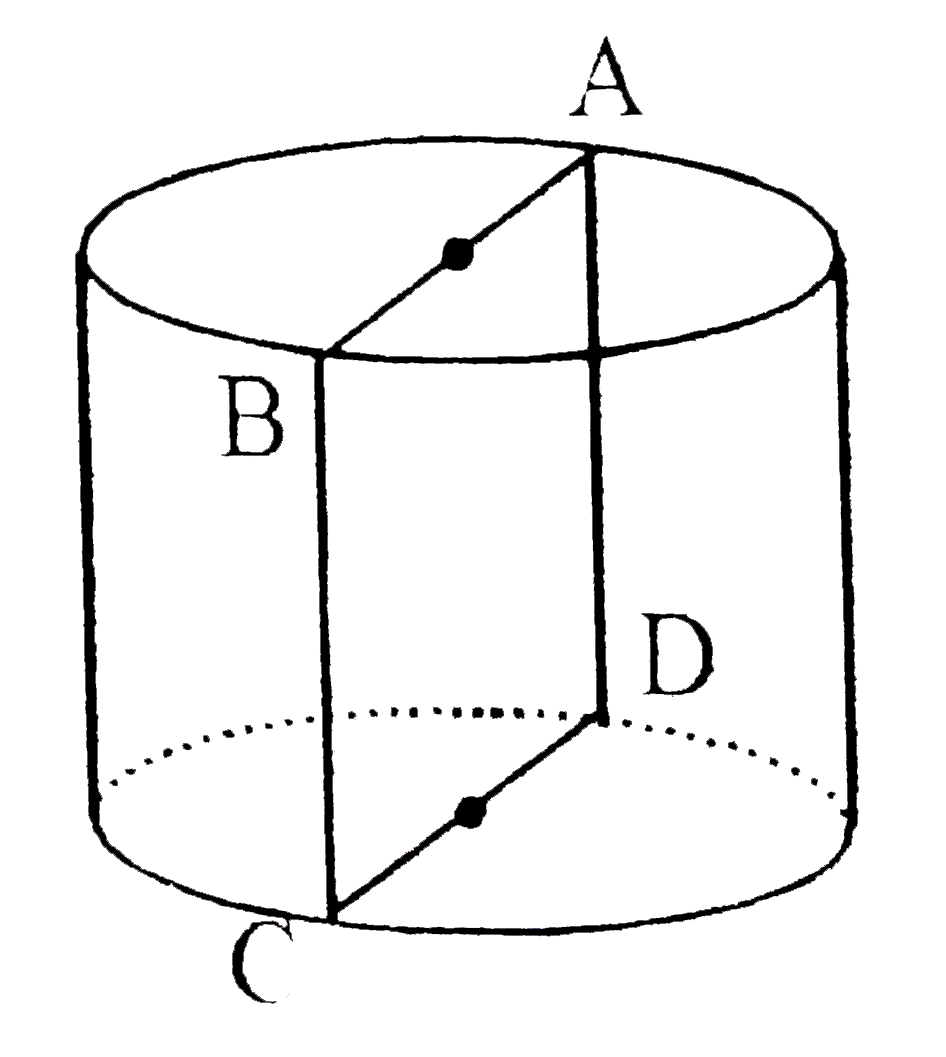
This element is given in the diagram. An imaginary cross-section ABCD divides this element in two equal semi cylinder. S is surface tensionof liquid. Now choose correct statement(s)

A

Surface energy of this elementary cylinder is `S[2piRh+2piR^(2)]`

B

Pressure inside the cylinder is more than atmospheric pressure by` (2S)/(R )`

C

Force exerted by one half cylinder on another half cylinder due to surface tension is 2Sh.

D

Surface energy of this elementary cylinder is `Sxx2piRh`

Text Solution

Verified by Experts

The correct Answer is:

C, D

`"Surface energy" = "free surface area" xx "surface tension"`
for a cylindrical surface excess pressure is `(S)/(R )`
Promotional Banner

Topper's Solved these Questions

  • TEST PAPERS

    ALLEN |Exercise part-2 physic|48 Videos
  • TEST PAPERS

    ALLEN |Exercise PHYSICS|16 Videos
  • TEST PAPERS

    ALLEN |Exercise Part-1 Physics|15 Videos
  • TEST PAPER 4

    ALLEN |Exercise PHYSICS|45 Videos
  • UNIT & DIMENSIONS, BASIC MATHS AND VECTOR

    ALLEN |Exercise Exercise (J-A)|7 Videos

Similar Questions

Explore conceptually related problems

Consider a water jar of radius R that has water filled up to height H and is kept on a stand of height h (see figure) through a hole of radius r(rltltR) at its bottom the water leaks out and the stream of water coming down towards the gound has a shape like a funnel as shown in the figure. it the radius of teh cross-section of water stream when it hits the ground is x. then.

A fixed thermally conducting cylinder has a radius R and height L_0 . The cylinder is open at its bottom and has a small hole at its top. A piston of mass M is held at a distance L from the top surface, as shown in the figure. The atmospheric pressure is P_0 . The piston is taken completely out of the cylinder. The hole at the top is sealed. A water tank is brought below the cylinder and put in a position so that the water surface in the tank is at the same level as the top of the cylinder as shown in the figure. The density of the water is rho . In equilibrium, the height H of the water coulmn in the cylinder satisfies

A fixed thermally conducting cylinder has a radius R and height L_0 . The cylinder is open at the bottom and has a small hole at its top. A piston of mass M is held at a distance L from the top surface, as shown in the figure. The atmospheric pressure is P_0 . The piston is now pulled out slowly and held at a distance 2L from the top. The pressure in the cylinder between its top and the piston will then be

A container of large uniform cross-sectional area A resting on a horizontal surface, holes two immiscible, non-viscon and incompressible liquids of densities d and 2d each of height H//2 as shown in the figure. The lower density liquid is open to the atmosphere having pressure P_(0) . A homogeneous solid cylinder of length L(LltH//2) and cross-sectional area A//5 is immeresed such that it floats with its axis vertical at the liquid-liquid interface with length L//4 in the denser liquid, The cylinder is then removed and the original arrangement is restroed. a tiny hole of area s(sltltA) is punched on the vertical side of the container at a height h(hltH//2) . As a result of this, liquid starts flowing out of the hole with a range x on the horizontal surface. The total pressure with cylinder, at the bottom of the container is

When an object moves through a fluid, as when a ball falls through air or a glass sphere falls through water te fluid exerts a viscous foce F on the object this force tends to slow the object for a small sphere of radius r moving is given by stoke's law, F_(w)=6pietarv . in this formula eta in the coefficient of viscosity of the fluid which is the proportionality constant that determines how much tangential force is required to move a fluid layer at a constant speed v, when the layer has an area A and is located a perpendicular distance z from and immobile surface. the magnitude of the force is given by F=etaAv//z . For a viscous fluid to move from location 2 to location 1 along 2 must exceed that at location 1, poiseuilles's law given the volumes flow rate Q that results from such a pressure difference P_(2)-P_(1) . The flow rate of expressed by the formula Q=(piR^(4)(P_(2)-P_(1)))/(8etaL) poiseuille's law remains valid as long as the fluid flow is laminar. For a sfficiently high speed however the flow becomes turbulent flow is laminar as long as the reynolds number is less than approximately 2000. This number is given by the formula R_(e)=(2overline(v)rhoR)/(eta) In which overline(v) is the average speed rho is the density eta is the coefficient of viscosity of the fluid and R is the radius of the pipe. Take the density of water to be rho=1000kg//m^(3) Q. What is the viscous force on a glass sphere of radius r=1mm falling through water (eta=1xx10^(-3)Pa-s) when the sphere has speed of 3m/s?

When an object moves through a fluid, as when a ball falls through air or a glass sphere falls through water te fluid exerts a viscous foce F on the object this force tends to slow the object for a small sphere of radius r moving is given by stoke's law, F_(w)=6pietarv . in this formula eta in the coefficient of viscosity of the fluid which is the proportionality constant that determines how much tangential force is required to move a fluid layer at a constant speed v, when the layer has an area A and is located a perpendicular distance z from and immobile surface. the magnitude of the force is given by F=etaAv//z . For a viscous fluid to move from location 2 to location 1 along 2 must exceed that at location 1, poiseuilles's law given the volumes flow rate Q that results from such a pressure difference P_(2)-P_(1) . The flow rate of expressed by the formula Q=(piR^(4)(P_(2)-P_(1)))/(8etaL) poiseuille's law remains valid as long as the fluid flow is laminar. For a sfficiently high speed however the flow becomes turbulent flow is laminar as long as the reynolds number is less than approximately 2000. This number is given by the formula R_(e)=(2overline(v)rhoR)/(eta) In which overline(v) is the average speed rho is the density eta is the coefficient of viscosity of the fluid and R is the radius of the pipe. Take the density of water to be rho=1000kg//m^(3) Q. Blood vessel is 0.10 m in length and has a radius of 1.5xx10^(-2) m blood flows at rate of 10^(-7)m^(3)//s through this vessel. The pressure difference that must be maintained in this flow between the two ends of the vessel is 20 Pa what is the viscosity sufficient of blood?

When an object moves through a fluid, as when a ball falls through air or a glass sphere falls through water te fluid exerts a viscous foce F on the object this force tends to slow the object for a small sphere of radius r moving is given by stoke's law, F_(w)=6pietarv . in this formula eta in the coefficient of viscosity of the fluid which is the proportionality constant that determines how much tangential force is required to move a fluid layer at a constant speed v, when the layer has an area A and is located a perpendicular distance z from and immobile surface. the magnitude of the force is given by F=etaAv//z . For a viscous fluid to move from location 2 to location 1 along 2 must exceed that at location 1, poiseuilles's law given the volumes flow rate Q that results from such a pressure difference P_(2)-P_(1) . The flow rate of expressed by the formula Q=(piR^(4)(P_(2)-P_(1)))/(8etaL) poiseuille's law remains valid as long as the fluid flow is laminar. For a sfficiently high speed however the flow becomes turbulent flow is laminar as long as the reynolds number is less than approximately 2000. This number is given by the formula R_(e)=(2overline(v)rhoR)/(eta) In which overline(v) is the average speed rho is the density eta is the coefficient of viscosity of the fluid and R is the radius of the pipe. Take the density of water to be rho=1000kg//m^(3) Q. If the sphere in previous question has mass of 1xx10^(-5)kg what is its terminal velocity when falling through water? (eta=1xx10^(-3)Pa-s)

When an object moves through a fluid, as when a ball falls through air or a glass sphere falls through water te fluid exerts a viscous foce F on the object this force tends to slow the object for a small sphere of radius r moving is given by stoke's law, F_(w)=6pietarv . in this formula eta in the coefficient of viscosity of the fluid which is the proportionality constant that determines how much tangential force is required to move a fluid layer at a constant speed v, when the layer has an area A and is located a perpendicular distance z from and immobile surface. the magnitude of the force is given by F=etaAv//z . For a viscous fluid to move from location 2 to location 1 along 2 must exceed that at location 1, poiseuilles's law given the volumes flow rate Q that results from such a pressure difference P_(2)-P_(1) . The flow rate of expressed by the formula Q=(piR^(4)(P_(2)-P_(1)))/(8etaL) poiseuille's law remains valid as long as the fluid flow is laminar. For a sfficiently high speed however the flow becomes turbulent flow is laminar as long as the reynolds number is less than approximately 2000. This number is given by the formula R_(e)=(2overline(v)rhoR)/(eta) In which overline(v) is the average speed rho is the density eta is the coefficient of viscosity of the fluid and R is the radius of the pipe. Take the density of water to be rho=1000kg//m^(3) Q. Calculate the highest average speed that blood (rho~~1000kg//m^(3) ) could have and still remain in laminar flow when it flows through the arorta (R=8xx10^(-3)m ) Take the coeffiicient of viscosity of blood to be 4xx10^(-3)Pa-s

A cylindrical container of radius 'R' and height 'h' is completely filled with a liquid. Two horizontal L -shaped pipes of small cross-sectional area 'a' are connected to the cylinder as shown in the figure. Now the two pipes are opened and fluid starts coming out of the pipes horizontally in opposite directions. Then the torque due to ejected liquid on the system is

A small particle of mass m is fixed to the perimeter of a ring of same mass and radius r. The system comprising of particle and ring is placed on a horizontal plane. Friction is negligible on horizontal plane. Initially particle is at top most point, then the system is released from rest. Answer next two question when the particle is at the same height as the centre of ring aftr being released from top most point. Assume that the ring stays in vertical plane during its motion under consideration Mark the CORRECT option(s):-

ALLEN -TEST PAPERS-part-2 physics
  1. The arms of a U shaped tube are vertical. The arm on right side is clo...

    Text Solution

    |

  2. A cup contains some mercury in it. Now a narrow glass tube is lowered ...

    Text Solution

    |

  3. From a water tap, liquid comes out from cylinder. As water moves down,...

    Text Solution

    |

  4. A small ball of mass m and charge q is attached to the bottom end of a...

    Text Solution

    |

  5. A small ball of mass m and charge q is attached to the bottom end of a...

    Text Solution

    |

  6. A small ball of mass m and charge q is attached to the bottom end of a...

    Text Solution

    |

  7. A cylindrical capacitor with external radius R, internal radius R-d(dl...

    Text Solution

    |

  8. A cylindrical capacitor with external radius R, internal radius R-d(dl...

    Text Solution

    |

  9. A cylindrical capacitor with external radius R, internal radius R-d(dl...

    Text Solution

    |

  10. A homogeneous magnetic field B is perpendicular to a sufficiently long...

    Text Solution

    |

  11. The sides of a square shaped frame, Shown in the diagram are made of w...

    Text Solution

    |

  12. There are two cylinder shaped wooden bullets, each having mass M, in a...

    Text Solution

    |

  13. A uniform wire of length l carrying current radiates energy at a rate ...

    Text Solution

    |

  14. A choke coil is connected to an AC source. Some power is dissipated in...

    Text Solution

    |

  15. Two voltmeters A and B are used to measures a voltage a cross a resist...

    Text Solution

    |

  16. In a specially designed vernier calipers, 10 divisions of the vernier...

    Text Solution

    |

  17. An almost inertia-less rod of length l3.5 m can rotate freely around a...

    Text Solution

    |

  18. Consider circuit as shown in figure. The current through wire AB is

    Text Solution

    |

  19. Consider the circuit as shown in figure. The equivalent resistance bet...

    Text Solution

    |

  20. In the circuit shown in the figure, the value of maximum rate of heat ...

    Text Solution

    |
