Home
Class 12
PHYSICS
The following objects are placed one aft...

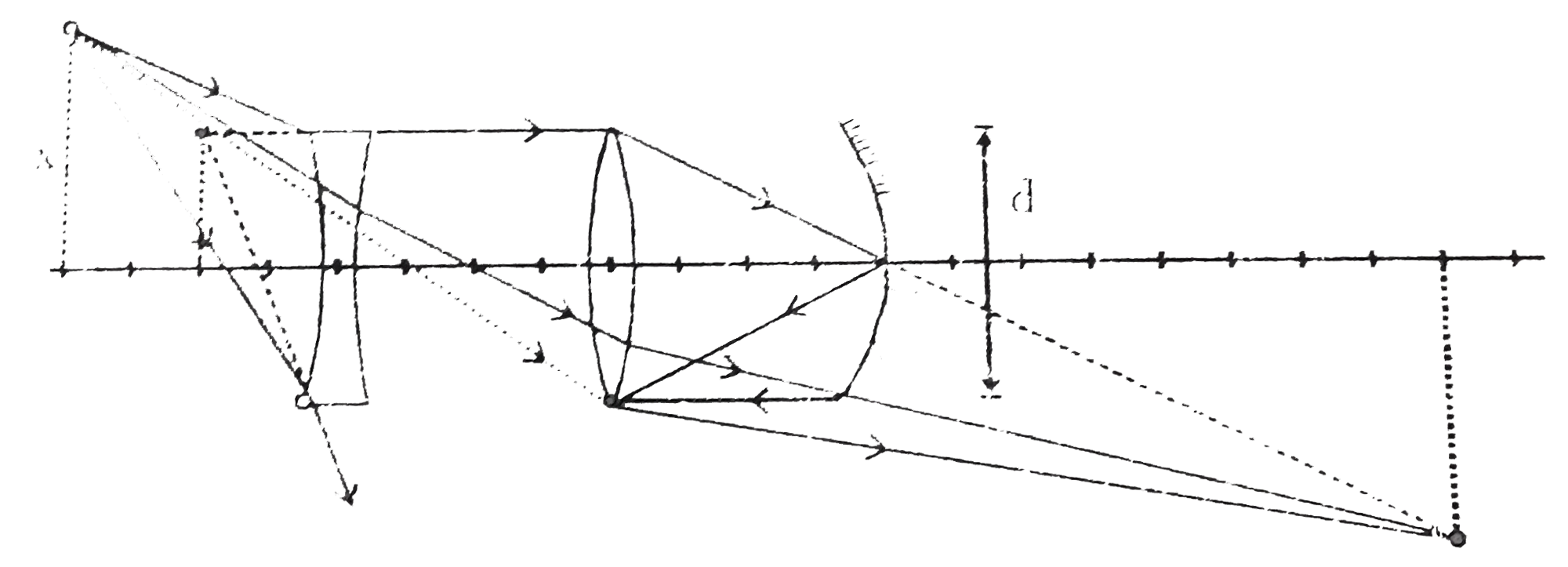
The following objects are placed one after each other in given order onto a central axis with a separation of 40 cm each. A point source of light O. a diverging lens of focal length 40 cm. a converging lens of focal length 40 cm and converging mirror of focal length 80 cm. The aperture diameter of lenses and mirror is d=20 cm. If a point source of light is placed at a perpendicular distance of x from central axis then. (You have to consider single optical event at any optical element)
Mark the CORRECT statement(s):-

A

Final image is formed in the plane of converging lens

B

If `x gt 1.5d` the rays will not be reflected by converging mirror

C

For `x gt d` final real images can be captured on a screen after on optical event (i.e refraction or reflection)at every optical system

D

Final image is real and inverted

Text Solution

Verified by Experts

The correct Answer is:
A, C, D

Let us follow the way the images are formed by the lenses and the mirror. The virtual image formed by the diverging lens has an image distance of
`i_(1)=(O_(1)f_(1))/(O_(1)-f_(1))=(-4.4)/(4-(-4))dm=-2dm` (dmrarrdecimeter)
Since the linear magnification is
`m_(1)=(H_(i1))/(H_(O1))=(i_(1))/(O_(1))=(1)/(2)`
the height of the first image is
`H_(i1)=(x)/(2)=H_(O2)`.
This virtual image is seen by the diverging lens as an object with an object distance of `O_(2)=f_(2)+|i_(2)|=6dm`, therefore the image formed by second lens has an image distance of
`i_(2)=(O_(2)f_(2))/(O_(2)-f_(2))=(6.4)/(6-4)dm=12dm`
The linear magnification of the second lens is
`m_(2)=(i_(2))/(O_(2))=(12)/(6)=2`

Hence the height of the second image is `H_(i2)=m_(2)H_(O2)=m_(2)H_(i1)=xc=H_(O3.)`
The second image is seen by the concave mirror as a virtual object bering at a distance of `O_(3)=f_(3)-i_(2)=-8dm`, therefore the image is formed at
`i_(3)=(O_(3)f_(3))/(O_(3)-f_(3))=(-8.8)/(-8-8)=(-64)/(-16)=1dm`
This is a real image and since the linear magnification of the mirror is:
`m_(3)=(i_(3))/(O_(3))=(1)/(2)`
the height of the final image is
`H_(i3)=m_(3)H_(O3)=(x)/(2)`
Note that final image is formed in the plane of the converging lens, therefore the image can only be captured on a screen if its height is greater than the radius of the lens. This happens when x is greater than d, therefore the list condition for perpendicular is d lt x. If x is increased further than `1.5 d`, the rays will all pass under the concave mirror and there will be no image formation. Therefore the solution of the problem is :
`d lt x lt 1.5 d`.creased further than `1.5 d`, the rays will all pass under the concave mirror and there will be no images formation. Therefore the solution of the problem is:
`d lt x lt 1.5 d`.
Promotional Banner

Topper's Solved these Questions

  • TEST PAPERS

    ALLEN |Exercise PHYSICS|16 Videos
  • TEST PAPERS

    ALLEN |Exercise MATHS|1 Videos
  • TEST PAPERS

    ALLEN |Exercise part-2 physics|73 Videos
  • TEST PAPER 4

    ALLEN |Exercise PHYSICS|45 Videos
  • UNIT & DIMENSIONS, BASIC MATHS AND VECTOR

    ALLEN |Exercise Exercise (J-A)|7 Videos

Similar Questions

Explore conceptually related problems

A convex lens of focal length 40 cm is in contact with a concave lens of focal length 25 cm. The power of the combination is ..........

An object O is kept infront of a converging lens of focal length 30 cm behind which there is a plane mirror at 15 cm from the lens.

An astronomical refractive telescope has an objective of focal length 20 m and an eyepiece of focal length 2 cm.

What is the focal length of a convex lens of focal length 30cm in contact with a concave lens of focal length 20cm? Is the system a converging or a diverging lens? Ignore thickness of the lenses.

A point source S is placed at distance of 15 cm from a converging lens of focal length 10 cm . Where should a (i) concave mirror (ii) convex mirror of focal length 12 cm be placed so that real image is formed on object itself.

A biconvex lens of focal length 15 cm is in front of a plane mirror. The distance between the lens and the mirror is 10 cm. A small object is kept at a distance of 30 cm from the lens. The final image is

A beam of light converges at a point P. Now a lens is placed in the path of the convergent beam 12cm from P. At what point does the beam converge if the lens is (a) a convex lens of focal length 20cm, and (b) a concave lens of focal length 16cm?

A converging lens of focal length f_(1) is placed in front of and coaxially with a convex mirror of focal length f_(2) . Their separation is d. A parallel beam of light incident on the lens returns as a parallel beam from the arrangement, Then,

ALLEN -TEST PAPERS-part-2 physic
  1. A uniform thin rod AB of mass M and length l attached to a string OA ...

    Text Solution

    |

  2. The following objects are placed one after each other in given order o...

    Text Solution

    |

  3. The following objects are placed one after each other in given order o...

    Text Solution

    |

  4. A small particle of mass m is fixed to the perimeter of a ring of same...

    Text Solution

    |

  5. A small particle of mass m is fixed to the perimeter of a ring of same...

    Text Solution

    |

  6. Given structures are lying in vertical plane and are hinged at x. Ever...

    Text Solution

    |

  7. Match the List-I with List-II (O is the point object shown in diagram)

    Text Solution

    |

  8. List-I gives different lens configurations. The radius of curvature of...

    Text Solution

    |

  9. List-I contains primary phenomenon related to light which are needed t...

    Text Solution

    |

  10. An optical fiber has index of refraction n=1.40 and diameter d=100 mu ...

    Text Solution

    |

  11. A thin rod of mass m has an angular velocity omega(0) while rotating ...

    Text Solution

    |

  12. There is a hole in the middle of a small thin circular converging lens...

    Text Solution

    |

  13. A uniform ring of mass m and radius R is performing pure rolling motio...

    Text Solution

    |

  14. A charge +2q moves vertically upwards with speed v, a second charge -q...

    Text Solution

    |

  15. Figure shows a square loop 10cm on each side in the x-y plane with its...

    Text Solution

    |

  16. In the shown diagram, all the wires are made up of same material, lent...

    Text Solution

    |

  17. A time varying uniform magnetic field passes through a circular region...

    Text Solution

    |

  18. Two identical conductors P and Q are placed on two friction less rails...

    Text Solution

    |

  19. A magnetic flux of 5xx10^(-4)wb is associated with every 10 turns of a...

    Text Solution

    |

  20. A coil has inductance of (11)/(5pi)H and is joined in series with a re...

    Text Solution

    |

