Home
Class 12
PHYSICS
A heavy and a light cylindrical rollers ...

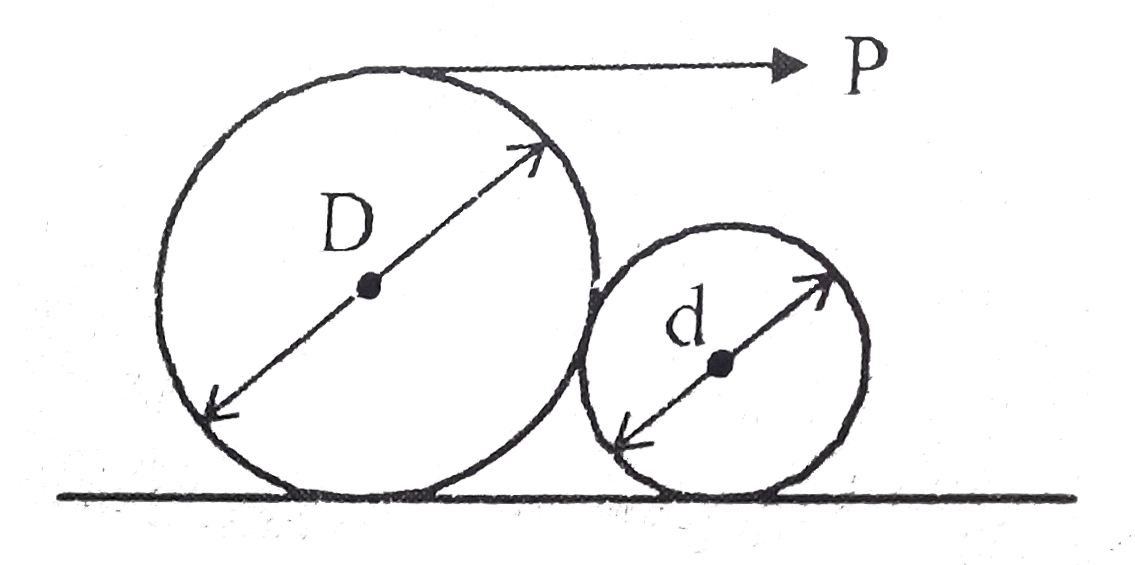
A heavy and a light cylindrical rollers of diameter D and d respectively rest on a horizontal plane as shown. The larger roller has a string wound around it to which a horizontal force 'P' can be applied as shown. Assuming 'mu' (coefficient of friction) is same at all surfaces of contact, find the critical value of 'mu' such that larger roller can be just pulled over smaller one.

A

`mu=sqrt((D)/(d))`

B

`mu=2sqrt((D)/(d))`

C

`mu=sqrt((d)/(D))`

D

`mu=2sqrt((D)/(d))`

Text Solution

Verified by Experts

The correct Answer is:
C

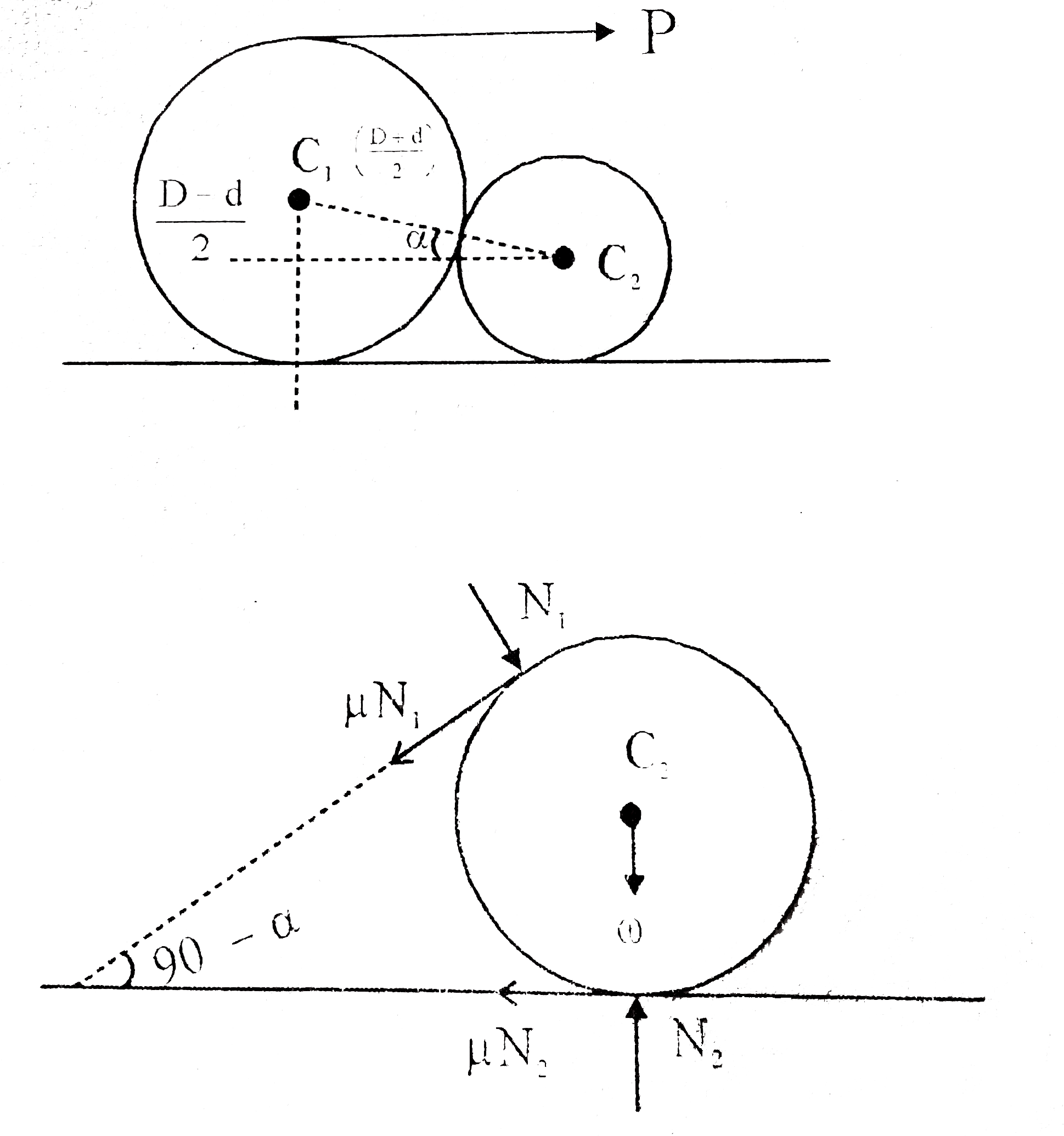
`sin alpha=(D-d)/(D+d)`
`cos alpha=(2sqrt(Dd))/(D+d)`

If smaller cylinder neither rolls nor slides then larger cylinder can be pulled over it. Then sum of moments about `C_(2)` should be zero
`muN_(1)d=muN_(2)d`
`N_(1)=N_(2)`
for no sliding
`muN_(2)+muN_(1) cos(90-alpha)=N_(1) cos alpha`
`implies mu (1+sin alpha)=cos alpha`
Promotional Banner

Topper's Solved these Questions

  • TEST PAPERS

    ALLEN |Exercise PHYSICS|16 Videos
  • TEST PAPERS

    ALLEN |Exercise MATHS|1 Videos
  • TEST PAPERS

    ALLEN |Exercise part-2 physics|73 Videos
  • TEST PAPER 4

    ALLEN |Exercise PHYSICS|45 Videos
  • UNIT & DIMENSIONS, BASIC MATHS AND VECTOR

    ALLEN |Exercise Exercise (J-A)|7 Videos

Similar Questions

Explore conceptually related problems

A block rest on a rough inclined plane as shown in fig. A horizontal force F is applied to it (a) Find out the force of reaction, (b) Can the force of friction be zero if yes when? And (c) Assuming that fricition is not zero find its magnitude and direction of its limiting value.

On end of a light spring of natural length d and spring constant k is fixed on a rigid wall and the other is attached to a smooth ring of mass m which can slide without friction on a vertical rod fixed at a distance d from the wall. Initially the spring makes an angle of 37^@ with the horizontal. as shown in figure. When the system is released from rest, find the speed of the ring when the spring becomes horizontal. (sin 37^@=3/5) .

A block is released on the slant face of a wedge of equal mass placed on a horizontal floor. The slant face of the wedge makes an angle of 45^(@) with the floor. Coefficient of friction between all surfaces in contact is the same. Different value/ range of coefficient of friction is given in column I and corresponding consequences in column II and III (wedge is fress to move) {:(,"Column-I",,"Column-II",,"Column-III",),((I),mu=0,(i),"Work done by friction on block and wedge is negative (on each)",(P),"Centre of mass of system (block+wedge) moves rightward and downward",),((II),mu gt 1,(ii),"Work done by friction on block is negative but on wedge it is zero",(Q),"Centre of mass of system (block+wedge) moves leftward and downward",),((III),sqrt(5)-2 lt mu lt 1,(iii),"Work done by friction on block and wedge is zero (on each)",(R ),"Centre of mass of system (block+wedge) remains at rest",),((IV),mu lt sqrt(5) - 2,(iv),"Friction between the block and wedge is static and between the wedge and ground it is kinetic in nature.",(S),"Centre of mass of system (block+wedge) moves vertically downward",):} Which of the following options is the correct representation of the case that the wedge remains motionless and the block slides down

A uniform thin cylindrical disk of mass M and radius R is attaached to two identical massless springs of spring constatn k which are fixed to the wall as shown in the figure. The springs are attached to the axle of the disk symmetrically on either side at a distance d from its centre. The axle is massless and both the springs and the axle are in horizontal plane. the unstretched length of each spring is L. The disk is initially at its equilibrium position with its centre of mass (CM) at a distance L from the wall. The disk rolls without slipping with velocity vecV_0 = vacV_0hati. The coefficinet of friction is mu. The maximum value of V_0 for whic the disk will roll without slipping is-

A uniform thin cylindrical disk of mass M and radius R is attaached to two identical massless springs of spring constatn k which are fixed to the wall as shown in the figure. The springs are attached to the axle of the disk symmetrically on either side at a distance d from its centre. The axle is massless and both the springs and the axle are in horizontal plane. the unstretched length of each spring is L. The disk is initially at its equilibrium position with its centre of mass (CM) at a distance L from the wall. The disk rolls without slipping with velocity vecV_0 = vacV_0hati. The coefficinet of friction is mu. The net external force acting on the disk when its centre of mass is at displacement x with respect to its equilibrium position is.

A rectangular box lies on a rough inclined surface. The coefficient of friction between the surface and the box is mu . Let the mass of the box be m. (a) At what angle of inclination 0 of the plane to the horizontal will the box just start to slide down the plane ? (b) What is the force acting on the box down the plane, if the angle of inclination of the plane is increased to a gt theta (c) What is the force needed to be applied upwards along the plane to make the box either remain stationary or just move up with uniform speed ? (d) What is the force needed to be applied upwards along the plane to make the box move up the plane with acceleration a ?

Two identical balls A and B each of mass 0.1 kg are attached to two identical mass less is springs. The spring-mass system is constrained to move inside a right smooth pipe bent in the form of a circle as shown in figure . The pipe is fixed in a horizontal plane. The center of the balls can move in a circle of radius 0.06 m . Each spring has a natural length of 0.06 pi m and force constant 0.1 N//m . Initially, both the balls are displaced by an angle theta = pi//6 radians with respect to diameter PQ of the circle and released from rest. a. Calculate the frequency of oscillation of the ball B. b. What is the total energy of the system ? c. Find the speed of the ball A when A and B are at the two ends of the diameter PQ.

Comprehension # 1 If net force on a system in a particular direction is zero (say in horizontal direction) we can apply: Sigmam_(R )x_(R )= Sigmam_(L)x_(L), Sigmam_(R )v_(R )= Sigmam_(L)v_(L) and Sigmam_(R )a_(R ) = Sigmam_(L)a_(L) Here R stands for the masses which are moving towards right and L for the masses towards left, x is displacement, v is veloctiy and a the acceleration (all with respect to ground). A small block of mass m = 1 kg is placed over a wedge of mass M = 4 kg as shown in figure. Mass m is released from rest. All surface are smooth. Origin O is as shown. At the same instant reaction on the wedge from the ground is ........N.

Two blocks A and B of mass m and 2m respectively are connected by a massless spring of spring constant K . This system lies over a smooth horizontal surface. At t=0 the bolck A has velocity u towards right as shown while the speed of block B is zero, and the length of spring is equal to its natural length at that at that instant. {:(,"Column I",,"Column II"),((A),"The velocity of block A",(P),"can never be zero"),((B),"The velocity of block B",(Q),"may be zero at certain instants of time"),((C),"The kinetic energy of system of two block",(R),"is minimum at maximum compression of spring"),((D),"The potential energy of spring",(S),"is maximum at maximum extension of spring"):}

Two parallel beams of light P and Q (separation d) containing radiations of wavelengts 4000Å and 5000 Å (which are mutually coherent in each wavelength separately) are incident normally on a prism as shown in figure the refractive index of the prism as a function of wavelength is given by the relation mu(lamda)=1.20+(b)/(lamda^(2)) where lamda is in Å and b is a positive constant. The value of b is such that the condition for total reflection at the face AC is just satisfied for one wavelength and is not satisfied for the other. A convergent lens is used to bring these transmitted beams into focus. If the intensities of the upper and the lower beams immediately after transmission from the face AC, are 4I and I respectively, find the resultant intensity at the focus.

ALLEN -TEST PAPERS-part-2 physic
  1. A container having two immiscible liquids of densities 'p' and '2p' mo...

    Text Solution

    |

  2. A non viscous liquid of constant density 10^(3) kg//m^(3) flows in st...

    Text Solution

    |

  3. A uniform thin rod is bent in the form of closed loop ABCDEFA as shown...

    Text Solution

    |

  4. Find force required to keep the system in equilibrium. The dimension o...

    Text Solution

    |

  5. A solid homogeneous sphere is moving on a rough horizontal surface, pa...

    Text Solution

    |

  6. Two current carrying coil having radius 'r' are seperated by distance ...

    Text Solution

    |

  7. The magnetic field in a region is given by vec(B)=B(0)(1+(x)/(a))hat(k...

    Text Solution

    |

  8. In the circuit shown in Fig. Sliding contact is moving with uniform ve...

    Text Solution

    |

  9. A bulb of 100 W is connected in parallel to an ideal inductance of 1H....

    Text Solution

    |

  10. A ray of light is incident on the surface of a sphere of refractive in...

    Text Solution

    |

  11. A cylindrical tank of base area A has a small hole of areal a at the b...

    Text Solution

    |

  12. A ring of mass 'm' and radius 'r' carrying current i(0) is lying in t...

    Text Solution

    |

  13. In the circuit shown in figure power factor of box is 0.5 and power fa...

    Text Solution

    |

  14. A parabolic mirror is silvered at inner surface. The equation of the c...

    Text Solution

    |

  15. A heavy and a light cylindrical rollers of diameter D and d respectiv...

    Text Solution

    |

  16. Figure shows the graph of angle of deviation del versus angle of incid...

    Text Solution

    |

  17. A plank P is placed on a solid cylinder S, which rolls on a horizontal...

    Text Solution

    |

  18. An object to the left of a lens is imaged by the lens on a screen 30cm...

    Text Solution

    |

  19. A direct current of 2 A and an alternating current having a maximum va...

    Text Solution

    |

  20. The potential difference across a 4 H inductor vary with time is as sh...

    Text Solution

    |

