Home
Class 12
PHYSICS
In a continuous printing process, paper ...

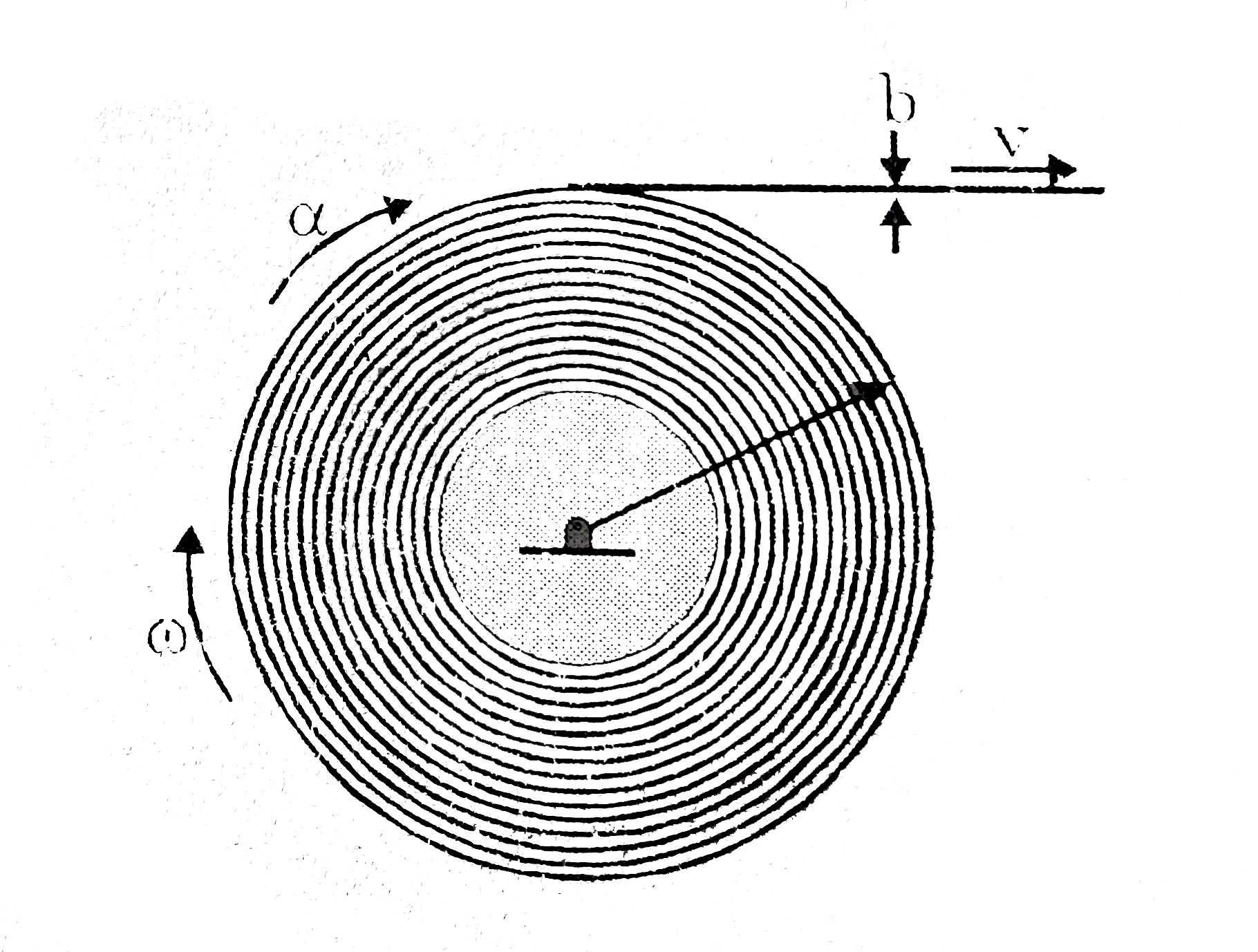
In a continuous printing process, paper is drawn into the press at a constant speed v. Denoting by 'r' the radius of the paper roll at any given time and by 'b' the thickness of the paper, what is the angular acceleration of the paper roll.?

A

`(bv^(2))/(2pir^(3))`

B

`(2bv^(2))/(pir^(3))`

C

`(bv^(2))/(4pir^(3))`

D

`(4bv^(2))/(pir^(3))`

Text Solution

Verified by Experts

Promotional Banner

Similar Questions

Explore conceptually related problems

A stone is launched upward at 45^(@) with speed v_(0) . A bee follow the trajectory of the stone at a constant speed equal to the initial speed of the stone. (a) Find the radius of curvature at the top point of the trajectory. (b) What is the acceleration of the bee at the top point of the trajectory? For the stone, neglect the air resistance.

A particle is moving in a circular orbit with a constant tangential acceleration. After a certain time t has elapsed after the beginning of motion, the between the total acceleration a and the direction along the radius r becomes equal to 45^(@) . What is the angular acceleration of the particle.

A disc of the radius R is confined to roll without slipping at A and B. If the plates have the velocities v and 2v as shown, the angular velocity of the disc is

Two identical discs of same radius R are rotating about their axes in opposite directions with the same constant angular speed omega . The discs are in the same horizontal plane. At time t = 0 , the points P and Q are facing each other as shown in the figure. The relative speed between the two points P and Q is v_(r) . In one time period (T) of rotation of the discs , v_(r) as a function of time is best represented by

As shown in figure, a long wire kept vertically on the plane of paper carries electric current-I. A conducting ring moves towards the wire with velocity v with its plane conducting with the plane of paper. Find the induced emf produced in the ring when it is at a perpendicular distance r from the wire. Radius of the ring is a and a lt lt r.

A particle is revolving in a circle of radius 1 m with an angular speed of 12 rad/s. At t = 0, it was subjected to a constant angular acceleration alpha and its angular speed increased to (480/pi) rotation per minute (rpm) in 2 sec. Particle then continues to move with attained speed. Calculate (i) angular acceleration of the particle, (ii) tangential velocity of the particle as a function of time.

A magnetic field B is confined to a region rle a and points out of the paper (the z-axis), r = 0 being the centre of the circular region. A charged ring (charge Q) of radius b, b gt a and mass m lies in the xy-plane with its centre at the origin. The ring is free to rotate and is at rest. The magnetic field is brought to zero in time Deltat . Find the angular velocity omega of the ring after the field vanishes.

Two particles A and B start at O travel in opposite directions along the circular path at constant speed v_(A)=0.7 m//s and v_(B)=1.5 m//s respectively. Determine the time when they collide and the magnitude of the acceleration of B just before this happening. ("radius"=5m)

An accelration produces a narrow beam of protons, each having an initial speed of v_(0) . The beam is directed towards an initially uncharges distant metal sphere of radius R and centered at point O. The initial path of the beam is parallel to the axis of the sphere at a distance of (R//2) from the axis, as indicated in the diagram. The protons in the beam that collide with the sphere will cause it to becomes charged. The subsequentpotential field at the accelerator due to the sphere can be neglected. The angular momentum of a particle is defined in a similar way to the moment of a force. It is defined as the moment of its linear momentum, linear replacing the force. We may assume the angular momentum of a proton about point O to be conserved. Assume the mass of the proton as m_(P) and the charge on it as e. Given that the potential of the sphere increases with time and eventually reaches a constant velue. One the potential of the sphere has reached its final, constant value, the minimum speed v of a proton along its trajectory path is given by

An accelration produces a narrow beam of protons, each having an initial speed of v_(0) . The beam is directed towards an initially uncharges distant metal sphere of radius R and centered at point O. The initial path of the beam is parallel to the axis of the sphere at a distance of (R//2) from the axis, as indicated in the diagram. The protons in the beam that collide with the sphere will cause it to becomes charged. The subsequentpotential field at the accelerator due to the sphere can be neglected. The angular momentum of a particle is defined in a similar way to the moment of a force. It is defined as the moment of its linear momentum, linear replacing the force. We may assume the angular momentum of a proton about point O to be conserved. Assume the mass of the proton as m_(P) and the charge on it as e. Given that the potential of the sphere increases with time and eventually reaches a constant velue. After a long time, when the potential of the sphere reaches a constant value, the trajectory of proton is correctly sketched as

