Home
Class 12
PHYSICS
A uniform thin rod AB of mass M and len...

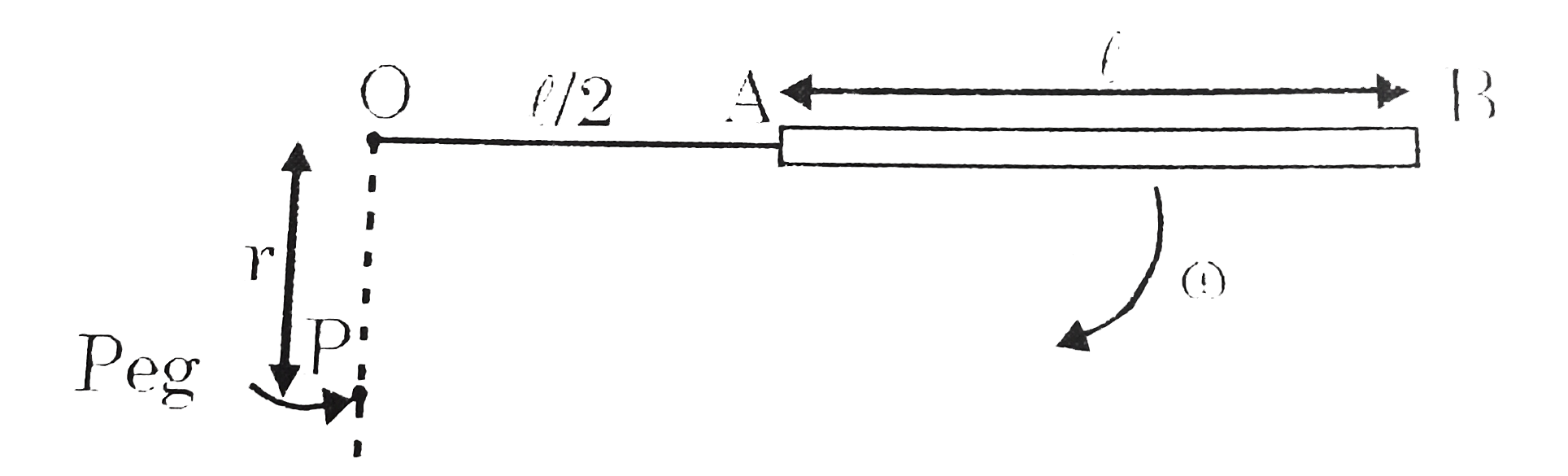
A uniform thin rod AB of mass M and length l attached to a string OA of length `(l)/(2)` is placed on a smooth horizontal plane and rotates with angular velocity omega around a vertical axis through O. A peg P is inserted in the plane in order that on striking it the bar will come exactly to rest

A

Location of peg for rod coming to rest is `r=(5l)/(6)`

B

Location of peg for rod coming to rest is `r =(3l)/(4)`

C

Location of peg for rod coming to rest is`r=(13)/(12)l`

D

Location of peg for rod coming to rest is `r=(2l)/(3)`

Text Solution

Verified by Experts

Promotional Banner

Similar Questions

Explore conceptually related problems

A uniform rod of mass m and length l rotates in a horizontal plane with an angular velocity omega about a vertical axis passing through one end. The tension in the rod at a distance x from the axis is

A particle P of mass m is attached to a vertical axis by two strings AP and BP of length l each. The separation AB=l. P rotates around the axis with an angular velocity omega . The tensions in the two strings are T_(1) and T_(2)

The thin rod shown below has mases M and length L. A force F acts at one end as shown and the rod is free to rotate about the other end in horizontal plane. Initial angular acceleration of the rod is :

A thin circular ring of mass M and radius R is rotating in a horizontal plane about an axis vertical to its plane with a constant angular velocity omega . If two objects each mass m be attached gently to the opposite ends of a diameter of the ring, the ring will then rotate with an angular velocity ...........

A thin uniform circular disc of mass M and radius R is rotating in a horizontal plane about an axis passing through its centre and perpendicular to the plane with n angular velocity omega another disc of one forth mass and same dimension is gently placed over it coaxially, the angular speed of the composite disc will be ............

Two blocks of mass m_(1)=10kg and m_(2)=5kg connected to each other by a massless inextensible string of length 0.3m are placed along a diameter of the turntable. The coefficient of friction between the table and m_(1) is 0.5 while there is no friction between m_(2) and the table. the table is rotating with an angular velocity of 10rad//s . about a vertical axis passing through its center O . the masses are placed along the diameter of the table on either side of the center O such that the mass m_(1) is at a distance of 0.124m from O . the masses are observed to be at a rest with respect to an observed on the tuntable (g=9.8m//s^(2)) . (a) Calculate the friction on m_(1) (b) What should be the minimum angular speed of the turntable so that the masses will slip from this position? (c ) How should the masses be placed with the string remaining taut so that there is no friction on m_(1) .

A thin uniform rod of mass .M. and length .L. rotates with constant angular velocity .omega. about perpendicular axis passing through its centre. Two bodies each of mass (M)/(3) are attached to its two ends. What is its angular velocity?

Four identical thin rods each of mass M and length l from a square frame. Moment of inerita of this frame about an axis through the centre of the square and perpendicular to its plane is ……………

A frame of reference that is accelerated with respect to an inertial frame of reference is called a non-inertial frame of reference. A coordinate system fixed on a circular disc rotating about a fixed axis with a constant angular velocity omega is an example of non=inertial frame of reference. The relationship between the force vecF_(rot) experienced by a particle of mass m moving on the rotating disc and the force vecF_(in) experienced by the particle in an inertial frame of reference is vecF_(rot)=vecF_(i n)+2m(vecv_(rot)xxvec omega)+m(vec omegaxx vec r)xxvec omega . where vecv_(rot) is the velocity of the particle in the rotating frame of reference and vecr is the position vector of the particle with respect to the centre of the disc. Now consider a smooth slot along a diameter fo a disc of radius R rotating counter-clockwise with a constant angular speed omega about its vertical axis through its center. We assign a coordinate system with the origin at the center of the disc, the x-axis along the slot, the y-axis perpendicular to the slot and the z-axis along the rotation axis (vecomega=omegahatk) . A small block of mass m is gently placed in the slot at vecr(R//2)hati at t=0 and is constrained to move only along the slot. The distance r of the block at time is

