List-I gives different lens configurations. The radius of curvature of each surface is R. Rays of light parallel to the axis of lens from left of lens traversing through the lens get focused at distance f from the lens. List-II gives corresponding values of magnitudes of f (mu represent refractive index):-
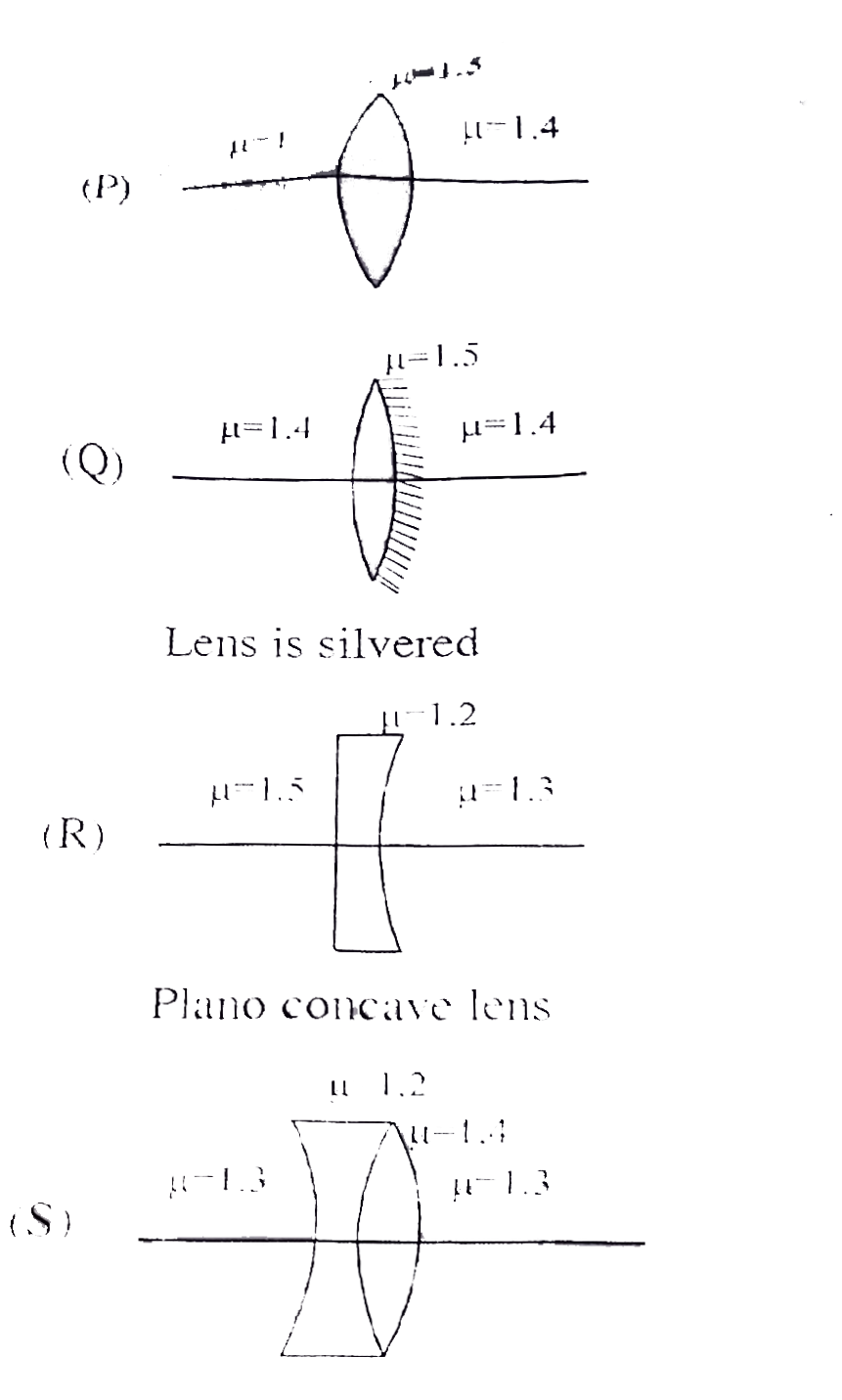
List-I gives different lens configurations. The radius of curvature of each surface is R. Rays of light parallel to the axis of lens from left of lens traversing through the lens get focused at distance f from the lens. List-II gives corresponding values of magnitudes of f (mu represent refractive index):-
A
`{:(P,Q,R,S),(1,3,2,4):}`
B
`{:(P,Q,R,S),(1,2,3,4):}`
C
`{:(P,Q,R,S),(2,3,4,1):}`
D
`{:(P,Q,R,S),(3,4,1,2):}`
Text Solution
Verified by Experts



Similar Questions
Explore conceptually related problems
Focal lens of plane convex lens (mu=3/2) is f and radius of curvature of curved surface is R. So write the relation between f and R.
A transparent thin film of uniform thickness and refractive index n_(1) =1.4 is coated on the convex spherical surface of radius R at one end of a long solid glass cylinder of refractive index n_(2) =1.5 , as shown in the figure. Rays of light parallel to the axis of the cylinder traversing through the film from air to glass get focused at distance f_(1) from the film, while rays of light traversing from glass to air get focused at distance f_(2) from the film, Then
A glass wedge with a small angle of refraction theta is placed at a certain distance from a converging lens with a focal length f ,one surface of the wedge being perpendicular to the optical axis of the lens. A point sources S of light is on the other side of the lens at its focus. The rays reflected from the wedge (not from base) produce, after refraction in the lens , two images of the source displaced with respect to each other by d. Find the refractive index of the wedge glass. [Consider only paraxial rays.]
A plano convex lens of refractive index 1.5 and radius of curvature 30cm. Is silvered at the curved surface. Now this lens has been used to form the image of an object. At what distance from this lens an object be placed in order to have a real image of size of the object.
Four combinations of two thin lenses are given in List I . The radius of curvature of all curved surfaces is r and the refractive index of all the lenses is 1.5 Match lens combinations in List I with their focal length in List II and select the correct answer using the code given below the lists. (A) (p) 2 r (B) (q) ( r)/(2) ( C) (r) - r (D) (s) r . Code :
The ciliary muscles of eye control the curvature of the lens in the eye and hence can alter the effective focal length of the system. When the muscles are fully relaxed, the focal length is maximum. When the muscles are strained, the curvature of lens increases. That means radius of curvature decreases and focal length decreases. For a clear vision, the image must be on the retina. The image distance is therefore fixed for clear vision and it equals the distance of retina from eye lens. It is about 2.5cm for a grown up person. A perosn can theoretically have clear vision of an object situated at any large distance from the eye. The smallest distance at which a person can clearly see is related to minimum possible focal length. The ciliary muscles are most strained in this position. For an average grown up person, minimum distance of the object should be around 25cm. A person suffering from eye defects uses spectacles (eye glass). The function of lens of spectacles is to form the image of the objects within the range in which the person can see clearly. The image o the spectacle lens becomes object for the eye lens and whose image is formed on the retina. The number of spectacle lens used for th eremedy of eye defect is decided by the power fo the lens required and the number of spectacle lens is equal to the numerical value of the power of lens with sign. For example, if power of the lens required is +3D (converging lens of focal length 100//3cm ), then number of lens will be +3 . For all the calculations required, you can use the lens formula and lensmaker's formula. Assume that the eye lens is equiconvex lens. Neglect the distance between the eye lens and the spectacle lens. Q. Maximum focal length of a eye lens of a normal person is
The ciliary muscles of eye control the curvature of the lens in the eye and hence can alter the effective focal length of the system. When the muscles are fully relaxed, the focal length is maximum. When the muscles are strained, the curvature of lens increases. That means radius of curvature decreases and focal length decreases. For a clear vision, the image must be on the retina. The image distance is therefore fixed for clear vision and it equals the distance of retina from eye lens. It is about 2.5cm for a grown up person. A perosn can theoretically have clear vision of an object situated at any large distance from the eye. The smallest distance at which a person can clearly see is related to minimum possible focal length. The ciliary muscles are most strained in this position. For an average grown up person, minimum distance of the object should be around 25cm. A person suffering from eye defects uses spectacles (eye glass). The function of lens of spectacles is to form the image of the objects within the range in which the person can see clearly. The image o the spectacle lens becomes object for the eye lens and whose image is formed on the retina. The number of spectacle lens used for th eremedy of eye defect is decided by the power fo the lens required and the number of spectacle lens is equal to the numerical value of the power of lens with sign. For example, if power of the lens required is +3D (converging lens of focal length 100//3cm ), then number of lens will be +3 . For all the calculations required, you can use the lens formula and lensmaker's formula. Assume that the eye lens is equiconvex lens. Neglect the distance between the eye lens and the spectacle lens. Q. Maximum focal length of a eye lens of a normal person is
The ciliary muscles of eye control the curvature of the lens in the eye and hence can alter the effective focal length of the system. When the muscles are fully relaxed, the focal length is maximum. When the muscles are strained, the curvature of lens increases. That means radius of curvature decreases and focal length decreases. For a clear vision, the image must be on the retina. The image distance is therefore fixed for clear vision and it equals the distance of retina from eye lens. It is about 2.5cm for a grown up person. A perosn can theoretically have clear vision of an object situated at any large distance from the eye. The smallest distance at which a person can clearly see is related to minimum possible focal length. The ciliary muscles are most strained in this position. For an average grown up person, minimum distance of the object should be around 25cm. A person suffering from eye defects uses spectacles (eye glass). The function of lens of spectacles is to form the image of the objects within the range in which the person can see clearly. The image o the spectacle lens becomes object for the eye lens and whose image is formed on the retina. The number of spectacle lens used for th eremedy of eye defect is decided by the power fo the lens required and the number of spectacle lens is equal to the numerical value of the power of lens with sign. For example, if power of the lens required is +3D (converging lens of focal length 100//3cm ), then number of lens will be +3 . For all the calculations required, you can use the lens formula and lensmaker's formula. Assume that the eye lens is equiconvex lens. Neglect the distance between the eye lens and the spectacle lens. Q. Maximum focal length of a eye lens of a normal person is
In figure , L is half part of an equiconvex glass lens (mu=1.5) whose surfaces have radius of curvature R =40cm and its right surface is silvered . Normal to its principal axis a plane mirror M is placed on right of the lens . Distance between lens L and mirror M is b. A small object O is placed on left of the lens such that there is no parallax between final images formed by the lens and mirror. If transverse length of final image formed by lens is twice that of image formed by the mirror , calculate distance'a' in cm between lens and object.
Recommended Questions
- List-I gives different lens configurations. The radius of curvature of...
Text Solution
|
- Consider an equiconvex lens of radius of curvature R and focal length ...
Text Solution
|
- A beam of light coming from infinty is passing through a biconvex lens...
Text Solution
|
- A double convex thin lens made of glass (refractive index mu = 1.5) h...
Text Solution
|
- A lens of refractive index mu becomes a lens of focal length f' when i...
Text Solution
|
- एक द्वि-उत्तल लेन्स के दोनों पृष्ठों की वक्रता त्रिज्या R है। लेन्स के...
Text Solution
|
- काँच (अपवर्तनांक,mu=1.5 ) के एक उभयोत्तल पतले लेन्स की प्रत्येक वक्...
Text Solution
|
- यदि किसी उत्तल लेंस पर आपतित किरण लेंस के अक्ष के समांतर है, तो वह लें...
Text Solution
|
- एक समोत्तल लेंस के पदार्थ का अपवर्तनांक 1.5 है। लेंस की फोकस दूरी f तथ...
Text Solution
|