An optical fiber has index of refraction `n=1.40` and diameter `d=100 mu m`. It is surrounded by air. Light is sent into the fiber along the axis as shown in figure. If smallest outside radius R permitted for a bend in the fiber for no light to escape is given by `50 x ("in" mu m)` fill value of x.
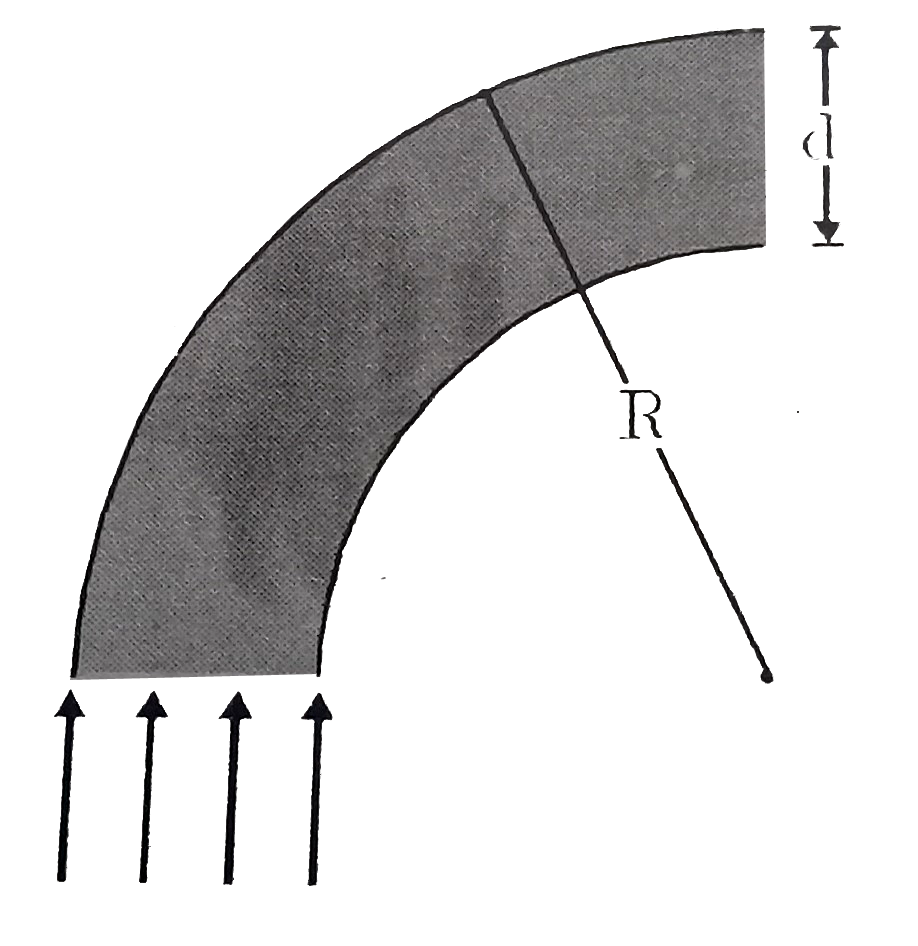
An optical fiber has index of refraction `n=1.40` and diameter `d=100 mu m`. It is surrounded by air. Light is sent into the fiber along the axis as shown in figure. If smallest outside radius R permitted for a bend in the fiber for no light to escape is given by `50 x ("in" mu m)` fill value of x.



Similar Questions
Explore conceptually related problems
What is the least radius through which an optical fiber of core diameter 0.05 mm may be bent (as shown in figure) without serious loss of light? The refractive index of the core is 1.6 and that of cladding is 1.5.
A right angled prism of refractive index mu_(1) is placed in a rectangular block of refractive index mu_(2) , which is surrounded by a medium of refractive index mu_(3) ,as shown in the figure . A ray of light 'e' enters the rectangular block at normal incidence . depending upon the relationship between mu_(1) , mu_(2) "and" mu_(3) , it takes one of the four possible paths 'ef' , 'eg' , 'eh' or 'ef' Match the paths in List I with conditions of refractive indices in List II and select the correct answer using the codes given below the lists: {:("List" I , "List" II) , ( P. e rarr f , 1. mu_(1)gt sqrt(2mu_(2))) , ( Q. e rarr g , 2. mu_(2) gt mu_(1) "and" mu_(2) gt mu_(3)), ( R. e rarr f , 3. mu_(1) = mu_(2)), ( S. e rarr f , 4. mu_(2) lt mu_(1) lt sqrt(2mu_(2)) "and" mu_(2) gt mu_(3)):} Codes : {:( P , Q , R , S) , ((A) 2 , 3 , 1 , 4), ((B) 1 , 2 , 4 , 3) , ((C) 4 , 1 , 2 , 3) , ((D) 2, 3 , 4 , 1):}
A transparent thin film of uniform thickness and refractive index n_(1) =1.4 is coated on the convex spherical surface of radius R at one end of a long solid glass cylinder of refractive index n_(2) =1.5 , as shown in the figure. Rays of light parallel to the axis of the cylinder traversing through the film from air to glass get focused at distance f_(1) from the film, while rays of light traversing from glass to air get focused at distance f_(2) from the film, Then
A system of coordinatees is drawn in a medium whose refractive index vaires as mu=(2)/(1+Y^(2)) where 0 le y le 1 . A ray of light is incident at origin at an angle 60^(@) with y-axis as shown in figure. At point P, the ray becomes parallel to x-axis, the volue of H is -
A thin equiconvex lens of glass of refractive index mu=3//2 & of focal length 0.3m in air is sealed into an opening at one end of a tank filled with water (mu=4//3) .On the opposite side of the lens ,a mirror is placed inside the tank on the tank wall perpendicular to the lens axis ,as shown in figure .the separation between the lens and the mirror is 0.8m A small object is placed outside the tank in front of the lens at a distance of 0.9 m form the lens along its axis .Find the position (relative to the lens)of the image of the object fromed by the stsyem.
Two identical glass rods S_(1) and S_(2) (refractive index=1.5) have one convex end of radius of curvature 10 cm. They are placed with the curved surfaces at a distance d as shown in the figure, with their axes (shown by the dashed line) aligned. When a point source of light P is placed inside rod S_(1) on its axis at a distance of 50 cm from the curved face, the light rays emenating from it are found to be parallel to the axis inside S_(2) . The distance d is
A rod made of glass (mu = 1.5) and of square cross-section is equal is bent into the shape shown in figure. A parallel beam of light falls perpendicurly on the plane flat surface . A . Referring to the diagram, d is the width of a side & R is radius of inner semicircle. find the maximum value of ratio (d)/(R) so that all light entering the glass through surface A emerge from the glass through surface B.
An object O (real ) is placed at focus of an equi-biconvex lens as shown in. figure-I . The refractive index of lens is mu = 1.5 and the radius of curvature of either suface of lens is R . The lens is surronded by air . In each statement of column-I some changes are made to situation given above and information regarding final image formed as a result is given in column-II . The distance between lens and object is unchanged in all statements of column-I. match the statements in column-I with resulting image in column-II.
A uniform thin cylindrical disk of mass M and radius R is attaached to two identical massless springs of spring constatn k which are fixed to the wall as shown in the figure. The springs are attached to the axle of the disk symmetrically on either side at a distance d from its centre. The axle is massless and both the springs and the axle are in horizontal plane. the unstretched length of each spring is L. The disk is initially at its equilibrium position with its centre of mass (CM) at a distance L from the wall. The disk rolls without slipping with velocity vecV_0 = vacV_0hati. The coefficinet of friction is mu. The net external force acting on the disk when its centre of mass is at displacement x with respect to its equilibrium position is.
Light guidance in an optical fiber can be understood by considering a structure comprising of thin solid glass cylinder of refractive index n_(1) surrounded by a medium of lower refractive index n_(2) . The light guidance in the structure takes place due to successive total internal reflections at the interface of the media n_(1) and n_(2) as shown in the figure . all rays with the angle of incidence i less than a particular value of i_(m) are confined in the medium of refractive index n_(1) . The numerical aperture (NA) of the structure is defined as "sin"i_(m) For two structures namely S_(1) with n_(1) = sqrt(45) //4 "and" n_(2) = 3//2 , "and" S_(2) with n_(1) = 8//5 "and" n_(2) = 7//5 and taking the refractive index of water to be 4/3 and that of air to be 1 , the correct option (s) is (are)
Recommended Questions
- An optical fiber has index of refraction n=1.40 and diameter d=100 mu ...
Text Solution
|
- A cylinderical optical fibre (quarter circular shape) of refractive in...
Text Solution
|
- An optical fiber has index of refraction n=1.40 and diameter d=100 mu ...
Text Solution
|
- An optical fiber has index of refraction n=1.40 and diameter d=100 mu ...
Text Solution
|
- An optical fibre has diameter d and is made of material of refractive ...
Text Solution
|
- एक प्रकाश किरण प्रकाशीय तन्तु (optical fibre) में चलती हैं-
Text Solution
|
- In figure, the optical fiber is l = 2 m long and has a diameter of d =...
Text Solution
|
- In an optical fiber during transmission of light
Text Solution
|
- In optical fiber the refractive index of the material of the core is……...
Text Solution
|