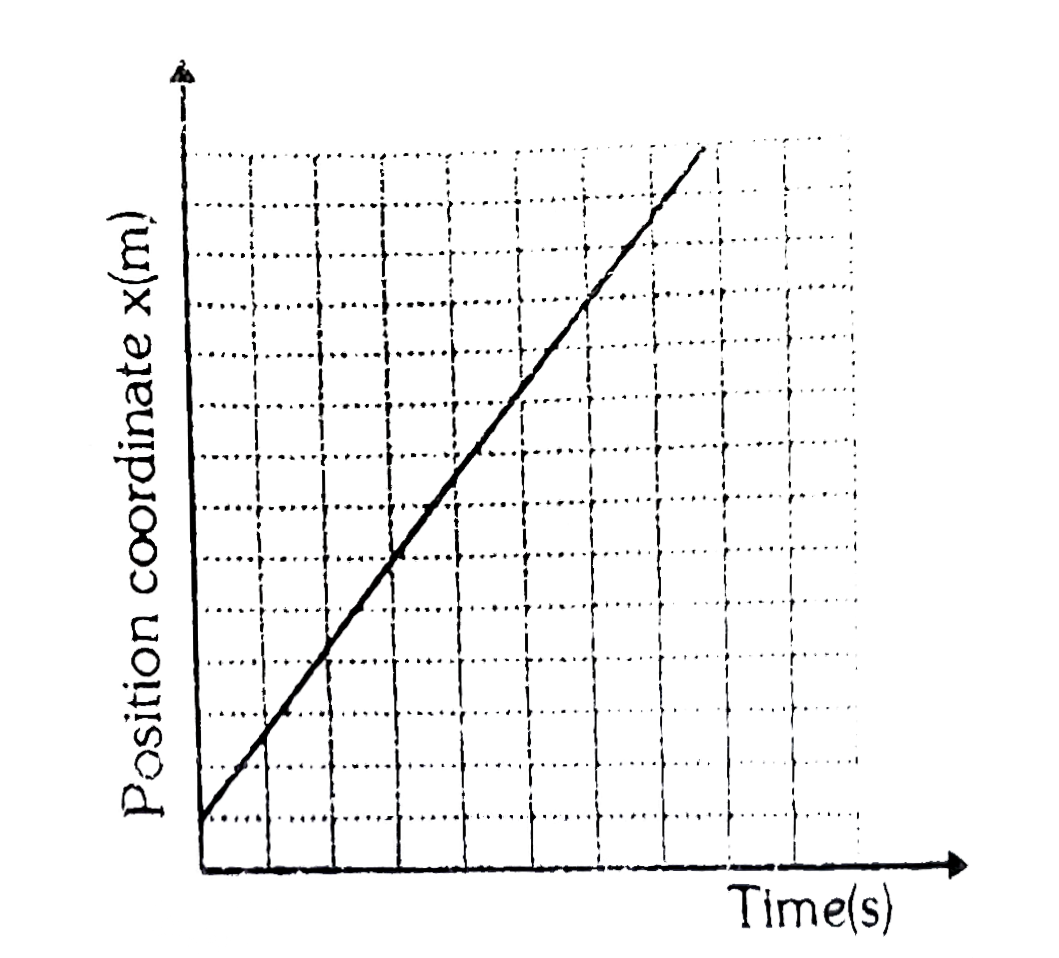
Cosider a body moving constant speed of `2 m//s` in a straight line. When ypu start your stopwatch, you observe the body `1 m` away from a fixed point on the line. Suggest suitable physical quantities, write a function and draw its graph decribing motion of the body.
Cosider a body moving constant speed of `2 m//s` in a straight line. When ypu start your stopwatch, you observe the body `1 m` away from a fixed point on the line. Suggest suitable physical quantities, write a function and draw its graph decribing motion of the body.
Text Solution
Verified by Experts
Distance x of the body from the given fixed point and time t measured by the stopwatch are the suitable variables. If we consider the fixed point as the origin, distance x is known as the position coordinate of the body.
In the following figure it is shown that the body is no point A at the instant `t=0`and after a time t it reaches another point B covering a distance, which equals to product of speed and time interval. Thus, distance s covered by the body in time t is given by the following equation.
`s=2t`
With the help of the above figure, position coordinate x of the body at any time t is given by the following equation, which is the required function describing motion of the body.
`x=2t+1`
Graph of this equation is also shown in the adjoining figure.
In the following figure it is shown that the body is no point A at the instant `t=0`and after a time t it reaches another point B covering a distance, which equals to product of speed and time interval. Thus, distance s covered by the body in time t is given by the following equation.
`s=2t`
With the help of the above figure, position coordinate x of the body at any time t is given by the following equation, which is the required function describing motion of the body.
`x=2t+1`
Graph of this equation is also shown in the adjoining figure.



Topper's Solved these Questions
MISCELLANEOUS
ALLEN |Exercise Part -II Example|61 VideosMISCELLANEOUS
ALLEN |Exercise Part -II Example Some worked out Examples|1 VideosKINEMATICS (MOTION ALONG A STRAIGHT LINE AND MOTION IN A PLANE)
ALLEN |Exercise BEGINNER S BOX-7|8 VideosPHYSICAL WORLD, UNITS AND DIMENSIONS & ERRORS IN MEASUREMENT
ALLEN |Exercise EXERCISE-IV|7 Videos
Similar Questions
Explore conceptually related problems
Some informations are given for a body moving in a straight line. The body starts its motion from rest at t=0 . Information I : The velocity of a body at the end of 4s is 16 m//s Information II : The velocity of a body at the end of 12s is 48 m//s Information III : the velocity of a body at the end of 22s is 88 m//s The body is certainly moving with
A 2-m wide truck is moving with a uniform speed v_(0)=8 m/s along a straight horizontal road. A pedestrian starts to cross the road with a uniform speed v when the truck is 4 m away from him, The minimum value of v so that he can cross the road safely is .
A particle of mass m, moving in a cicular path of radius R with a constant speed v_2 is located at point (2R,0) at time t=0 and a man starts moving with a velocity v_1 along the +ve y-axis from origin at time t=0 . Calculate the linear momentum of the particle w.r.t. the man as a function of time.
A body starting from rest moves along a straight line with a constant acceleration. The variation of speed (v) with distance (s) is represented by the graph:
A and B are two points on the path of a particle executing SHM in a straight line, at which its velocity is zero. Starting from a certain point X (AXltBX) the particle crosses this pint again at successive intervals of 2 seconds and 4 seconds with a speed of 5m//s Q. Amplitude of oscillation is
When a particle is undergoing motion, the diplacement of the particle has a magnitude that is equal to or smaller than the total distance travelled by the particle. In many cases the displacement of the particle may actually be zero, while the distance travelled by it is non-zero. Both these quantities, however depend on the frame of reference in which motion of the particle is being observed. Consider a particle which is projected in the earth's gravitational field, close to its surface, with a speed of 100sqrt(2) m//s , at an angle of 45^(@) with the horizontal in the eastward direction. Ignore air resistance and assume that the acceleration due to gravity is 10 m//s^(2) . Consider an observer in frame D (of the previous question), who observes a body of mass 10 kg acelerating in the upward direction at 30 m//s^(2) (w.r.t. himself). The net force acting on this body, as observed from the ground is :-
A body of mass 0.40 kg moving initially with a constant speed of 10 m s^(-1) to the north is subject to a constant force of 8.0 N directed towards the south for 30 s. Take the instant the force is applied to be t = 0, the position of the body at that time to be x = 0, and predict its position at t = –5 s, 25 s, 100 s.
When a particle is undergoing motion, the diplacement of the particle has a magnitude that is equal to or smaller than the total distance travelled by the particle. In many cases the displacement of the particle may actually be zero, while the distance travelled by it is non-zero. Both these quantities, however depend on the frame of reference in which motion of the particle is being observed. Consider a particle which is projected in the earth's gravitational field, close to its surface, with a speed of 100sqrt(2) m//s , at an angle of 45^(@) with the horizontal in the eastward direction. Ignore air resistance and assume that the acceleration due to gravity is 10 m//s^(2) . " A third observer (C) close to the surface of the reports that particle is initially travelling at a speed of 100sqrt(2) m//s making on angle of 45^(@) with the horizontal, but its horizontal motion is northward". The third observer is moving in :-
Two bodies, each of mass M, are kept fixed with a separation 2L. A particle of mass m is projected from the midpoint of the line joining their cehntres, perpendicualr to the line. The gravitational constant is G. The correct statement (s) is (are)
If d is the distance between the centre of the earth of mass M_(1) and the moon of mass M_(2) , then the velocity with which a body should be projected from the mid point of the line joining the earth and the moon, so that it just escape is