Home
Class 11
PHYSICS
A car charges its velocity linearly from...

A car charges its velocity linearly from `10 m//s` to `20 m//s` in `5` seconds. Plot v-t graph and write velocity as a function of time.

Text Solution

Verified by Experts
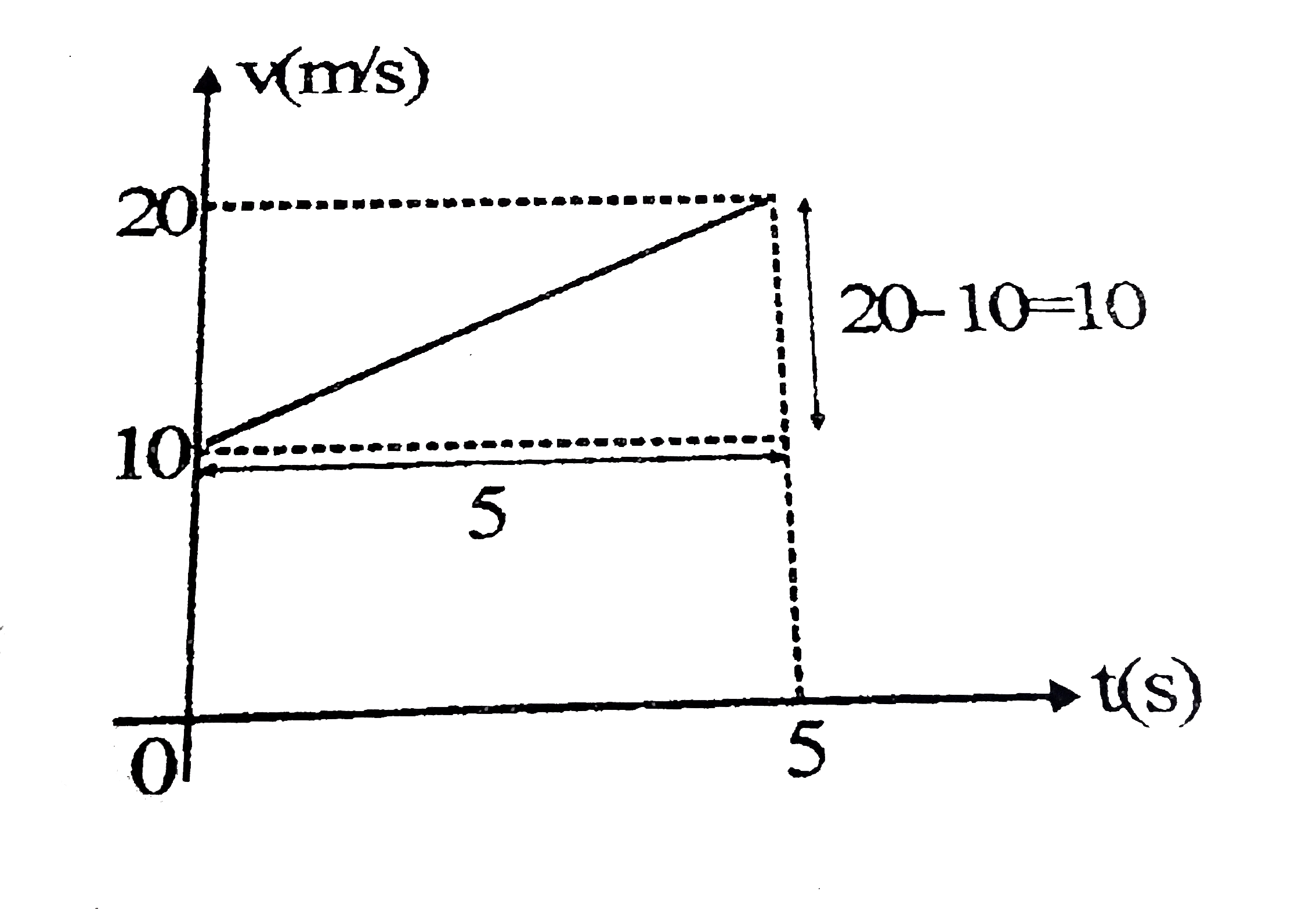
Slope`=(20-10)/(5-0)=2=m` y-intercept`=10=crArrv=2t+10`
Promotional Banner

Topper's Solved these Questions

  • MISCELLANEOUS

    ALLEN |Exercise Part -II Example|61 Videos
  • MISCELLANEOUS

    ALLEN |Exercise Part -II Example Some worked out Examples|1 Videos
  • KINEMATICS (MOTION ALONG A STRAIGHT LINE AND MOTION IN A PLANE)

    ALLEN |Exercise BEGINNER S BOX-7|8 Videos
  • PHYSICAL WORLD, UNITS AND DIMENSIONS & ERRORS IN MEASUREMENT

    ALLEN |Exercise EXERCISE-IV|7 Videos

Similar Questions

Explore conceptually related problems

Acceleration of particle moving along the x-axis varies according to the law a=-2v , where a is in m//s^(2) and v is in m//s . At the instant t=0 , the particle passes the origin with a velocity of 2 m//s moving in the positive x-direction. (a) Find its velocity v as function of time t. (b) Find its position x as function of time t. (c) Find its velocity v as function of its position coordinates. (d) find the maximum distance it can go away from the origin. (e) Will it reach the above-mentioned maximum distance?

Acceleration of a particle moving along the x-axis is defined by the law a=-4x , where a is in m//s^(2) and x is in meters. At the instant t=0 , the particle passes the origin with a velocity of 2 m//s moving in the positive x-direction. (a) Find its velocity v as function of its position coordinates. (b) find its position x as function of time t. (c) Find the maximum distance it can go away from the origin.

A particle moves in a straight line with a constant acceleration. It changes its velocity from 10 ms^-1 to 20 ms^-1 while passing through a distance 135 m in t seconds. The value of t is.

Two cars a and B starts motion with a velocity of 10 m//s and 20 m//s respectively. Car a moves with a constant acceleration of 2.5 m//s^(2) and car B have constant acceleration of 0.5 m//s^(2) as shown in figure. Find when car A will over take car B. Dimension of car is negligible as compare to distance. Find the time after which car A over takes car B.

The velocity of a particle moving with constant acceleration at an instant t_(0) is 10m//s After 5 seconds of that instant the velocity of the particle is 20m/s. The velocity at 3 second before t_(0) is:-

A car moving with a velocity of 10m/s can be stopped by the application of a constant force F In a distance of 20m. If the velocity of the car is 30m/s. It can be stopped by this force in

A particle moves in straight line in same direction for 20 seconds with velocity 3 m//s and the moves with velocity 4 m//s for another 20 sec and finally moves with velocity 5 m//s for next 20 seconds. What is the average velocity of the particle?

The figure shows the velocity time graph of the particle which moves along a straight line starting with velocity at 5 m//sec and coming to rest at t=30 s . Then :-

Two balls are moving on the same smooth horizontal plane. Their velocity components along one adge of the square plane are 10sqrt(3)m//s & 20 m//s respectively. Their velocity components along a perpenficular edge are 30 m//s & 20 m//s . Find the angle between their directions of motion.

A car of mass m starts from rest and acquires a velocity along east, v - vhat(i) (v gt 0) in two seconds. Assuming the car moves with uniform acceleration, the force exerted on the car is

