Home
Class 11
PHYSICS
Two identically charged spheres are susp...

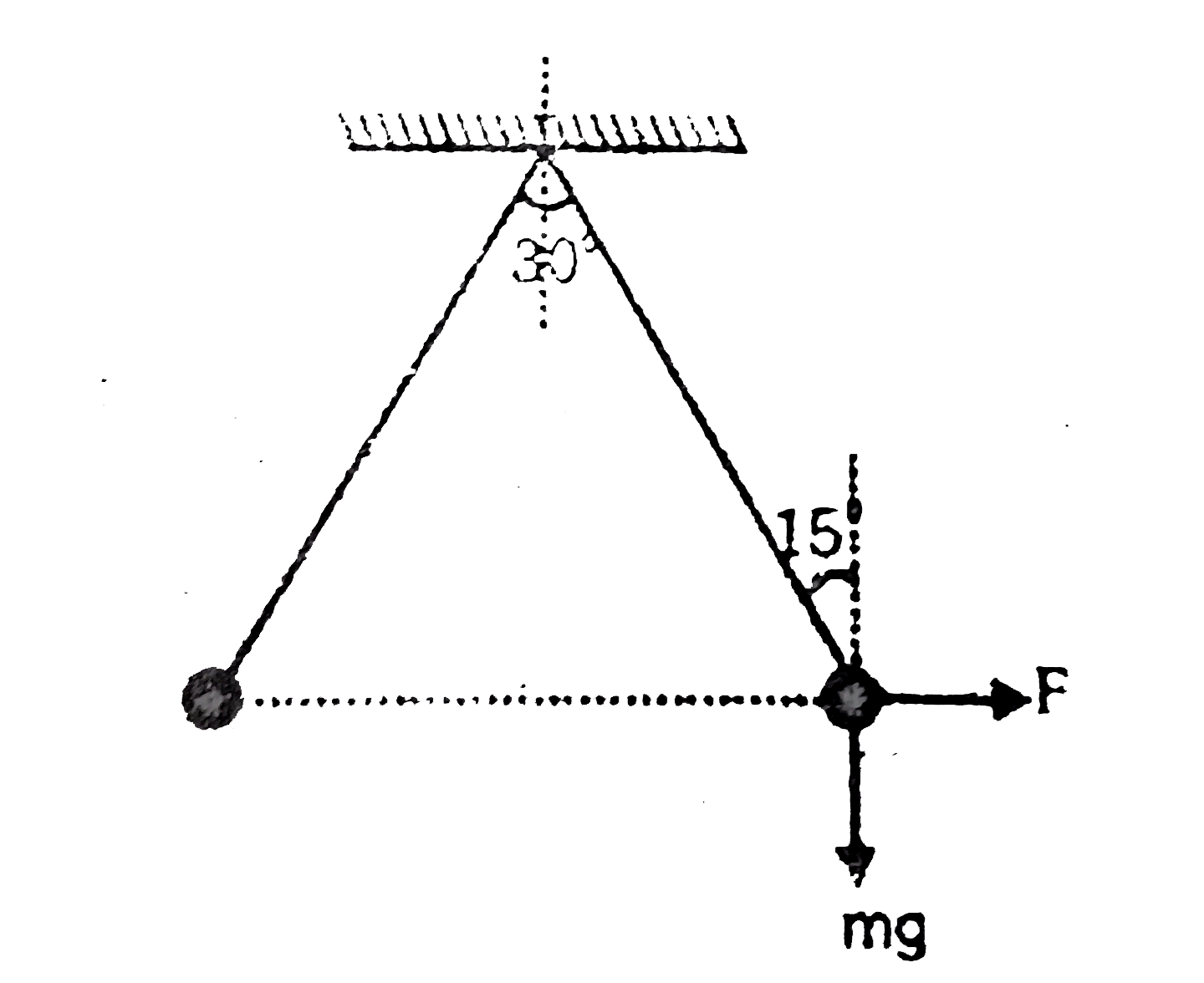
Two identically charged spheres are suspended by strings of equal length. The strings make an angle of `30^(@)` with each other. When suspended in a liquid of density `0.8 g// c c` the angle remains same. What is the dielectric constant of liquid. Density of sphere`=1.6 g//c c`

Text Solution

Verified by Experts
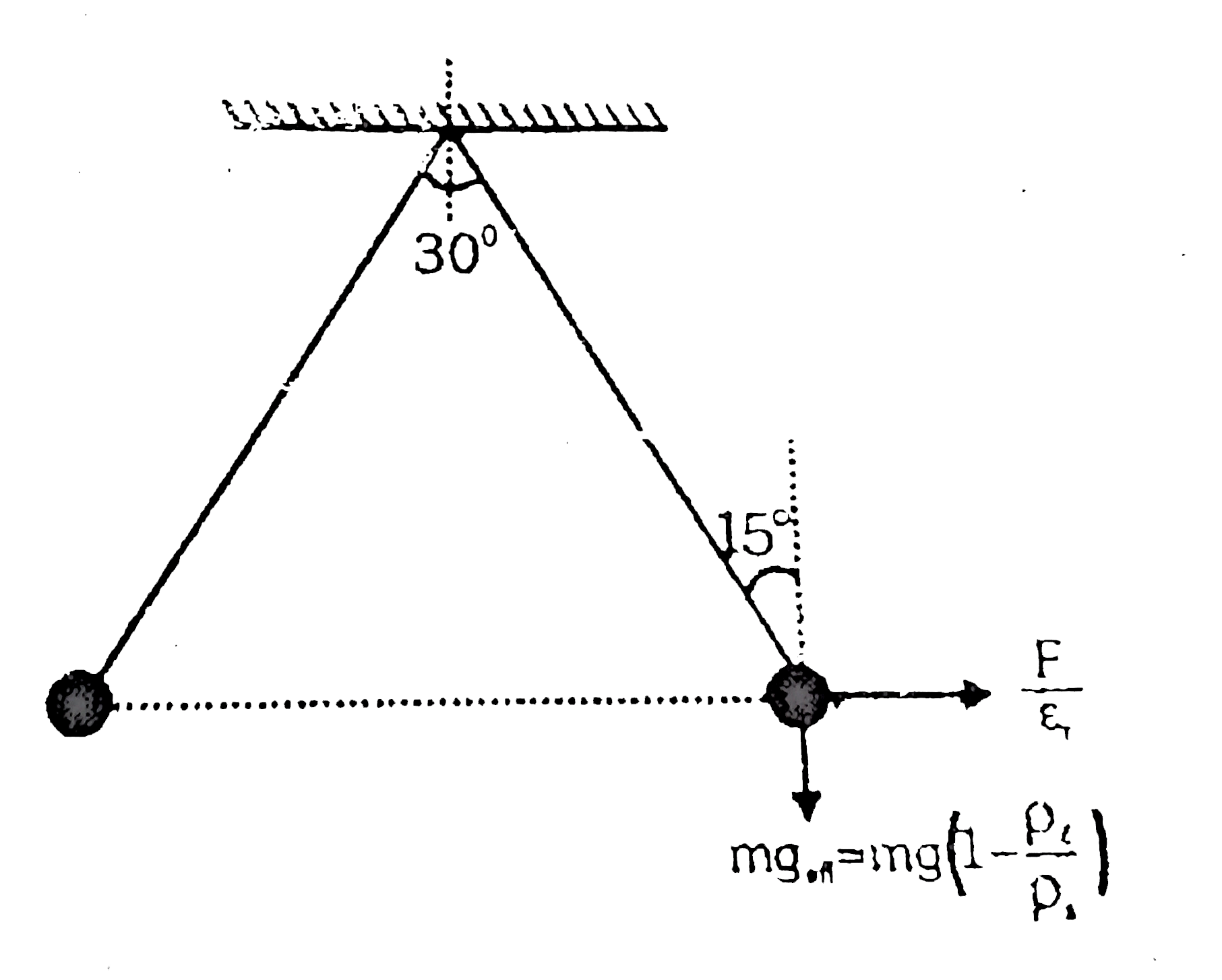
When set up shown in figure is in air, we have `tan 15^(@)=F/(mg)` When set up is immersed in the medium as shown in figure, the electric force experienced by the ball will reduce and will be equal to `F/epsilon_(r)` and the effective graviational force will become `mg(1-rho_(l)/rho_(s))`
Thus we have `tan 15^(@)=(F)/(mg in_(r)(1-rho_(l)/rho_(s)))=(F)/(mg) rArr in_(r)=1/(1-rho_(l)/rho_(s))=2`
Promotional Banner

Topper's Solved these Questions

  • MISCELLANEOUS

    ALLEN |Exercise Part -II Example Some worked out Examples|1 Videos
  • MISCELLANEOUS

    ALLEN |Exercise Exercise-01|87 Videos
  • MISCELLANEOUS

    ALLEN |Exercise Question|1 Videos
  • KINEMATICS (MOTION ALONG A STRAIGHT LINE AND MOTION IN A PLANE)

    ALLEN |Exercise BEGINNER S BOX-7|8 Videos
  • PHYSICAL WORLD, UNITS AND DIMENSIONS & ERRORS IN MEASUREMENT

    ALLEN |Exercise EXERCISE-IV|7 Videos

Similar Questions

Explore conceptually related problems

Two identical charged spheres suspended from a common point by two massless strings of lengths I, are initially at a distance d(d ltlt l) apart because of their mutual repulsion. The charges begin to leak from both the spheres at a constant rate. As a result, the spheres approach each other with a velocity v. Then v varies as a function of the distance x between as:

The rise in boiling point of a solution containing 1.8g glucose in 100g of a solvent is 0.1^(@)C . The molal elevation constant of the liquid is-

Two infinite linear charges are placed parallel to each other at a distance 0.1 m from each other. If the linear charge density on each is 5 mu C//m , then the force acting on a unit length of each linear charge will be:

Consider two solid spheres P and Q each of density 8gm cm^-3 and diameters 1cm and 0.5cm, respectively. Sphere P is dropped into a liquid of density 0.8gm cm^-3 and viscosity eta=3 poiseulles. Sphere Q is dropped into a liquid of density 1.6gmcm^-3 and viscosity eta=2 poiseulles. The ratio of the terminal velocities of P and Q is

A spherical capacitor has an inner sphere of radius 12 cm and an outer sphere of radius 13 cm. The outer sphere is earthed and the inner sphere is given a charge of 2.5 µC. The space between the concentric spheres is filled with a liquid of dielectric constant 32. (a) Determine the capacitance of the capacitor. (b) What is the potential of the inner sphere? (c) Compare the capacitance of this capacitor with that of an isolated sphere of radius 12 cm. Explain why the latter is much smaller.

When a vertical capillary of length l with a sealed upper end was brought in contact with the surface of a liquid, the level of this liquid rose to the height h . The liquid density is rho , the inside diameter the capillary is d , the contact angle is theta , the atmospheric pressure is rho_(0) . Find the surface tension of the liquid. (Temperature in this process remains constant.)

Two identical cylindrical vessels with their bases at the same level each, contain a liquid of density rho . The area of either base is A but in one vessel the liquid heigth is h_(1) and in the other liquid height is h_(2)(h_(2)lth_(1)) . If the two vessel are connected, the work done by gravity in equalizing the level is

Charges on identical spheres A and B are equal. When the separation between them is 1 m, the repulsion between them is 80 N. Now, another identical and uncharged sphere C is brought in contact with A and then separated. Then, C is brought in contact with B and then separated. What will be the new force between A and B ?

ALLEN -MISCELLANEOUS-Part -II Example
  1. The force of repulsion between two point charges is F, when these are ...

    Text Solution

    |

  2. A body rotates about a fixed axis with an angular acceleration of 5 ra...

    Text Solution

    |

  3. Two identically charged spheres are suspended by strings of equal leng...

    Text Solution

    |

  4. Given a cube with point charges q on each of its vertices. Calculate t...

    Text Solution

    |

  5. Five point charges, each of value +q are placed on five vertices of a ...

    Text Solution

    |

  6. Calculate the electric field at origin due to infinite number of charg...

    Text Solution

    |

  7. A charges particles particle is kept in equilibrium in the electric fi...

    Text Solution

    |

  8. Calculate the electric field intensity E which would be just sufficien...

    Text Solution

    |

  9. If a point charge q is placed at the centre of a cube. What is the f...

    Text Solution

    |

  10. If a point charge q is placed at one corner of a cube, what is the flu...

    Text Solution

    |

  11. As shown in figure a closed surface intersects a spherical conductor. ...

    Text Solution

    |

  12. Consider a uniform electric field E=3xx10^(3) hati N/C (a) what is ...

    Text Solution

    |

  13. Find the electric field due to an infinitely long cylindrical charge d...

    Text Solution

    |

  14. A point charge of 0.009 mu C is placed at origin. Calculate intensit...

    Text Solution

    |

  15. A proton moves with a speed of 7.45xx10^(5) m//s dirctly towards a fre...

    Text Solution

    |

  16. A charge 2 mu C is taken from infinity to a point in an electric field...

    Text Solution

    |

  17. 1 mu C charge is shifted from A to B and it is found that work done by...

    Text Solution

    |

  18. If V=-5x+3y+sqrt(15)z then find magnitude of electric field at point (...

    Text Solution

    |

  19. A system has two charges qA = 2.5 xx 10^(-7) C and q(B) = - 2.5 xx 1...

    Text Solution

    |

  20. Calculate force on a dipole in the surrounding of a long charged wire ...

    Text Solution

    |

