Home
Class 11
PHYSICS
Prove that the frequency of oscillation ...

Prove that the frequency of oscillation of an electric dipole of moment p and rotational inertia `I` for small amplitudes about its equilibrium position in a uniform electric field strength E is `1/(2pi) sqrt(((pE)/I))`

Text Solution

Verified by Experts
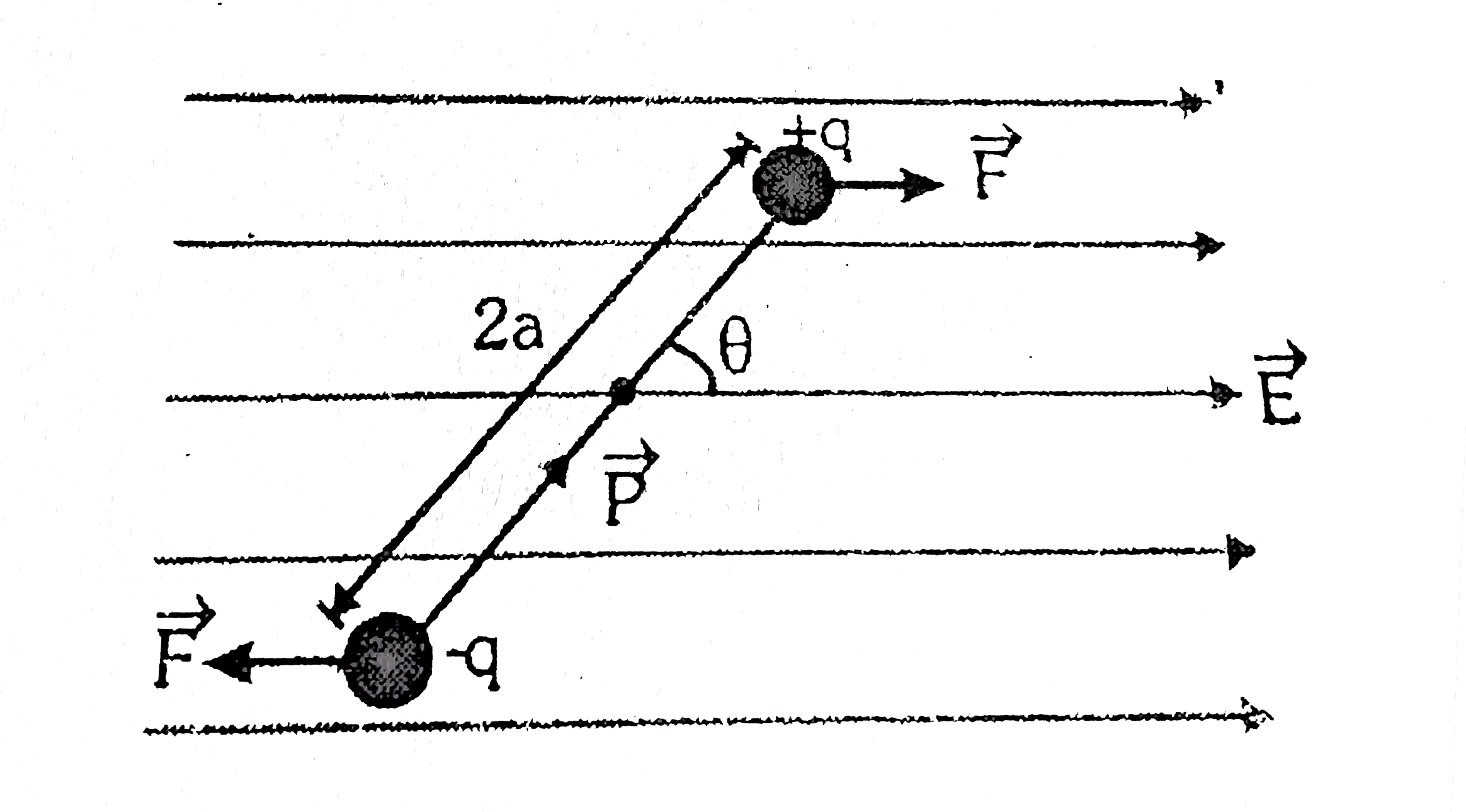
Let an electric dipole (charge q and -q at a distance 2a apart) placed in a uniform external electric field of strength E.

Restoring torque on dipole `" " tau=-pE sin theta=-pE theta("as " theta "is small")`
Here -ve sign shows the restoring tendendency of torque `:' tau =I alpha :.` angular acceleration `=alpha=tau/I=(PE)/I theta`
For SHM `alpha=-omega^(2) theta" "` comparing we get `omega=sqrt((pE)/(I))`
Thus frequency of oscillations of dipole `n=omega/(2pi)=1/(2pi)sqrt(((pE)/I))`
Promotional Banner

Topper's Solved these Questions

  • MISCELLANEOUS

    ALLEN |Exercise Part -II Example Some worked out Examples|1 Videos
  • MISCELLANEOUS

    ALLEN |Exercise Exercise-01|87 Videos
  • MISCELLANEOUS

    ALLEN |Exercise Question|1 Videos
  • KINEMATICS (MOTION ALONG A STRAIGHT LINE AND MOTION IN A PLANE)

    ALLEN |Exercise BEGINNER S BOX-7|8 Videos
  • PHYSICAL WORLD, UNITS AND DIMENSIONS & ERRORS IN MEASUREMENT

    ALLEN |Exercise EXERCISE-IV|7 Videos

Similar Questions

Explore conceptually related problems

The work in rotating electric dipole of dipole moment p in an electric field E through an angle theta from the direction of electric field, is:

An electric dipole of momentum vecp is placed in a uniform electric field. The dipole is rotated through a very small angle theta from equilibrium and is released. It executes simple harmonic motion with frequency f=1/(2pi)sqrt((pE)/I) where, I= moment of interia of the dipole.

A small electric dipole is placed at origin with its dipole moment directed along positive x-axis. The direction of electric field at point (2, 2sqrt(2), 0) is

Figure shows a pulley block system in which a block A is hanging one side of pulley and an other side a small bead B of mass m is welded on pe=ulley. The moment of intertia of pulley is I and the sytem is in equilibrium position when bead is at an angle alpha from the vertical. If the system is slightly disturbed from its equlibrium position, find the time period of its oscillations.

An electron of mass m_(e ) initially at rest moves through a certain distance in a uniform electric field in time t_(1) . A proton of mass m_(p) also initially at rest takes time t_(2) to move through an equal distance in this uniform electric field.Neglecting the effect of gravity, the ratio of t_(2)//t_(1) is nearly equal to

A block with mass (M) is connected by a massless spring with stiffness constant (k) to a rigid wall and moves without friction on a horizontal surface. The block oscillates with small amplitude A about an equilibrium position (x_0). Consider two cases : (i) when the block is at (x_0) , and (ii) when the block is at x = x_0 + A . In both the cases, a particle with mass m(lt M) is softly placed on the block after which they strick to each other. Which of the following statement (s) is (are) true about the motion after the mass (m) is placed on the mass (M) ?

A charges cork of mass m suspended by a light stright is placed in uniform electric field strength E=(hat(i)+hat(j))xx10^(5) NC^(-1) as shown in the figure. If in equilibrium position tension in the string is (2mg)/((1+sqrt(3))) then angle 'alpha' with the vertical is:

Write the equation of torque on the needle placed in a uniform magnetic field and obtain the equation of its periodic time T = 2 pi sqrt((I)/( mB)) .

An almost inertia-less rod of length l3.5 m can rotate freely around a horizontal axis passing through its top end. At the bottom end of the roa a small ball of mass m andat the mid-point another small ball of mass 3m is attached. Find the angular frequency (in SI units) of small oscillations of the system about the equilibrium position. Gravitational acceleration is g=9.8 m//s^(2).

ALLEN -MISCELLANEOUS-Part -II Example
  1. Calculate force on a dipole in the surrounding of a long charged wire ...

    Text Solution

    |

  2. A short electric dipole is situated at the origin of coordinate axis w...

    Text Solution

    |

  3. Prove that the frequency of oscillation of an electric dipole of momen...

    Text Solution

    |

  4. Brass has a tensile strength 3.5xx10^(8) N//m^(2). What charge density...

    Text Solution

    |

  5. Prove that if an isolated (isolated means no charges are near the shee...

    Text Solution

    |

  6. If an isolated infinite plate contains a charge Q1 on one of its surfa...

    Text Solution

    |

  7. Three large conducting sheets placed parallel to each other at a finit...

    Text Solution

    |

  8. Two conducting plates A and B are placed parallel to each other. A is ...

    Text Solution

    |

  9. Figure shows three large metallic plates with chrges -Q, 3Q and Q resp...

    Text Solution

    |

  10. An isolated conducting sheet of area A and carrying a charge Q is plac...

    Text Solution

    |

  11. An uncharged conductor of inner radius R(1) and outer radius R(2) cons...

    Text Solution

    |

  12. An unchanged conductor of inner radius R(1) and outer radius R(2) cont...

    Text Solution

    |

  13. When the switch is closed find the charge flown through switch?

    Text Solution

    |

  14. The two conducting spherical shells are joined by a conducting wire an...

    Text Solution

    |

  15. Find charge on each spherical shell after joining the inner most shell...

    Text Solution

    |

  16. Two conducting hollow spherical shells of radius R and 2R carry charge...

    Text Solution

    |

  17. An isolated conducting sphere of charge Q and radius R is connected to...

    Text Solution

    |

  18. Two positrons (e+) and two protons (p) are kept on four corners of a s...

    Text Solution

    |

  19. Four charges are placed at the circumference of a dial clock as shown ...

    Text Solution

    |

  20. A small electric dipole is placed at origin with its dipole moment dir...

    Text Solution

    |

