Home
Class 11
PHYSICS
Two positrons (e+) and two protons (p) a...

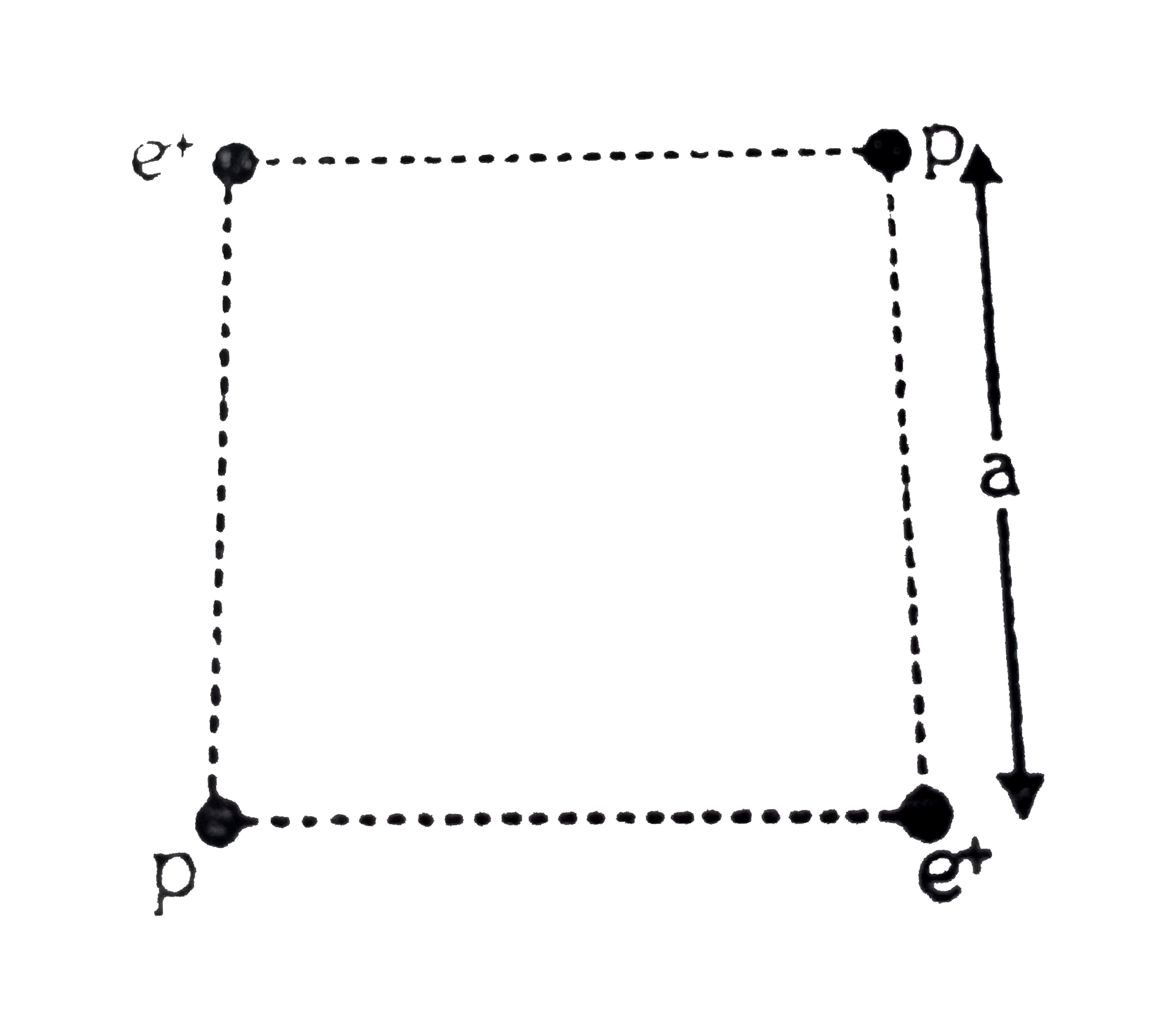
Two positrons (e+) and two protons (p) are kept on four corners of a square of side a as shown in figure. The mass of proton is much larger than the mass of positron. Let q denotes the charge on the proton as well as the position then the kinetic energies of one of the positrons and one of the protons respectively after a very long time will be-

A

`q^(2)/(4pi in_(0)a)(1+1/(2sqrt(2))), q^(2)/(4pi in_(0)a)(1+1/(2sqrt(2)))`

B

`q^(2)/(2pi in_(0)a),q^(2)/(4sqrt(2)pi in_(0)a)`

C

`q^(2)/(4pi in_(0)a),q^(2)/(4pi in_(0)a)`

D

`q^(2)/(2pi in_(0)a)(1+1/(4sqrt(2))), q^(2)/(8sqrt(2) pi in_(0)a)`

Text Solution

Verified by Experts

The correct Answer is:
D

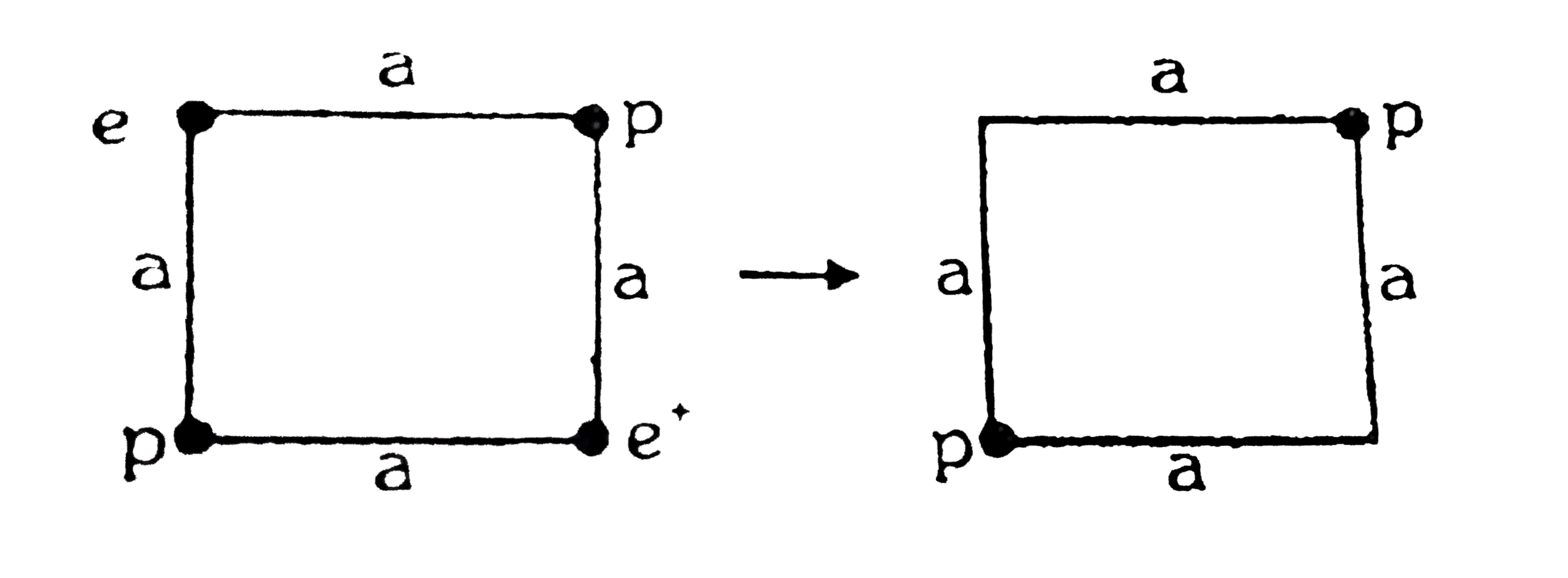
As mass of proton `gt gt gt` mass of position so initial accelaration of position is much larger than proton. Therefore position reach far away in very short time as compare to proton.

`2K_(e^(+))=((4kq^(2))/a+(2kq^(2))/(asqrt(2)))-(kq^(2))/(asqrt(2))rArrK_(e^(+))=q^(2)/(2pi in_(0)a)(1+1/(4sqrt(2)))` and `2K_(p)=(kq^(2))/(asqrt(2))-0rArr K_(p)=q^(2)/(8sqrt(2)pi in_(0)a)`
Promotional Banner

Topper's Solved these Questions

  • MISCELLANEOUS

    ALLEN |Exercise Part -II Example Some worked out Examples|1 Videos
  • MISCELLANEOUS

    ALLEN |Exercise Exercise-01|87 Videos
  • MISCELLANEOUS

    ALLEN |Exercise Question|1 Videos
  • KINEMATICS (MOTION ALONG A STRAIGHT LINE AND MOTION IN A PLANE)

    ALLEN |Exercise BEGINNER S BOX-7|8 Videos
  • PHYSICAL WORLD, UNITS AND DIMENSIONS & ERRORS IN MEASUREMENT

    ALLEN |Exercise EXERCISE-IV|7 Videos

Similar Questions

Explore conceptually related problems

A proton is kept at rest . A positively charged particle is released from rest at a distance d in its field .Consider two experiments , one in which the charged particle is also a proton and in another , a position . In same time t , the work done on the two moving charged particle is

Two positive charges of magnitude q are placed at the ends of a side ( side 1) of a square of side 2a . Two negative charges of the same magnitude are kept at the other corners . Staring from rest , a charge Q moves from the middle of side 1 to the centre of square , its kinetic energy at the centre of square is -.

An accelration produces a narrow beam of protons, each having an initial speed of v_(0) . The beam is directed towards an initially uncharges distant metal sphere of radius R and centered at point O. The initial path of the beam is parallel to the axis of the sphere at a distance of (R//2) from the axis, as indicated in the diagram. The protons in the beam that collide with the sphere will cause it to becomes charged. The subsequentpotential field at the accelerator due to the sphere can be neglected. The angular momentum of a particle is defined in a similar way to the moment of a force. It is defined as the moment of its linear momentum, linear replacing the force. We may assume the angular momentum of a proton about point O to be conserved. Assume the mass of the proton as m_(P) and the charge on it as e. Given that the potential of the sphere increases with time and eventually reaches a constant velue. After a long time, when the potential of the sphere reaches a constant value, the trajectory of proton is correctly sketched as

An accelration produces a narrow beam of protons, each having an initial speed of v_(0) . The beam is directed towards an initially uncharges distant metal sphere of radius R and centered at point O. The initial path of the beam is parallel to the axis of the sphere at a distance of (R//2) from the axis, as indicated in the diagram. The protons in the beam that collide with the sphere will cause it to becomes charged. The subsequentpotential field at the accelerator due to the sphere can be neglected. The angular momentum of a particle is defined in a similar way to the moment of a force. It is defined as the moment of its linear momentum, linear replacing the force. We may assume the angular momentum of a proton about point O to be conserved. Assume the mass of the proton as m_(P) and the charge on it as e. Given that the potential of the sphere increases with time and eventually reaches a constant velue. If the initial kinetic energy of a proton is 2.56 ke V , then the final potential of the sphere is

An accelration produces a narrow beam of protons, each having an initial speed of v_(0) . The beam is directed towards an initially uncharges distant metal sphere of radius R and centered at point O. The initial path of the beam is parallel to the axis of the sphere at a distance of (R//2) from the axis, as indicated in the diagram. The protons in the beam that collide with the sphere will cause it to becomes charged. The subsequentpotential field at the accelerator due to the sphere can be neglected. The angular momentum of a particle is defined in a similar way to the moment of a force. It is defined as the moment of its linear momentum, linear replacing the force. We may assume the angular momentum of a proton about point O to be conserved. Assume the mass of the proton as m_(P) and the charge on it as e. Given that the potential of the sphere increases with time and eventually reaches a constant velue. One the potential of the sphere has reached its final, constant value, the minimum speed v of a proton along its trajectory path is given by

An accelration produces a narrow beam of protons, each having an initial speed of v_(0) . The beam is directed towards an initially uncharges distant metal sphere of radius R and centered at point O. The initial path of the beam is parallel to the axis of the sphere at a distance of (R//2) from the axis, as indicated in the diagram. The protons in the beam that collide with the sphere will cause it to becomes charged. The subsequentpotential field at the accelerator due to the sphere can be neglected. The angular momentum of a particle is defined in a similar way to the moment of a force. It is defined as the moment of its linear momentum, linear replacing the force. We may assume the angular momentum of a proton about point O to be conserved. Assume the mass of the proton as m_(P) and the charge on it as e. Given that the potential of the sphere increases with time and eventually reaches a constant velue. The total energy (E) of a proton in the beam travelling with seed v at a distance of r (r ge R) from point O. Assuming that the sphere has acquired an electrostatic charge Q is

Consider a disc rotating in the horizontal plane with a constant angular speed omega about its centre O . The disc has a shaded region on one side of the diameter and an unshaded region on the other side as shown in the figure. When the disc is in the orientation as shown, two pebbles P and Q are simultaneously projected at an angle towards R. The velocity of projection is in the y-z plane and is same for both pebbles with respect to the disc. Assume that (i) they land back on the disc before the disc has completed (1)/(8) rotation, (ii) their range is less than half the disc radius, and (iii) w remains constant throughout. Then

Columb law for electrostatic force between two point charges and newton law for gravitational force between two the distance between the charges and masses respectively (a) compare the strength of these forces by determining the ratio of their magnitudes (i) for an electron and a proton and (ii) for two protons (b) estimate the acceleratons of electron and proton due to the electrical force oftheir mutual attarction when they are 1A (=10^(-10) m) a part (m_(p)=1.67xx10^(27) kg m_(e )=9.11xx10^(-31) kg)

Coulomb's law for electrostatic force between two point charges and Newton's law for gravitational force between two stationary point masses, both have inverse-square dependence on the distance between the charges and masses respectively, (a) Compare the strength of these forces by determining the ratio of their magnitudes (i) for an electron and a proton and (ii) for two protons. (b) Estimate the accelerations of electron an proton due to the electrical force of the mutual attraction when they are =10^(-10)m apart? (m_(p) = 1.67 xx 10^(-27) kg, m_(e) = 9.11 xx 10^(-31) kg)

Consider the decay of a free neutron at rest : n to p +e^(-) Show that the two body decay of this type must necessary give an electron of fixed energy and therefore cannot account distribution in the beta - decay of a neutron or a nucleous as shown in figure . [ Note : The simple result of this exercise was one among the several arguments advanced by W . Pauli to perdict the existence of a third particle in the decay products of beta - decay . This particle is known as neutrino spin 1/2 ( like e^(-) p or n ) but is neutral ad either massless or having an extremely small mass (compared to the mass of electron) and which interacts very weakly with matter . The correct decay process of neutron is : n to p+e(-)+v)

ALLEN -MISCELLANEOUS-Part -II Example
  1. Two conducting hollow spherical shells of radius R and 2R carry charge...

    Text Solution

    |

  2. An isolated conducting sphere of charge Q and radius R is connected to...

    Text Solution

    |

  3. Two positrons (e+) and two protons (p) are kept on four corners of a s...

    Text Solution

    |

  4. Four charges are placed at the circumference of a dial clock as shown ...

    Text Solution

    |

  5. A small electric dipole is placed at origin with its dipole moment dir...

    Text Solution

    |

  6. Uniform electric field of magnitude 100 V//m in space is directed alon...

    Text Solution

    |

  7. Figure shows a uniformly charged hemisphere of radius R. It has a volu...

    Text Solution

    |

  8. A metallic rod of length I rotates at angular velocity omega about an...

    Text Solution

    |

  9. Consider a finite charged rod. Electric field at point P (shown) makes...

    Text Solution

    |

  10. The alectric potential in a region is given by the relation V(x)=4+5x^...

    Text Solution

    |

  11. A thin homogeneous rod of mass m and length l is free to rotate in ver...

    Text Solution

    |

  12. A thin homogeneous rod of mass m and length l is free to rotate in ver...

    Text Solution

    |

  13. A thin homogeneous rod of mass m and length l is free to rotate in ver...

    Text Solution

    |

  14. A simple pendulum is suspended in a lift which is going up with an acc...

    Text Solution

    |

  15. The variation of potential with distance x from a fixed point is shown...

    Text Solution

    |

  16. The energy density u is plotted against the distance r from the centre...

    Text Solution

    |

  17. The figure shown four situations in which charges as indicated (q gt 0...

    Text Solution

    |

  18. An electric field is given by vec(E)=(yhat(i)+xhat(j))N/C. Find the wo...

    Text Solution

    |

  19. The arrangement shown consists of three elements. (i) A thin rod of ...

    Text Solution

    |

  20. Six charges are kept at the vertices of a regular hexagon as shown in ...

    Text Solution

    |

