
Home
Class 11
PHYSICS
A thin homogeneous rod of mass m and len...

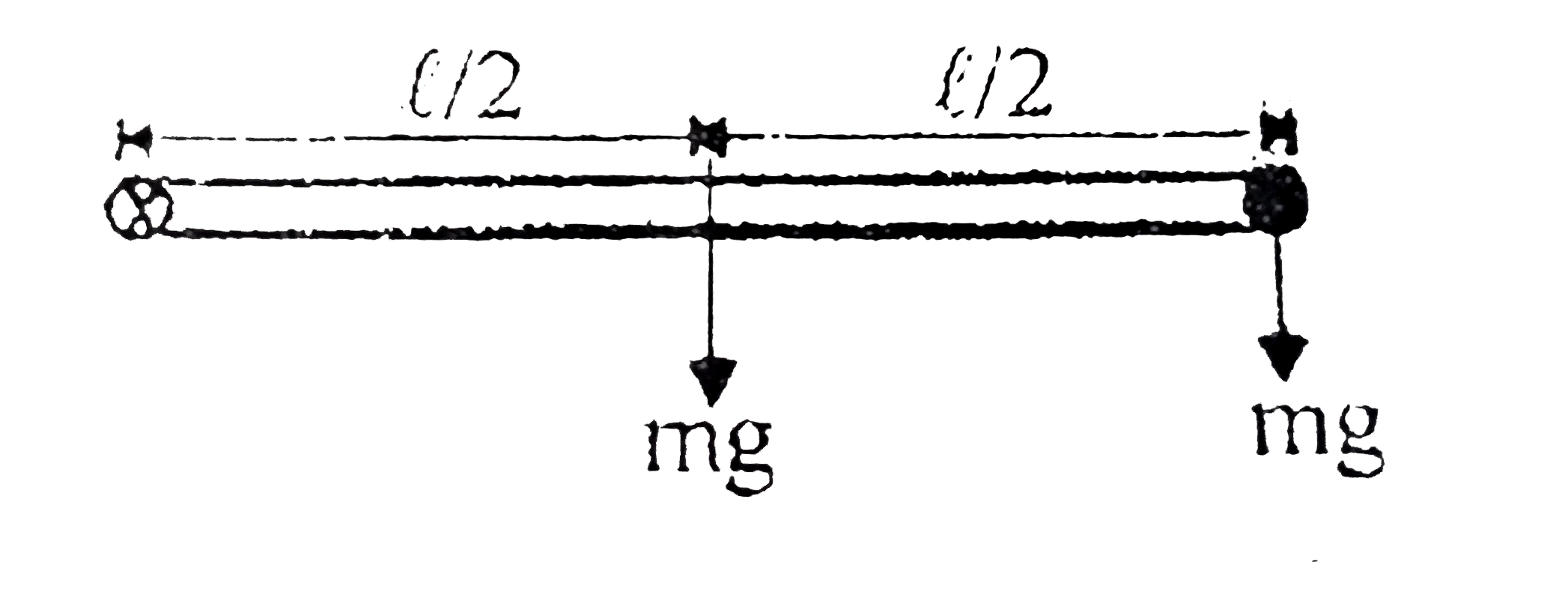
A thin homogeneous rod of mass m and length `l` is free to rotate in vertical plane about a horizontal axle pivoted at one end of the rod. A small ballof mass m and charge q is attached to the opposite end of this rod. The whole system is positioned in a horizontal electric field of magnitude `E=(mg)/(2q)`. The rod is released from, shown position from rest.

What is the angular acceleration of the rod at the instant of releasing the rod?

A

`(8g)/(9l)`

B

`(3g)/(2l)`

C

`(9g)/(8l)`

D

`(2g)/(9l)`

Text Solution

Verified by Experts

The correct Answer is:
C


By taking torque about hinge `Ialpha=mg(l/2)+mg(l)` when `I=(ml^(2))/3+ml^(2)rArr alpha=(9g)/(8l)`
Promotional Banner

Topper's Solved these Questions

  • MISCELLANEOUS

    ALLEN |Exercise Part -II Example Some worked out Examples|1 Videos
  • MISCELLANEOUS

    ALLEN |Exercise Exercise-01|87 Videos
  • MISCELLANEOUS

    ALLEN |Exercise Question|1 Videos
  • KINEMATICS (MOTION ALONG A STRAIGHT LINE AND MOTION IN A PLANE)

    ALLEN |Exercise BEGINNER S BOX-7|8 Videos
  • PHYSICAL WORLD, UNITS AND DIMENSIONS & ERRORS IN MEASUREMENT

    ALLEN |Exercise EXERCISE-IV|7 Videos

Similar Questions

Explore conceptually related problems

A thin homogeneous rod of mass m and length l is free to rotate in vertical plane about a horizontal axle pivoted at one end of the rod. A small ballof mass m and charge q is attached to the opposite end of this rod. The whole system is positioned in a horizontal electric field of magnitude E=(mg)/(2q) . The rod is released from, shown position from rest. What is the acceleration of the small ball at the instant of releasing the rod?

A thin homogeneous rod of mass m and length l is free to rotate in vertical plane about a horizontal axle pivoted at one end of the rod. A small ballof mass m and charge q is attached to the opposite end of this rod. The whole system is positioned in a horizontal electric field of magnitude E=(mg)/(2q) . The rod is released from, shown position from rest. What is the speed of ball when rod becomes vertical?

A uniform rod of mass m and length l rotates in a horizontal plane with an angular velocity omega about a vertical axis passing through one end. The tension in the rod at a distance x from the axis is

A rod PQ of mass M and length L is hinged at end P. The rod is kept horizontal by a massless string tied to point Q as shown in figure. When string is cut, the initial angular acceleration of the rod is

A uniform rod of mass M and length L lies flat on a frictionless horizantal surface. Two forces F and 2F are applied along the length of the rod as shown. The tension in the rod at point P is

A disc of mass m and radius r is free to rotate about its centre as shown in the figure. A string is wrapped over its rim and a block of mass m is attached to the free end of the string. The system is released from rest. The speed of the block as it descends through a height h, is :-

A rod of mass m and length l is hinged at one of its ends A as shown in figure. A force F is applied at a distance x from A . The acceleration of centre of mass varies with x as -

A simple pendulum of mass m and length L is held in horizontal position. If it is released from this position, then find the angular momentum of the bob about the point of suspension when it is vertically below the point of suspension.

The thin rod shown below has mases M and length L. A force F acts at one end as shown and the rod is free to rotate about the other end in horizontal plane. Initial angular acceleration of the rod is :

Consider two cylindrical rods of identical dimensions, one of rubber and the other of steel. Both the rods are fixed rigidly at one end to the roof. A mass M is attached to each of the free ends at the centre of the rods.

ALLEN -MISCELLANEOUS-Part -II Example
  1. Two positrons (e+) and two protons (p) are kept on four corners of a s...

    Text Solution

    |

  2. Four charges are placed at the circumference of a dial clock as shown ...

    Text Solution

    |

  3. A small electric dipole is placed at origin with its dipole moment dir...

    Text Solution

    |

  4. Uniform electric field of magnitude 100 V//m in space is directed alon...

    Text Solution

    |

  5. Figure shows a uniformly charged hemisphere of radius R. It has a volu...

    Text Solution

    |

  6. A metallic rod of length I rotates at angular velocity omega about an...

    Text Solution

    |

  7. Consider a finite charged rod. Electric field at point P (shown) makes...

    Text Solution

    |

  8. The alectric potential in a region is given by the relation V(x)=4+5x^...

    Text Solution

    |

  9. A thin homogeneous rod of mass m and length l is free to rotate in ver...

    Text Solution

    |

  10. A thin homogeneous rod of mass m and length l is free to rotate in ver...

    Text Solution

    |

  11. A thin homogeneous rod of mass m and length l is free to rotate in ver...

    Text Solution

    |

  12. A simple pendulum is suspended in a lift which is going up with an acc...

    Text Solution

    |

  13. The variation of potential with distance x from a fixed point is shown...

    Text Solution

    |

  14. The energy density u is plotted against the distance r from the centre...

    Text Solution

    |

  15. The figure shown four situations in which charges as indicated (q gt 0...

    Text Solution

    |

  16. An electric field is given by vec(E)=(yhat(i)+xhat(j))N/C. Find the wo...

    Text Solution

    |

  17. The arrangement shown consists of three elements. (i) A thin rod of ...

    Text Solution

    |

  18. Six charges are kept at the vertices of a regular hexagon as shown in ...

    Text Solution

    |

  19. Electric field in a region is given by vec(E)=-4xhat(i)+6yhat(j). The ...

    Text Solution

    |

  20. An infinite plane of charge with sigma=2 in(0) C/m^(2) is tilted at a ...

    Text Solution

    |

