Home
Class 11
PHYSICS
I started walking down a road in morning...

I started walking down a road in morning facing the sun. After walking for some-time, I turned to my left, then I turned to the right once again. In which direction was I going then-

A

East

B

North-west

C

North-east

D

South

Text Solution

Verified by Experts

The correct Answer is:
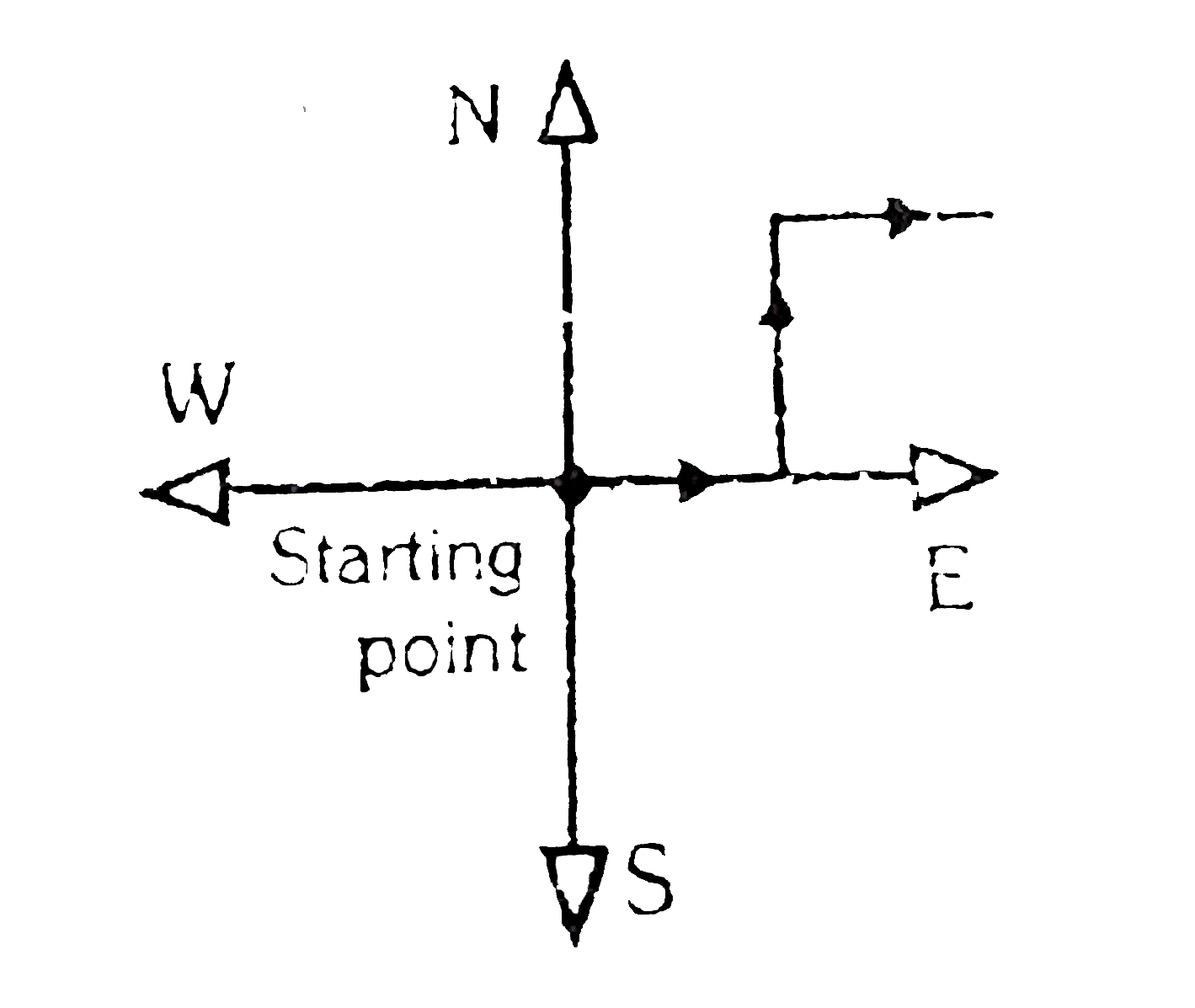
A

Promotional Banner

Topper's Solved these Questions

  • MISCELLANEOUS

    ALLEN |Exercise Exersice-03|7 Videos
  • MISCELLANEOUS

    ALLEN |Exercise ASSERTION-REASON|18 Videos
  • MISCELLANEOUS

    ALLEN |Exercise Part -II Example Some worked out Examples|1 Videos
  • KINEMATICS (MOTION ALONG A STRAIGHT LINE AND MOTION IN A PLANE)

    ALLEN |Exercise BEGINNER S BOX-7|8 Videos
  • PHYSICAL WORLD, UNITS AND DIMENSIONS & ERRORS IN MEASUREMENT

    ALLEN |Exercise EXERCISE-IV|7 Videos

Similar Questions

Explore conceptually related problems

I started walking down a road to day-break facing the sun. After walking for some time. I turned to my left, then I turned to the right once again. In which direction was I going then :

A man standing on a moving escalator, completes a certain distance in time t_(1) . If the escalator does not move then man covers this distance in time t_(2) by walking. (i) How much time will he take to cover the same distance if he move on the moving escalator in the same direction ? (ii) How much time will he take to cover the same distance if he move on the moving escalator in the opposite direction ?

Two speakers are driven by the same oscillator with frequency of 200 Hz. They are located 4 m part on a vertical pole. A man walks straight towards the lower speaker in a direction perpendicular to the pole, as shown in figure. (i) How many times will he hear a minimum in sound intensity, and (ii) how far is he from the pole and at these moments ? Take the speed of sound to be 330 m/s, and ignore any sound reflections coming off the ground. .

A beam of ultraviolet light of all wavelength passes through hydrogen gas at room temperature, in the x-direction. Assume that all photons emitted due to electron transitions inside the gas emerge in the y-direction. Let A and B denote the lights emerging from the gas in the x-and y-directions respectively. (i) Some of the incident wavelengths will be absent in A (ii) Only those wavelengths will be present in B which are absent in A (iii) B will contain some visible light (iv) B will contain some infrared light

On a long horizontally moving belt, a child runs to an fro with a speed 9 kmh^(-1) ( with respect to the belt) between his father and mother located 50m a part on the moving belt. The belt moves with a speed of 4 kmh^(-1) . For an observer on a stationery platform outside, what is the (i) speed of the child running in the direction of motion of the belt, (ii) speed of the child running opposited to the direction of motion of the belt , and (iii) time taken by child in (i) and (ii) ? which of the answers alter if motion is viewed by one of the parents?

A swimmer starts to swim from point a to cross a river. He wants to reach point B on the opposite side of the river. The line AB makes an angle 60^(@) with the river flow as hown. The velocity of the swimmer in still water is same as that of the water (i) In what direction should he try to direct his velocity ? Calculate angle between his velocity anf river velocity. (ii) Find the ratio of the time taken to cross the river in this situation to the minimum time in which he can cross this river.

A swimmer starts to swim from point a to cross a river. He wants to reach point B on the opposite side of the river. The line AB makes an angle 60^(@) with the river flow as shown. The velocity of the swimmer in still water is same as that of the water (i) In what direction should he try to direct his velocity ? Calculate angle between his velocity and river velocity. (ii) Find the ratio of the time taken to cross the river in this situation to the minimum time in which he can cross this river.

ALLEN -MISCELLANEOUS-Exercise-01
  1. Figure shows three vectors vec(a), vec(b) and vec(c), where R is the m...

    Text Solution

    |

  2. A displacement vector, at an angle of 30^(@) with y-axis has an x-comp...

    Text Solution

    |

  3. I started walking down a road in morning facing the sun. After walking...

    Text Solution

    |

  4. A bird moves from point (1 m, -2 m, 3 m) to (4 m, 2 m, 3 m). If the sp...

    Text Solution

    |

  5. Any vector in an arbitrary direction can always be replaced by two (or...

    Text Solution

    |

  6. There are two forces vectors, one of 5N and other of 12N at what angle...

    Text Solution

    |

  7. A particle has displacement of 12m towards east and 5 m towards north ...

    Text Solution

    |

  8. 21 coplanar non collinear forces (all of equal magnitude) maintain a b...

    Text Solution

    |

  9. A vector vecA points vertically upward and vecB points towards north. ...

    Text Solution

    |

  10. If |vec(A)xxvec(B)|=sqrt(3)vec(A).vec(B), then the value of |vec(A)+ve...

    Text Solution

    |

  11. The projection of vec(A) on vec(B) is :-

    Text Solution

    |

  12. Given that P=Q=R. If vec(P)+vec(Q)=vec(R) then the angle between vec(P...

    Text Solution

    |

  13. At what angle must the two forces (X+y) and (x-y) act so that the re...

    Text Solution

    |

  14. The value of (vec(A)+vec(B)).(vec(A)xxvec(B)) is :-

    Text Solution

    |

  15. The projection of vector, vec(r)=3hat(i)+hat(j)+2hat(k), on the x-y pl...

    Text Solution

    |

  16. Two balls are rolling on a flat smooth table. One ball has velocity co...

    Text Solution

    |

  17. Select incorrect statement

    Text Solution

    |

  18. If vec(e(1)) and vec(e(2)) are two unit vectors and theta is the angle...

    Text Solution

    |

  19. Three concurrent forces of the same magnitude are in equilibrium. What...

    Text Solution

    |

  20. In a clockwise system:

    Text Solution

    |

