Home
Class 11
PHYSICS
3 boys are pulling a heavy trolley by me...

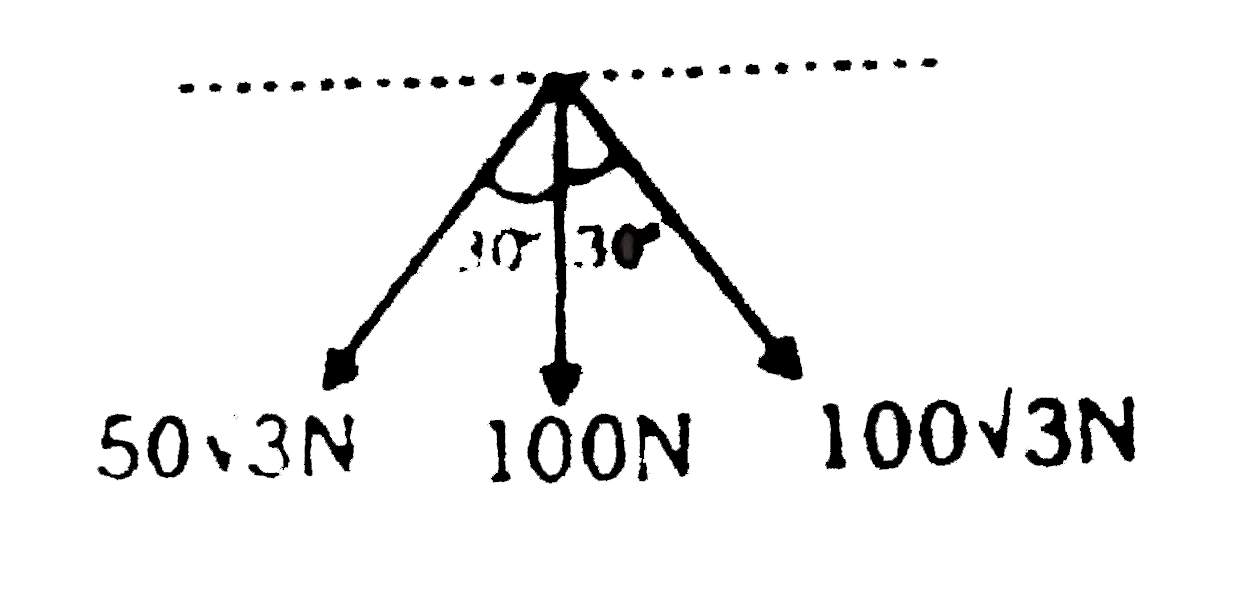
`3` boys are pulling a heavy trolley by means of `3` ropes. The boy in the middle is exerting a pull of `100 N`. The other `2` boys, whose ropes both make an angle of `30^(@)` with the centre rope, are pulling with forces of `50 sqrt(3)N` & `100 sqrt(3)N`. Find the magnitude of the resultant pull the trolley. Consider all the forces in the same plane.

Text Solution

Verified by Experts

The correct Answer is:
327.9 N

Resultant force in vertical direction

`=50sqrt(3) cos 30^(@)+100+100sqrt(3) cos 30^(@)`
`=50xx3/2+100+100xx3/2=325 N`
Resultant force in horizontal direction
`=100 sqrt(3) sin 30^(@)-50 sqrt(3) sin 30^(@)`
`100 sqrt(3)/2-(50sqrt(3))/2=25sqrt(3)N`
so resultant pull`=sqrt((325)^(2)+(25sqrt(3))^(2))=327.9 N`
Promotional Banner

Topper's Solved these Questions

  • MISCELLANEOUS

    ALLEN |Exercise Exersice-4[B]|14 Videos
  • MISCELLANEOUS

    ALLEN |Exercise EXERCISE-5(A)|15 Videos
  • MISCELLANEOUS

    ALLEN |Exercise DATA SUFFICIENCY QUESTIONS|3 Videos
  • KINEMATICS (MOTION ALONG A STRAIGHT LINE AND MOTION IN A PLANE)

    ALLEN |Exercise BEGINNER S BOX-7|8 Videos
  • PHYSICAL WORLD, UNITS AND DIMENSIONS & ERRORS IN MEASUREMENT

    ALLEN |Exercise EXERCISE-IV|7 Videos

Similar Questions

Explore conceptually related problems

Three ant P,Q and R are pulling a grain with forces of magnitude 6N,3sqrt(3) N " and " 3sqrt(2)N as shown in the figure. Find the magnitude of resultant force (in N ) acting on the grain .

Two equal forces are acting at a point with an angle of 60^(@) between them. If the resultant force is equal to 40sqrt(3)N , The magnitude of each force is :-

Two equal forces are acting at a point with an angle of 60^(@) between them. If the resultant force is equal to 20sqrt(3)N , The magnitude of each force is :-

Two equal forces are acting at a point with an angle of 60^(@) between them. If the resultant force is equal to 60sqrt(3)N , The magnitude of each force is :-

A rope of negligible mass is wound round a hollow cylinder of mass 3 kg and radius 40 cm. What is the angular acceleration of the cylinder if the rope is pulled with a force of 30 N ? What is the linear acceleration of the rope ? Assume that there is no slipping.

A rope of negligible mass is wound round a hollow cylinder of mass 3 kg and radius 40 cm. What is the angular acceleration of the cylinder if the rope is pulled with a force of 30 N? What is the linear acceleration of the rope? Assume that there is no slipping.

Thin films, including soap bubbles and oil slicks, show patterns of alternating dark and bright regions resulting from interference among the reflected light waves. If two waves are in phase their crest and troughs will coincide. The interference will be constructive and the aplitude of the resultant wave will be greater than the amplitude of either constituent wave. if the two waves are out of phase, the crests of one wave will coincide with the troughs of the other wave. The interference will be destructive and the amplitude of the resultant wave will be less than that of either constituent wave. at the interface between two transparent media some light is reflected and some light is refracted. * When incident light, reaches the surface at point a, some of the light is reflected as ray R_(a) and and some is refracted following the path ab to the back of the film. *At point b some of the light is refracted out of the film and part is reflected back refracted out of the fiml as ray R_(c) . R_(a) and R_(c) are parallel. However, R_(c) has travelled the extra distance within the film of abc. if the angle of incidence is small then abc is approximately twice the film's thickness. if R_(a) and R_(c) are in phase they will undergo constructive interference and the region ac will be bright if R_(a) and R_(c) are out of phase, they will undergo destructive interference. * Refraction at an interface never changes the phase of the wave. * For reflection at the interface between two media 1 and 2, if n_(1)ltn_(2) the reflected wave will change phase by pi . if n_(1)gtn_(2) the reflected wave will not undergo a phase change. for reference n_(air)=1.00 * if the waves are in phase after refection at all interfaces, then the effects of path length in the film are Constructive interference occur when (n= refractive index) 2t=mlamda//n" "m=0,1,2,3... .. Destructive interference occurs when 2t=(m+1//2)lamda//n" "m=0,1,2,3... Q. A 600 nm light is perpendicularly incident on a soap film suspended in air. The film is 1.00 mum thick with n=1.35. Which statement most accurately describes the interference of the light reflected by the two surfaces of the film?

Thin films, including soap bubbles and oil slicks, show patterns of alternating dark and bright regions resulting from interference among the reflected light waves. If two waves are in phase their crest and troughs will coincide. The interference will be constructive and the aplitude of the resultant wave will be greater than the amplitude of either constituent wave. if the two waves are out of phase, the crests of one wave will coincide with the troughs of the other wave. The interference will be destructive and the amplitude of the resultant wave will be less than that of either constituent wave. at the interface between two transparent media some light is reflected and some light is refracted. * When incident light, reaches the surface at point a, some of the light is reflected as ray R_(a) and and some is refracted following the path ab to the back of the film. *At point b some of the light is refracted out of the film and part is reflected back refracted out of the fiml as ray R_(c) . R_(a) and R_(c) are parallel. However, R_(c) has travelled the extra distance within the film of abc. if the angle of incidence is small then abc is approximately twice the film's thickness. if R_(a) and R_(c) are in phase they will undergo constructive interference and the region ac will be bright if R_(a) and R_(c) are out of phase, they will undergo destructive interference. * Refraction at an interface never changes the phase of the wave. * For reflection at the interface between two media 1 and 2, if n_(1)ltn_(2) the reflected wave will change phase by pi . if n_(1)gtn_(2) the reflected wave will not undergo a phase change. for reference n_(air)=1.00 * if the waves are in phase after refection at all interfaces, then the effects of path length in the film are Constructive interference occur when (n= refractive index) 2t=mlamda//n" "m=0,1,2,3... .. Destructive interference occurs when 2t=(m+1//2)lamda//n" "m=0,1,2,3... Q. The average human eye sees colors with wavelengths between 430 nm to 680 nm. For what visible wavelength will a 350 nm thick n=1.35 soap film produce maximum destructive interference?

Three boys are pushing horizontally a box placed on horizontal table. One is pushing towards north with a 5sqrt(3) N force. The second is pushing towards east and third pushes with a force 10 N such that the box is in equilibrium. Find the magnitude of the force, second by is applying in newton.

Thin films, including soap bubbles and oil show patterns of alternative dark and bright regions resulting from interference among the reflected light waves. If two waves are in phase, their crests and troughs will coincide. The interference will be constructive and the amplitude of resultant wave will be greater then either of constituent waves. If the two wave are not of phase by half a wavelength (180^(@)) , the crests of one wave will coincide width the troughs of the other wave. The interference will be destructive and the amplitude of the resultant wave will be less than that of either constiuent wave. 1. When incident light I, reaches the surface at point a, some of the light is reflected as ray R_(a) and some is refracted following the path ab to the back of the film. 2. At point b, some of the light is refracted out of the film and part is reflected back through the film along path bc. At point c, some of the light is reflected back into the film and part is reflected out of the film as ray R_(c) . R_(a) and R_(c) are parallel. However, R_(c) has traveled the extra distance within the film of abc. If the angle of incidence is small, then abc is approximately twice the film's thickness . If R_(a) and R_(c) are in phase, they will undergo constructive interference and the region ac will be bright. If R_(a) and R_(c) are out of phase, they will undergo destructive interference and the region ac will be dark. I. Refraction at an interface never changes the phase of the wave. II. For reflection at the interfere between two media 1 and 2, if n_(1) gt n_(2) , the reflected wave will change phase. If n_(1) lt n_(2) , the reflected wave will not undergo a phase change. For reference, n_(air) = 1.00 . III. If the waves are in phase after reflection at all intensities, then the effects of path length in the film are: Constrictive interference occurs when 2 t = m lambda // n, m = 0, 1,2,3 ,... Destructive interference occurs when 2 t = (m + (1)/(2)) (lambda)/(n) , m = 0, 1, 2, 3 ,... If the waves are 180^(@) out of the phase after reflection at all interference, then the effects of path length in the film area: Constructive interference occurs when 2 t = (m + (1)/(2)) (lambda)/(n), m = 0, 1, 2, 3 ,... Destructive interference occurs when 2 t = (m lambda)/(n) , m = 0, 1, 2, 3 ,... 72. A film with index of refraction 1.50 coats a glass lens with index of refraction 1.80. What is the minimum thickness of the thin film that will strongly reflect light with wavelength 600 nm?

ALLEN -MISCELLANEOUS-Exercise-04 [A]
  1. The greatest & the least magnitude of the resultant of two forces of c...

    Text Solution

    |

  2. A vector vecA of length 10 units makes an angle of 60^(@) with the vec...

    Text Solution

    |

  3. 3 boys are pulling a heavy trolley by means of 3 ropes. The boy in the...

    Text Solution

    |

  4. The position vector of car w.r.t. its starting point is given as vecr=...

    Text Solution

    |

  5. Answer the following : (i) A vector has magnitude & direction. Does ...

    Text Solution

    |

  6. A room has dimensions 3 m xx 4 m xx5 m. A fly starting at one cronet e...

    Text Solution

    |

  7. Vector vec(a) has components a(x)=3, a(y)=4. Find the components of a ...

    Text Solution

    |

  8. Find: (i) "north cross west" " " (ii) "down dot south" (iii) "we...

    Text Solution

    |

  9. The position vector of a particle of mass m= 6kg is given as vec(r)=[(...

    Text Solution

    |

  10. A plane body has perpendicular axes OX and OY marked on it and is acte...

    Text Solution

    |

  11. State with reasons, whether the following algebraic operations with sc...

    Text Solution

    |

  12. A car travels due east on a level road for 30 km. It then turns due no...

    Text Solution

    |

  13. Write the vector representation of the vectors A and B with respect to...

    Text Solution

    |

  14. Find the kinetic energy of a particle of mass 200 g moving with veloci...

    Text Solution

    |

  15. Acceleration of particle moving in straight line can be written as a=(...

    Text Solution

    |

  16. The position vector of an object moving in X-Z plane is vec(r)=v(0)tha...

    Text Solution

    |

  17. The position of a particle at time t is given by the relation x(t)=((V...

    Text Solution

    |

  18. The related equations are : Q=mc(T(2)-T(1)), l(1)=l(0)[1+alpha(T(2)-T(...

    Text Solution

    |

  19. A particle of mass m is in a uni-directional potential field where the...

    Text Solution

    |

  20. Assume that the largest stone of mass 'm' that can be moved by a flowi...

    Text Solution

    |

