Home
Class 11
PHYSICS
Rank the work required to assemble the c...

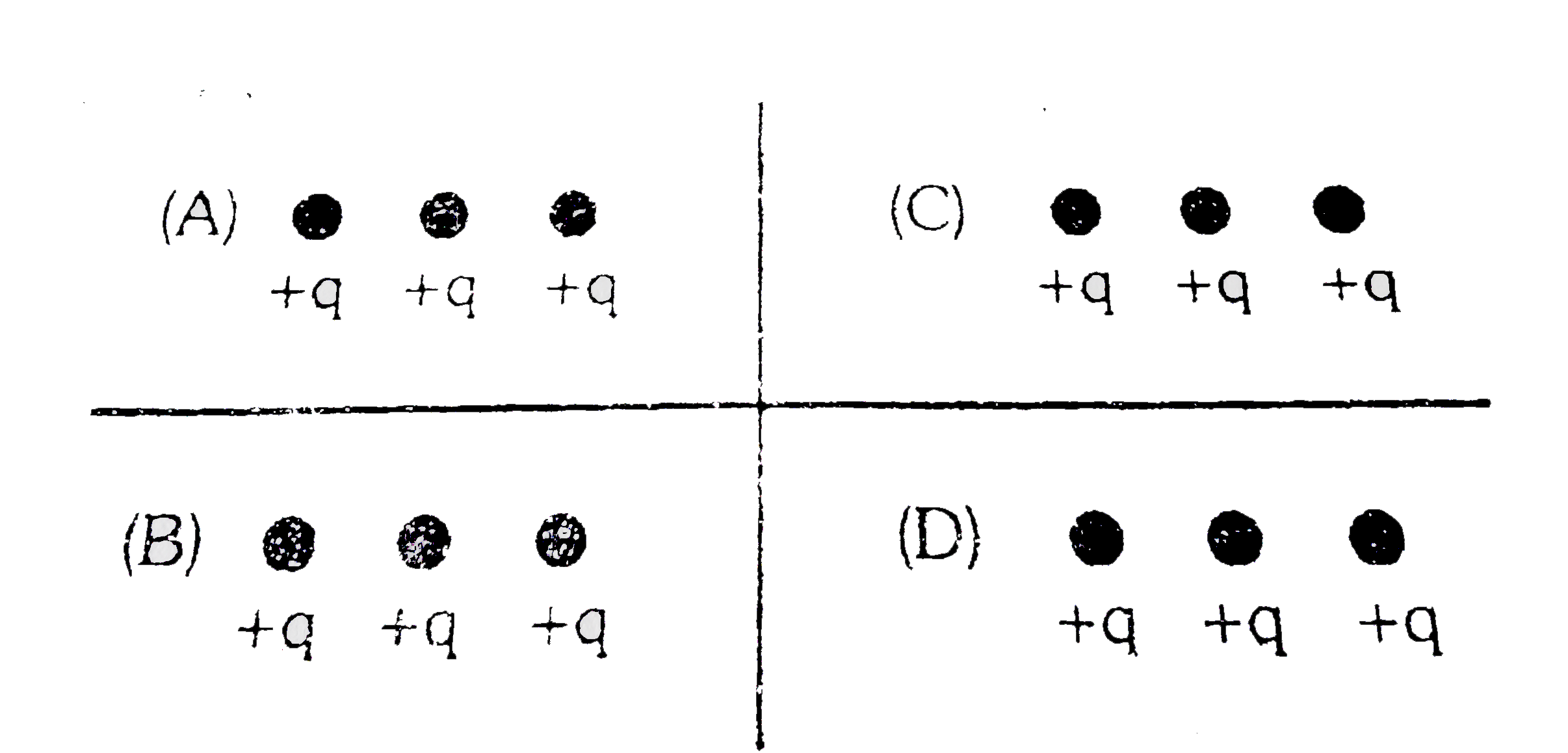
Rank the work required to assemble the charge distribution below from leats to greatest. In all cases, the separation between the middle charge and the outer charges are the same. Use a reference of zero potential energy at `oo`.

A

`A lt B lt C=D`

B

`C=D lt B lt A`

C

`A lt B=C=D`

D

`(B=C) lt ( D = A)`

Text Solution

Verified by Experts

The correct Answer is:
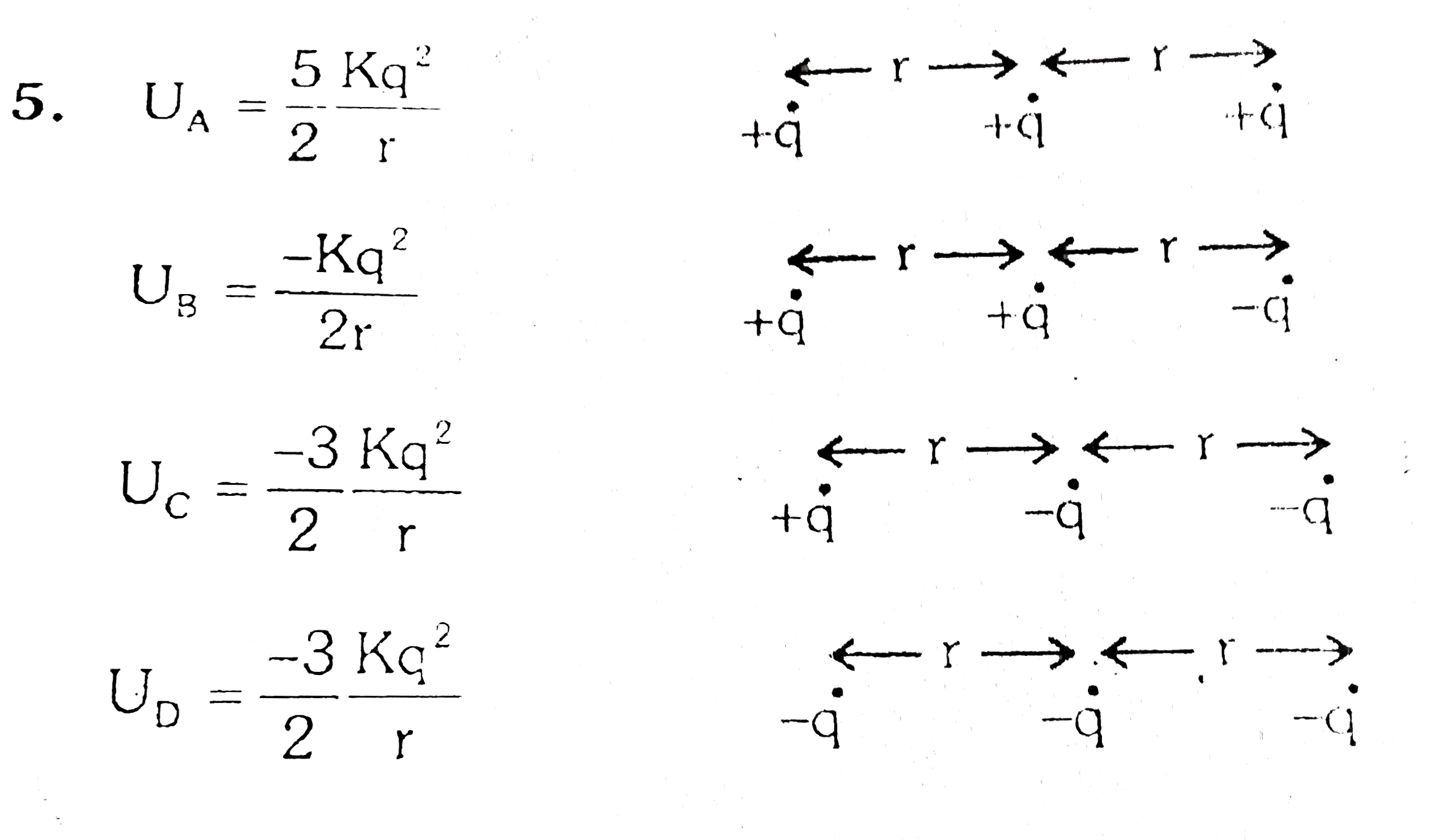
B

Promotional Banner

Topper's Solved these Questions

  • MISCELLANEOUS

    ALLEN |Exercise Exersice-03|7 Videos
  • MISCELLANEOUS

    ALLEN |Exercise ASSERTION-REASON|18 Videos
  • MISCELLANEOUS

    ALLEN |Exercise Part -II Example Some worked out Examples|1 Videos
  • KINEMATICS (MOTION ALONG A STRAIGHT LINE AND MOTION IN A PLANE)

    ALLEN |Exercise BEGINNER S BOX-7|8 Videos
  • PHYSICAL WORLD, UNITS AND DIMENSIONS & ERRORS IN MEASUREMENT

    ALLEN |Exercise EXERCISE-IV|7 Videos

Similar Questions

Explore conceptually related problems

How much work is required separate the two charges infinitely away from each other ?

In a hydrogen atom, the electron and proton are bound at a distance of about 0.53 Å (a) Estimate the potential energy of the system in eV, taking the zero of the potential energy at infinite separation of the electron from proton. (b) What is the minimum work required to free the electron, given that its kinetic energy in the orbit is half the magnitude of potential energy obtained in (a)? (c) What are the answers to (a) and (b) above if the zero of potential energy is taken at 1.06 Å separation?

If the work done to take 3 C electric charge from one point to another point is 15 J, what will be the potential difference between these two points?

Scientists are working hard to develop nuclear fusion reactor Nuclei of heavy hydrogen, _(1)^(2)H , known as deuteron and denoted by D , can be thought of as a candidate for fusion rector . The D-D reaction is _(1)^(2) H + _(1)^(2) H rarr _(2)^(1) He + n+ energy. In the core of fusion reactor, a gas of heavy hydrogen of _(1)^(2) H is fully ionized into deuteron nuclei and electrons. This collection of _1^2H nuclei and electrons is known as plasma . The nuclei move randomly in the reactor core and occasionally come close enough for nuclear fusion to take place. Usually , the temperature in the reactor core are too high and no material will can be used to confine the to plasma for a time t_(0) before the particles fly away from the core. If n is the density (number volume ) of deuterons , the product nt_(0) is called Lawson number. In one of the criteria , a reactor is termed successful if Lawson number is greater then 5 xx 10^(14) s//cm^(2) it may be helpfull to use the following boltzmann constant lambda = 8.6 xx 10^(-5)eV//k, (e^(2))/(4 pi s_(0)) = 1.44 xx 10^(-9) eVm Assume that two deuteron nuclei in the core of fusion reactor at temperature energy T are moving toward each other, each with kinectic energy 1.5 kT , when the seperation between them is large enough to neglect coulomb potential energy . Also neglate any interaction from other particle in the core . The minimum temperature T required for them to reach a separation of 4 xx 10^(-15) m is in the range

Scientists are working hard to develop nuclear fusion reactor Nuclei of heavy hydrogen, _(1)^(2)H , known as deuteron and denoted by D , can be thought of as a candidate for fusion rector . The D-D reaction is _(1)^(2) H + _(1)^(2) H rarr _(2)^(1) He + n+ energy. In the core of fusion reactor, a gas of heavy hydrogen of _(1)^(2) H is fully ionized into deuteron nuclei and electrons. This collection of _1^2H nuclei and electrons is known as plasma . The nuclei move randomly in the reactor core and occasionally come close enough for nuclear fusion to take place. Usually , the temperature in the reactor core are too high and no material will can be used to confine the to plasma for a time t_(0) before the particles fly away from the core. If n is the density (number volume ) of deuterons , the product nt_(0) is called Lawson number. In one of the criteria , a reactor is termed successful if Lawson number is greater then 5 xx 10^(14) s//cm^(2) it may be helpfull to use the following boltzmann constant lambda = 8.6 xx 10^(-5)eV//k, (e^(2))/(4 pi s_(0)) = 1.44 xx 10^(-9) eVm Assume that two deuteron nuclei in the core of fusion reactor at temperature energy T are moving toward each other, each with kinectic energy 1.5 kT , when the seperation between them is large enough to neglect coulomb potential energy . Also neglate any interaction from other particle in the core . The minimum temperature T required for them to reach a separation of 4 xx 10^(-15) m is in the range

An insulating solid sphere of radius R has a uniformaly positive charge density rho . As a result of this uniform charge distribution there is a finite value of electric potential at the centre of the sphere, at the surface of the sphere and also at a point out side the sphere. The electric potential at infinity is zero. Statement-1: Wgen a charge 'q' is taken from the centre to the surface of the sphere, its potential energy charges by (qrho)/(3 in_(0)) Statement-2 : The electric field at a distance r (r lt R) from the centre of the the sphere is (rho r)/(3in_(0))

The method of electrical images is used to solve the electrostatic problems, where charge distribution is not specified completely. The method consists of replacement of given charge distribution by a simplified charge distribution or a signal point charge or a number of point charges [rovided the original boundary conditions are still satisfied. For example consider a system consider a system containing a point charge q placed at a distance d of form an infinite conducting plane. The boundary conditions are : (i) Potential is zero at infinity (ii) Potential is zero at each point on the conducting plane If we replaced the conducting plane by a point charge (-q) placed at a distance 'd' opposite to conducting plane. The charge (-q) is called the electrical image. Now system consists of two charge +q an -q at seperation 2d . If charge +q moves to a distance 'y' from the boundary of conducting plane (now absent), the electrical image -q also moves to the same 'y' from the boundary of conducting plane, so that the new distance between +q and -q is 2y The potential energy of system of charge +q placed at a distance d from the earthed conducting plane is

The method of electrical images is used to solve the electrostatic problems, where charge distribution is not specified completely. The method consists of replacement of given charge distribution by a simplified charge distribution or a signal point charge or a number of point charges [rovided the original boundary conditions are still satisfied. For example consider a system consider a system containing a point charge q placed at a distance d of form an infinite conducting plane. The boundary conditions are : (i) Potential is zero at infinity (ii) Potential is zero at each point on the conducting plane If we replaced the conducting plane by a point charge (-q) placed at a distance 'd' opposite to conducting plane. The charge (-q) is called the electrical image. Now system consists of two charge +q an -q at seperation 2d . If charge +q moves to a distance 'y' from the boundary of conducting plane (now absent), the electrical image -q also moves to the same 'y' from the boundary of conducting plane, so that the new distance between +q and -q is 2y The work done in carrying charge q from distance d to distance y from earthed conducting plane is

The method of electrical images is used to solve the electrostatic problems, where charge distribution is not specified completely. The method consists of replacement of given charge distribution by a simplified charge distribution or a signal point charge or a number of point charges [rovided the original boundary conditions are still satisfied. For example consider a system consider a system containing a point charge q placed at a distance d of form an infinite conducting plane. The boundary conditions are : (i) Potential is zero at infinity (ii) Potential is zero at each point on the conducting plane If we replaced the conducting plane by a point charge (-q) placed at a distance 'd' opposite to conducting plane. The charge (-q) is called the electrical image. Now system consists of two charge +q an -q at seperation 2d . If charge +q moves to a distance 'y' from the boundary of conducting plane (now absent), the electrical image -q also moves to the same 'y' from the boundary of conducting plane, so that the new distance between +q and -q is 2y The force between point charge +q and earthed conducting plane is

Figures 2.8 (a) and (b) show the field lines of a positive and negative point charge respectively. (a) Give the signs of the potential difference V_(P)-V_(Q): V_(B)-V_(A) . (b) Give the sign of the potential energy difference of a small negative charge between the points Q and P, A and B. (c) Give the sign of the work done by the field in moving a small positive charge from Q to P. (d) Give the sign of the work done by the external agency in moving a small negative charge from B to A. (e) Does the kinetic energy of a small negative charge increase or decrease in going from B to A?

ALLEN -MISCELLANEOUS-Exercise-01
  1. A positive point charge 50mu C is located in the plane xy at a point w...

    Text Solution

    |

  2. Three point charges 1C, 2C and 3C are placed at the corners of an equi...

    Text Solution

    |

  3. Rank the work required to assemble the charge distribution below from ...

    Text Solution

    |

  4. The are AB with the centre C and infinitely long wire having linear ch...

    Text Solution

    |

  5. The diagram shows the electric field lines produced by an electrostali...

    Text Solution

    |

  6. As per this diagram a point charge +q is placed at the origin O. Work ...

    Text Solution

    |

  7. Two identical thin ring, each of radius R meters, are coaxially placed...

    Text Solution

    |

  8. Two identical particles of mass m carry a charge Q, each. Initially on...

    Text Solution

    |

  9. In a regular polygon of n sides, each corner is at a distance r from t...

    Text Solution

    |

  10. An alpha particle of energy 5 MeV is scattered through 180^(@) by a fi...

    Text Solution

    |

  11. A charge 3 coulomb experiences a force 300 N when placed in a uniform ...

    Text Solution

    |

  12. Uniform electric field of magnitude 100 V//m in space is directed alon...

    Text Solution

    |

  13. The equation of an equipotential line in an electric field is y = 2 x...

    Text Solution

    |

  14. In a certain region of space, the potential is given by V=k(2x^(2)-y^(...

    Text Solution

    |

  15. Figure shown two equipotential lies x, y plane for an electric field. ...

    Text Solution

    |

  16. The electric potential V(z, y,z) for a planar charge distribution is g...

    Text Solution

    |

  17. Three equal charges are placed at the corners of an equilateral triang...

    Text Solution

    |

  18. A non-conducting ring of radius 0.5 m carries a total charge 1.11xx10^...

    Text Solution

    |

  19. Two point charges +q and -q are held fixed at (-d,o) and (d,0) respect...

    Text Solution

    |

  20. The work in rotating electric dipole of dipole moment p in an electric...

    Text Solution

    |

