Home
Class 11
PHYSICS
Column-I show graph of electric potentia...

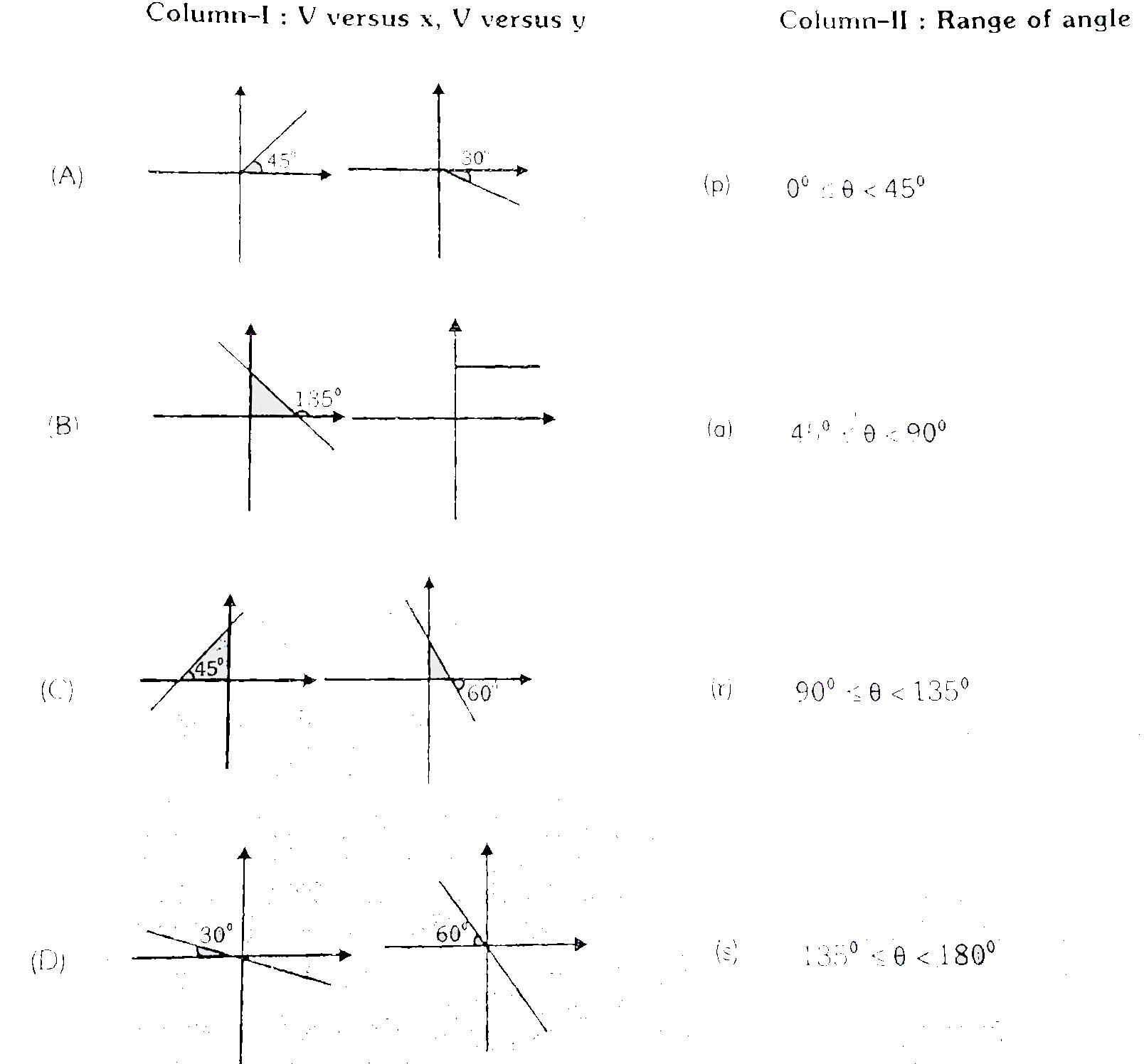
Column-I show graph of electric potential V versus x and y in a certain region for four situations. Column-II shows the range of angle which the electric field vector makes with positive x-direction

Text Solution

Verified by Experts

The correct Answer is:

(A) s, (B) p, (C) r, (D) q

Electric field `vec(E)=-(del V)/(delx)hat(i)-(delV)/(dely)hat(j)`
For (A): `vec(E)=-hat(i)+1/sqrt(3)hat(j)`
For (B): `vec(E)=+hat(i)`
For (C): `vec(E)=-hat(i)+sqrt(3)hat(j)`
For (D): `vec(E)=+1/sqrt(3)hat(i)+sqrt(3)hat(j)`
Promotional Banner

Topper's Solved these Questions

  • MISCELLANEOUS

    ALLEN |Exercise ASSERTION-REASON|18 Videos
  • MISCELLANEOUS

    ALLEN |Exercise Comprehension 1|5 Videos
  • MISCELLANEOUS

    ALLEN |Exercise Exercise-01|87 Videos
  • KINEMATICS (MOTION ALONG A STRAIGHT LINE AND MOTION IN A PLANE)

    ALLEN |Exercise BEGINNER S BOX-7|8 Videos
  • PHYSICAL WORLD, UNITS AND DIMENSIONS & ERRORS IN MEASUREMENT

    ALLEN |Exercise EXERCISE-IV|7 Videos

Similar Questions

Explore conceptually related problems

Column I shows different charge distributions and short electric dipole at a distance x from the charge distributions. Column II gives the dependence of force acting on the dipole as of function of x.

Column -I shows different situations in which an object O is shown in front of the optical element. Column-II gives the corresponding velocity vector of the image of the object. Object is moving with velocity v and diverging mirror is moving with velocity 2v

A graph of the x-component of the electric field as a function of x in a region of space is shown in figure. The y- and z-components of the electric field are zero in this region. If the electric potential is 10 V at the origin, then the potential at x = 2.0 m is

Column-I shows different charge distributions. Cloumn-II gives corresponding electric dipole moments.

The alectric potential in a region is given by the relation V(x)=4+5x^(2) . If a dipole is placed at position (-1, 0) with dipole moment vec(p) pointing along positive Y-direction, then

In a certain region of space, the potential is given by V=k(2x^(2)-y^(2)+z^(2)) . The electric field at the point (1, 1, 1) has magnitude:

The potential at a point x ( measured in mu m) due to some charges situated on the x-axis is given by V(x)=20//(x^2-4) vol t the electric field at x=4 mu m is given by

A circus wishes to develop a new clown act. Fig. (1) shows a diagram of the proposed setup. A clown will be shot out of a cannot with velocity v_(0) at a trajectory that makes an angle theta=45^(@) with the ground. At this angile, the clown will travell a maximum horizontal distance. The cannot will accelerate the clown by applying a constant force of 10, 000N over a very short time of 0.24s . The height above the ground at which the clown begins his trajectory is 10m . A large hoop is to be suspended from the celling by a massless cable at just the right place so that the clown will be able to dive through it when he reaches a maximum height above the ground. After passing through the hoop he will then continue on his trajectory until arriving at the safety net. Fig (2) shows a graph of the vertical component of the clown's velocity as a function of time between the cannon and the hoop. Since the velocity depends on the mass of the particular clown performing the act, the graph shows data for serveral different masses. If a clown holds on to hoop instead of passing through it, what is the position of the cable so that he doesn't hit his head on the ceiling as he swings upward?

In a certain region, the electric potential is given by the formula V(x ,y, z) = 6xy - y + 2yz Find the components of electric field and the vector electric field at point (1, 1, 0) in this field. Find the vector of electric at (1, 1, 0).

A V - X graph for an electric field in X-direction is shown in the figure. In which region is the magnitude of electric field maximum ? (a) A (b) B (c) C (d) D
