The sketech below show cross secion so equipotential surfaces between two charged.Conductors that are shwon in solid black.Some points on the wquipotenital surfaces .near the conductors are marked as `A,B,C…. .` The arrangements lies in air (Take `epsilon_(0)=8.85xx10^(-12)C^(2)//Nm^(2)]`
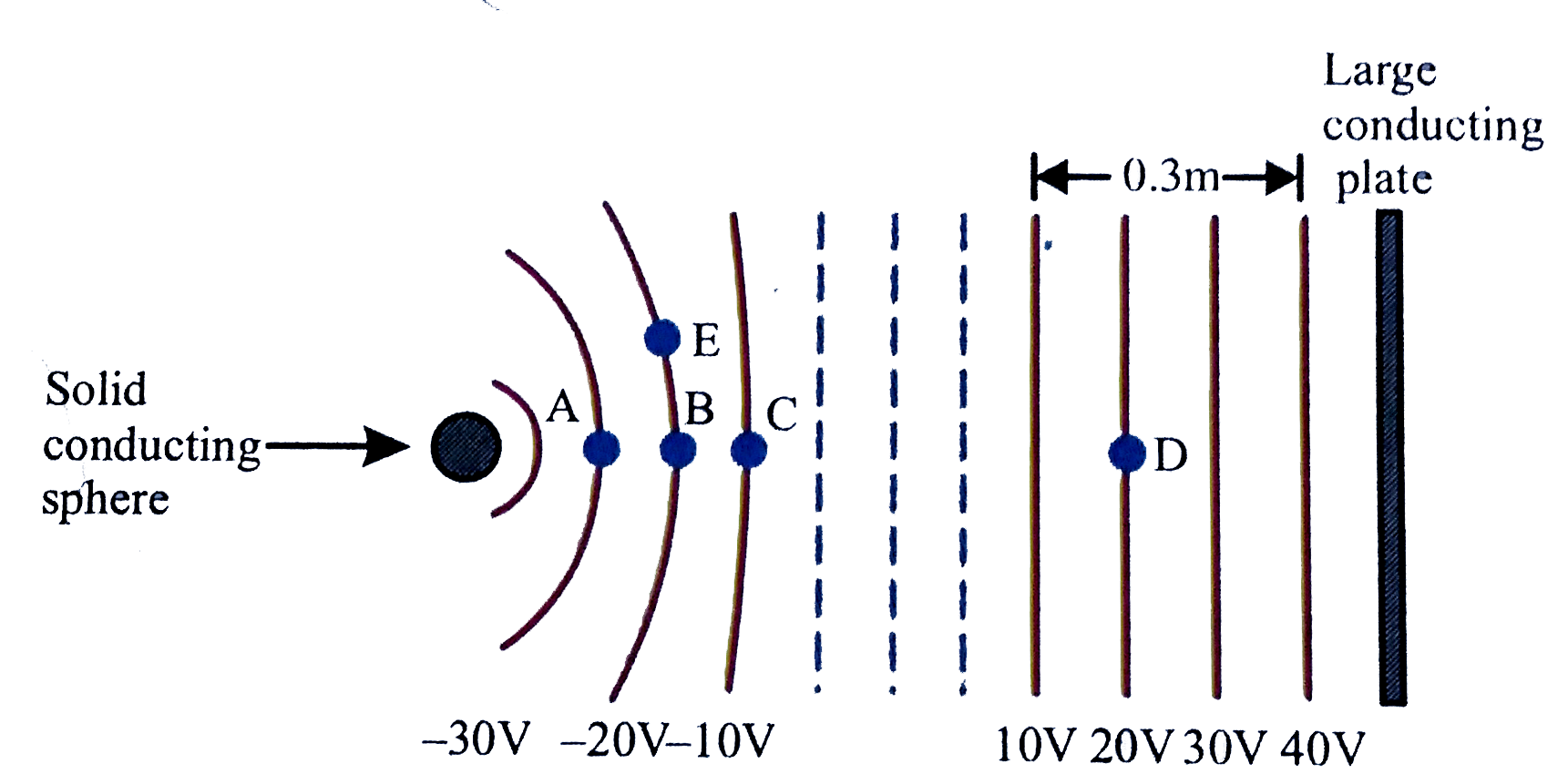
A positive charge is placed at `B`,When it is released:
The sketech below show cross secion so equipotential surfaces between two charged.Conductors that are shwon in solid black.Some points on the wquipotenital surfaces .near the conductors are marked as `A,B,C…. .` The arrangements lies in air (Take `epsilon_(0)=8.85xx10^(-12)C^(2)//Nm^(2)]`
A positive charge is placed at `B`,When it is released:
A positive charge is placed at `B`,When it is released:
A
no force will be exerted on it
B
it will move towards A
C
it will move towards C
D
it will move towards E
Text Solution
Verified by Experts
The correct Answer is:
B
Positive charge has a tendency to move from higher potential to lower potential hence it will move from `B (-20 V)` to `A(-30V)`.



Topper's Solved these Questions
MISCELLANEOUS
ALLEN |Exercise Comprehension 7|3 VideosMISCELLANEOUS
ALLEN |Exercise Comprehension 8|4 VideosMISCELLANEOUS
ALLEN |Exercise Comprehension 5|5 VideosKINEMATICS (MOTION ALONG A STRAIGHT LINE AND MOTION IN A PLANE)
ALLEN |Exercise BEGINNER S BOX-7|8 VideosPHYSICAL WORLD, UNITS AND DIMENSIONS & ERRORS IN MEASUREMENT
ALLEN |Exercise EXERCISE-IV|7 Videos
Similar Questions
Explore conceptually related problems
The sketch below show cross section so equipotential surfaces between two charged.Conductors that are shown in solid black.Some points on the equipotenital surfaces .near the conductors are marked as A,B,C…. . The arrangements lies in air (Take epsilon_(0)=8.85xx10^(-12)C^(2)//Nm^(2)] Surfaces charge density of the plate is equal to
The sketch below shows cross-sections of equipotential surface between two charged conductors that are shown in solid black. Some points one the euquipotential surface near the conductors are marked as A, B, C ………. The arrangement lies in air. ["Take " in_(0)=8.85xx10^(-12) C^(2)//N m^(2)] How much work is required to slowly move a -1 mu C charge from E to D?
Find E_(0), B_(0) , intensity I and force exerted on surface for a spherical surface 20 m away from the point source bulb of 2000 W. Efficiency of bulb is 2% and consider the bulb as point source. (epsilon_(0)=8.85xx10^(-12)SI and c=3xx10^(8)ms^(-1))
The maximum electric field at a distance of 10m from an isotropic point source of light is 3.0 Vm^(-1) . Calculate (a) the maximum value of magnetic field, (b) average intensity of light at that place and (c ) the power of the source. [c=3xx10^(8)ms^(-1), epsilon_(0)=8.854xx10^(-12)C^(2)N^(-1)m^(-2)]
Two metallic plate A and B , each of area 5 xx 10^(-4)m^(2) , are placed parallel to each at a separation of 1 cm plate B carries a positive charge of 33.7 xx 10^(-12) C A monocharonatic beam of light , with photoes of energy 5 eV each , starts falling on plate A at t = 0 so that 10^(16) photons fall on it per square meter per second. Assume that one photoelectron is emitted for every 10^(6) incident photons fall on it per square meter per second. Also assume that all the emitted photoelectrons are collected by plate B and the work function of plate A remain constant at the value 2 eV Determine (a) the number of photoelectrons emitted up to i = 10s, (b) the magnitude of the electron field between the plate A and B at i = 10 s, and (c ) the kinetic energy of the most energotic photoelectrons emitted at i = 10 s whenit reaches plate B Negilect the time taken by the photoelectrons to reach plate B Take epsilon_(0) = 8.85 xx 10^(-12)C^(2)N- m^(2)
Two insulating plates arc both uniformly charged in such a way that the potential difference between them is V_(2) - V_(1) = 20V (i.e. plate 2 is at a higher potential). The plate are separated by d = 0.1m and can be treated as infinitely large. An electron is released from rest on the inner surface of plate 1. What is its speed when it hits plate 2 ? (e = 1.6xx10^(-19) C m_(e)= 9.11xx10^(-31) kg )
Thin films, including soap bubbles and oil show patterns of alternative dark and bright regions resulting from interference among the reflected ligth waves. If two waves are in phase, their crests and troughs will coincide. The interference will be cosntructive and the amlitude of resultant wave will be greater then either of constituent waves. If the two wave are not of phase by half a wavelength (180^(@)) , the crests of one wave will coincide width the troughs of the other wave. The interference will be destructive and the ampliutde of the resultant wave will be less than that of either consituent wave. 1. When incident light I, reaches the surface at point a, some of the ligth is reflected as ray R_(a) and some is refracted following the path ab to the back of the film. 2. At point b, some of the light is refracted out of the film and part is reflected back through the film along path bc. At point c, some of the light is reflected back into the film and part is reflected out of the film as ray R_(c) . R_(a) and R_(c) are parallel. However, R_(c) has travelled the extra distance within the film fo abc. If the angle of incidence is small, then abc is approxmately twice the film's thickness . If R_(a) and R_(c) are in phase, they will undergo constructive interference and the region ac will be bright. If R_(a) and R_(c) are out of phase, they will undergo destructive interference and the region ac will be dark. I. Refraction at an interface never changes the phase of the wave. II. For reflection at the interfere between two media 1 and 2, if n_(1) gt n_(2) , the reflected wave will change phase. If n_(1) lt n_(2) , the reflected wave will not undergo a phase change. For reference, n_(air) = 1.00 . III. If the waves are in phase after reflection at all intensities, then the effects of path length in the film are: Constrictive interference occurs when 2 t = m lambda // n, m = 0, 1,2,3 ,... Destrcutive interference occurs when 2 t = (m + (1)/(2)) (lambda)/(n) , m = 0, 1, 2, 3 ,... If the waves are 180^(@) out of the phase after reflection at all interference, then the effects of path length in the film ara: Constructive interference occurs when 2 t = (m + (1)/(2)) (lambda)/(n), m = 0, 1, 2, 3 ,... Destructive interference occurs when 2 t = (m lambda)/(n) , m = 0, 1, 2, 3 ,... A soap film of thickness t is surrounded by air and is illuminated at near normal incidence by monochromatic light wavelength lambda in the film. With respect to the wavelength of the monochromatic ligth in the film, what film thickness will produce maximum consturctive interference
Thin films, including soap bubbles and oil show patterns of alternative dark and bright regions resulting from interference among the reflected light waves. If two waves are in phase, their crests and troughs will coincide. The interference will be constructive and the amplitude of resultant wave will be greater then either of constituent waves. If the two wave are not of phase by half a wavelength (180^(@)) , the crests of one wave will coincide width the troughs of the other wave. The interference will be destructive and the amplitude of the resultant wave will be less than that of either constiuent wave. 1. When incident light I, reaches the surface at point a, some of the light is reflected as ray R_(a) and some is refracted following the path ab to the back of the film. 2. At point b, some of the light is refracted out of the film and part is reflected back through the film along path bc. At point c, some of the light is reflected back into the film and part is reflected out of the film as ray R_(c) . R_(a) and R_(c) are parallel. However, R_(c) has traveled the extra distance within the film of abc. If the angle of incidence is small, then abc is approximately twice the film's thickness . If R_(a) and R_(c) are in phase, they will undergo constructive interference and the region ac will be bright. If R_(a) and R_(c) are out of phase, they will undergo destructive interference and the region ac will be dark. I. Refraction at an interface never changes the phase of the wave. II. For reflection at the interfere between two media 1 and 2, if n_(1) gt n_(2) , the reflected wave will change phase. If n_(1) lt n_(2) , the reflected wave will not undergo a phase change. For reference, n_(air) = 1.00 . III. If the waves are in phase after reflection at all intensities, then the effects of path length in the film are: Constrictive interference occurs when 2 t = m lambda // n, m = 0, 1,2,3 ,... Destructive interference occurs when 2 t = (m + (1)/(2)) (lambda)/(n) , m = 0, 1, 2, 3 ,... If the waves are 180^(@) out of the phase after reflection at all interference, then the effects of path length in the film area: Constructive interference occurs when 2 t = (m + (1)/(2)) (lambda)/(n), m = 0, 1, 2, 3 ,... Destructive interference occurs when 2 t = (m lambda)/(n) , m = 0, 1, 2, 3 ,... 72. A film with index of refraction 1.50 coats a glass lens with index of refraction 1.80. What is the minimum thickness of the thin film that will strongly reflect light with wavelength 600 nm?
Thin films, including soap bubbles and oil show patterns of alternative dark and bright regions resulting from interference among the reflected ligth waves. If two waves are in phase, their crests and troughs will coincide. The interference will be cosntructive and the amlitude of resultant wave will be greater then either of constituent waves. If the two wave are not of phase by half a wavelength (180^(@)) , the crests of one wave will coincide width the troughs of the other wave. The interference will be destructive and the ampliutde of the resultant wave will be less than that of either consituent wave. 1. When incident light I, reaches the surface at point a, some of the ligth is reflected as ray R_(a) and some is refracted following the path ab to the back of the film. 2. At point b, some of the light is refracted out of the film and part is reflected back through the film along path bc. At point c, some of the light is reflected back into the film and part is reflected out of the film as ray R_(c) . R_(a) and R_(c) are parallel. However, R_(c) has travelled the extra distance within the film fo abc. If the angle of incidence is small, then abc is approxmately twice the film's thickness . If R_(a) and R_(c) are in phase, they will undergo constructive interference and the region ac will be bright. If R_(a) and R_(c) are out of phase, they will undergo destructive interference and the region ac will be dark. I. Refraction at an interface never changes the phase of the wave. II. For reflection at the interfere between two media 1 and 2, if n_(1) gt n_(2) , the reflected wave will change phase. If n_(1) lt n_(2) , the reflected wave will not undergo a phase change. For reference, n_(air) = 1.00 . III. If the waves are in phase after reflection at all intensities, then the effects of path length in the film are: Constrictive interference occurs when 2 t = m lambda // n, m = 0, 1,2,3 ,... Destrcutive interference occurs when 2 t = (m + (1)/(2)) (lambda)/(n) , m = 0, 1, 2, 3 ,... If the waves are 180^(@) out of the phase after reflection at all interference, then the effects of path length in the film ara: Constructive interference occurs when 2 t = (m + (1)/(2)) (lambda)/(n), m = 0, 1, 2, 3 ,... Destructive interference occurs when 2 t = (m lambda)/(n) , m = 0, 1, 2, 3 ,... A thin film with index of refraction 1.33 coats a glass lens with index of refraction 1.50. Which of the following choices is the smallest film thickness that will not reflect light with wavelength 640 nm?