Home
Class 11
PHYSICS
Consider the configuration of a system o...

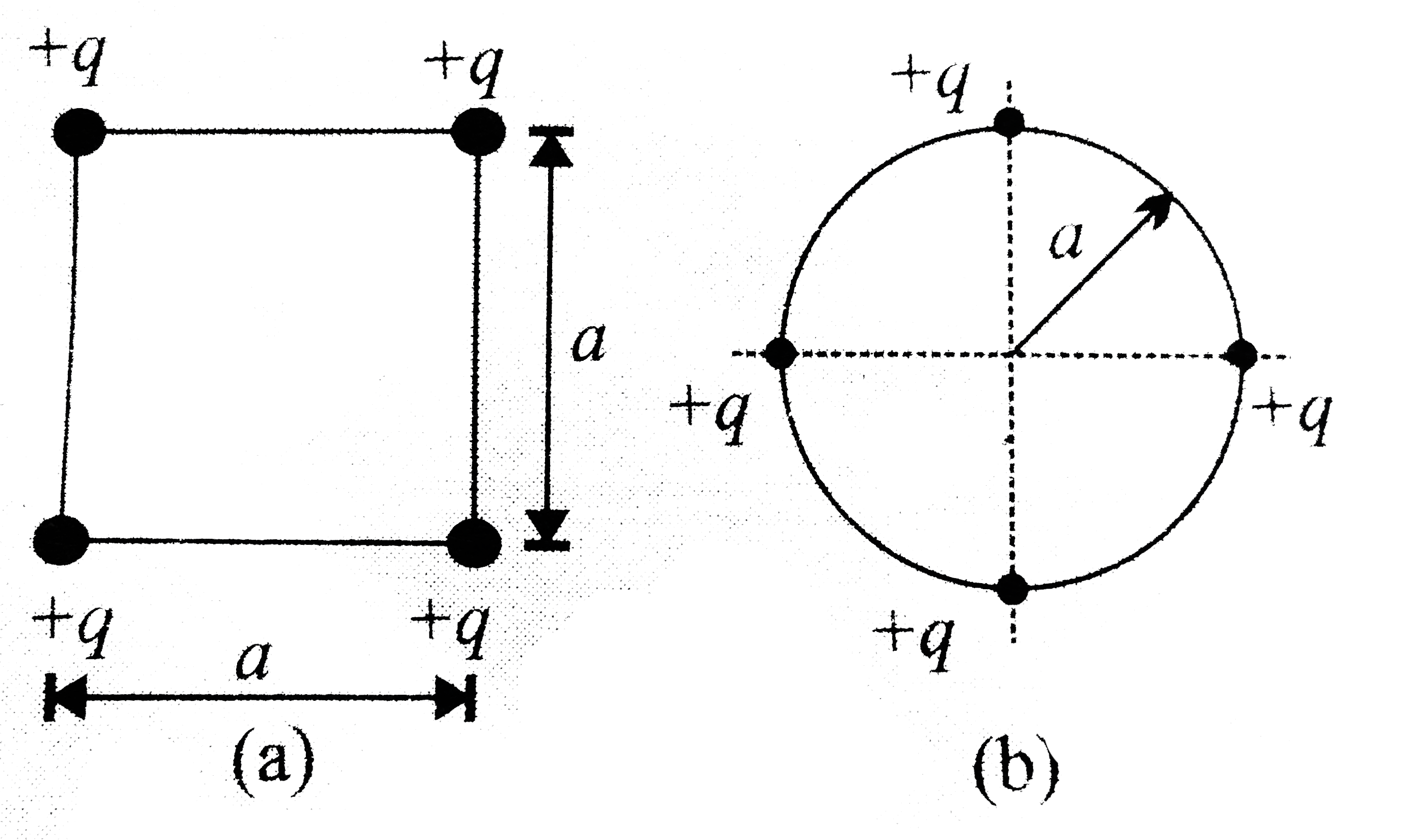
Consider the configuration of a system of four charges each of value (+q). Find the work done by external agent in changing the configuration of the system from (Fig. 3.44 A) to (Fig. 3.4B).
a. ,

Text Solution

Verified by Experts

The correct Answer is:

`(-Kq^(2))/a (3-sqrt(2))`

`U_("total")=U_(12)+U_(13)+U_(14)+U_(23)+U_(24)+U_(34)`
`U_("initial")=(Kq^(2))/a+(Kq^(2))/a+(Kq^(2))/(sqrt(2)a)+(Kq^(2))/a+(Kq^(2))/(sqrt(2)a)+(Kq^(2))/a`
`U_("final")=(Kq^(2))/(sqrt(2)a)+(Kq^(2))/(sqrt(2)a)+(Kq^(1))/(sqrt(2)a)+(Kq^(2))/(2a)+(Kq^(2))/(sqrt(2)a)`
`DeltaU=U_(f)-U_(i)=-(3-sqrt(2))(Kq^(2))/a`
Promotional Banner

Topper's Solved these Questions

  • MISCELLANEOUS

    ALLEN |Exercise Exersice-04[B]|16 Videos
  • MISCELLANEOUS

    ALLEN |Exercise Exercise-05(A)|35 Videos
  • MISCELLANEOUS

    ALLEN |Exercise Comprehension 9|2 Videos
  • KINEMATICS (MOTION ALONG A STRAIGHT LINE AND MOTION IN A PLANE)

    ALLEN |Exercise BEGINNER S BOX-7|8 Videos
  • PHYSICAL WORLD, UNITS AND DIMENSIONS & ERRORS IN MEASUREMENT

    ALLEN |Exercise EXERCISE-IV|7 Videos

Similar Questions

Explore conceptually related problems

Figures 2.8 (a) and (b) show the field lines of a positive and negative point charge respectively. (a) Give the signs of the potential difference V_(P)-V_(Q): V_(B)-V_(A) . (b) Give the sign of the potential energy difference of a small negative charge between the points Q and P, A and B. (c) Give the sign of the work done by the field in moving a small positive charge from Q to P. (d) Give the sign of the work done by the external agency in moving a small negative charge from B to A. (e) Does the kinetic energy of a small negative charge increase or decrease in going from B to A?

1 mu C charge is shifted from A to B and it is found that work done by external force is 80 mu J against electrostic forces, find V_(A)-V_(B)

Four bodies each of mass m are placed at the different corners of a square of side a. find the work done on the system to take any one budy to infinity.

A cord of negligible mass is wound round the rim of a fly wheel of mass 20 kg and radius 20 cm. A steady pull of 25 N is applied on the cord as shown in Fig. 7.35. The flywheel is mounted on a horizontal axle with frictionless bearings. (a) Compute the angular acceleration of the wheel. (b) Find the work done by the pull, when 2m of the cord is unwound. (c) Find also the kinetic energy of the wheel at this point. Assume that the wheel starts from rest. (d) Compare answers to parts (b) and (c).

A gaseous system absorbs 450 cal heat. The work done by the system is 836.2 J. Find the change in internal energy of the gas in calorie. (J=4.186 J "cal"^(-1) )

Conisder a system of three charges q//3 , q//3 and -2q//3 placed at point A, B and C, respectively, as shown in the figure. Take O to be centre of the circle of radius R and angle CAB=60^@

Four particles of masses m, 2m, 3m, 4m are placed at corners of a square of side 'a' as shown in fig. Find out coordinateds of centre of mass.

Two fixed, identical conducting plates (a and (3), each of surface area S are charged to - Q and q, respectively, where Q > q > 0. A third identical plate ( lambda ), free to move Is located on the other side of the plate with charge q at a distance d as per figure. The third plate is released and collides with the plate f_3 . Assume the collision is elastic and the time of collision is sufficient to redistribute charge amongst beta and gamma . (a) Find the electric field acting on the plate gamma before collision. (b) Find the charges on beta and gamma after the collision. (c) Find the velocity of the plate gamma after the collision and at a distance d from the plate beta

Consider the situation in figure. The bottom of the pot is reflecting plane mirror , S is small fish is a human eye . Refractive index of water is mu . Fish can see two images of human eye , first due to refractive only and other due to refraction and than reflection . Distance of these images from fish are S_(1) "and" S_(2) respectively . Human eye can also see the two images of fish, first due to refraction only and other due to reflection and then refraction . Distance of these images from human eye are S_(3) "and" S_(4) respectively . Match the quantities of column-I (with their value in column-(II) {:("Column I","Column II"),((A) S_(1),(p)H[1 + (1)/(2mu)]),((B)S_(2),(q) H[mu + (1)/(2)]),((C)S_(3) , (r) H[1 + (3)/(2mu)]) , ((D) S_(4) , (s) H[mu + (3)/(2)]):}

ALLEN -MISCELLANEOUS-Exersice-04[A]
  1. In the figure shown S is a large nonconducting sheet of uniform charge...

    Text Solution

    |

  2. root(4)(16)xxroot(4)(2) is equal t :-

    Text Solution

    |

  3. Consider the configuration of a system of four charges each of value (...

    Text Solution

    |

  4. Which of the following has different dimensional formula ?

    Text Solution

    |

  5. Which of the following has different dimensional formula ?

    Text Solution

    |

  6. root(5)(64)××root(6)(2) is equal to :-

    Text Solution

    |

  7. Three point charges q, 2q and 8q are to be placed on a . 9cm long st...

    Text Solution

    |

  8. A charge +Q is uniformly distributed over a thin ring with radius R....

    Text Solution

    |

  9. A simple pendulum of length l and bob mass m is hanging in front of a ...

    Text Solution

    |

  10. Two fixed, equal, positive charges, each of magnitude 5xx10^-5 coul ar...

    Text Solution

    |

  11. Positive and negative charges of 1 muC each are placed at two points a...

    Text Solution

    |

  12. what is the dimensional formula of angular acceleration and angular ve...

    Text Solution

    |

  13. what is the dimensional formula of the angular momentum? also find the...

    Text Solution

    |

  14. A dipole is placed at origin of coordinate system as shown in figure, ...

    Text Solution

    |

  15. Two short dipoles phat(k) and P/2 hat(k) are located at (0,0,0) & (1m,...

    Text Solution

    |

  16. Show that, for a given dipole, V & E cannot have the same magnitude at...

    Text Solution

    |

  17. The length of each side of a cubical closed surface is l If charge q i...

    Text Solution

    |

  18. A point charge Q is located on the axis of a disc of radius R at a dis...

    Text Solution

    |

  19. A charge Q is uniformly distributed over a rod of length l. Consider a...

    Text Solution

    |

  20. A particle of mass m and charge -q moves along a diameter of a uniform...

    Text Solution

    |
