Home
Class 11
PHYSICS
A non-conducting solid sphere of radius ...

A non-conducting solid sphere of radius R is uniformly charged. The magnitude of the electric filed due to the sphere at a distance r from its centre

A

increases as r increases for `r lt R`

B

decreases as r increases for `0 lt r lt oo`

C

decreases as r increases for `R lt r lt oo`

D

is discontinuous at `r=R`

Text Solution

Verified by Experts

The correct Answer is:
A, C

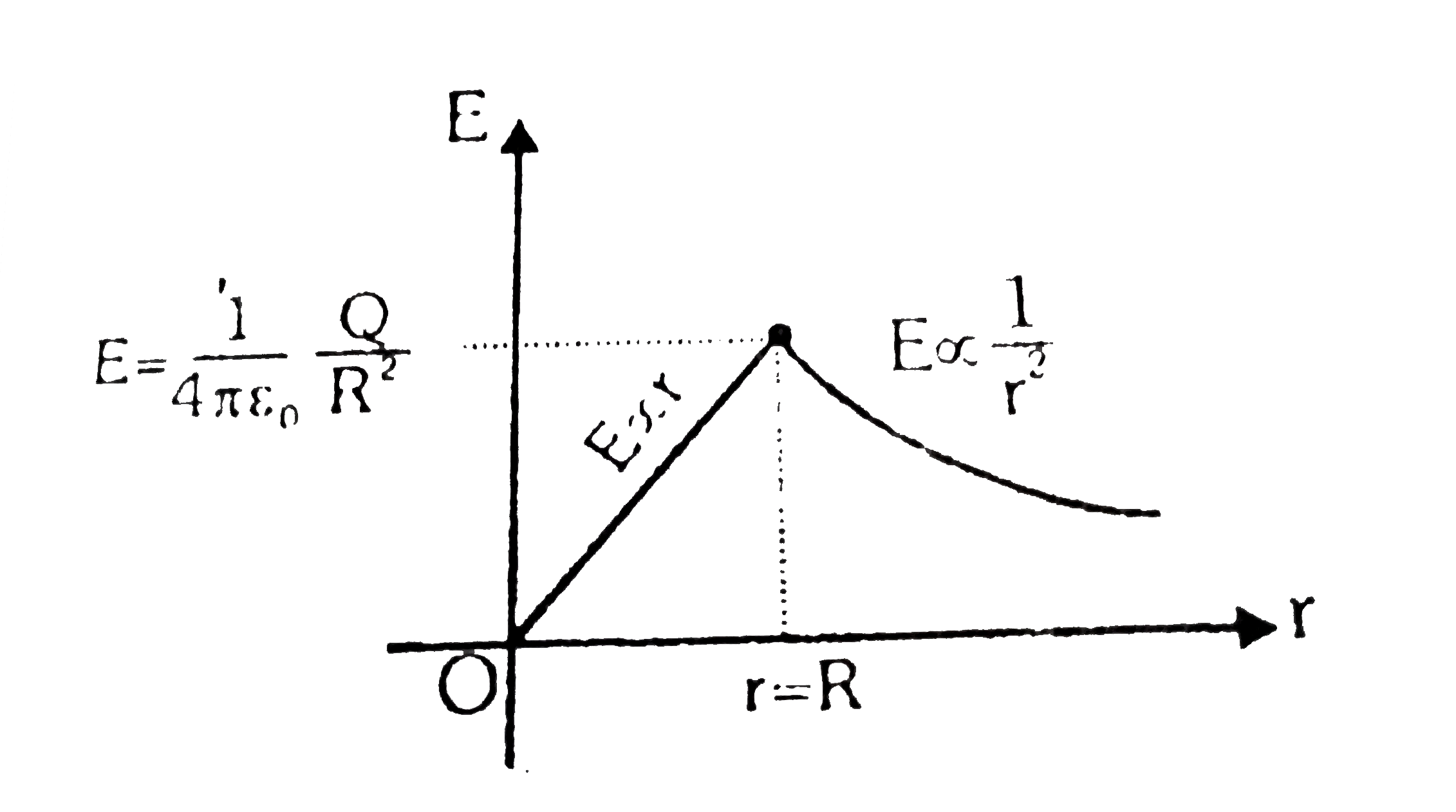
Inside the sphere `E=1/(4pi epsilon_(0)).Q/R^(3)r rArr E prop r` for `r le R`
i.e., E at centre `=0 (r=0)`
and E at surface `=1/(4pi epsilon_(0)).Q/r^(2)(r=R)`
Outside the sphere `E=1/(4piepsilon_(0))Q/r^(2)(r ge R)` or `E prop 1/r^(2)`
Thus, variation of electric field (E) with distance (r) from the centre will be as follows:
Promotional Banner

Topper's Solved these Questions

  • MISCELLANEOUS

    ALLEN |Exercise REASONING TYPE|1 Videos
  • MISCELLANEOUS

    ALLEN |Exercise MATCH THE COLUME TYPE|1 Videos
  • MISCELLANEOUS

    ALLEN |Exercise Exercise-05(B)|19 Videos
  • KINEMATICS (MOTION ALONG A STRAIGHT LINE AND MOTION IN A PLANE)

    ALLEN |Exercise BEGINNER S BOX-7|8 Videos
  • PHYSICAL WORLD, UNITS AND DIMENSIONS & ERRORS IN MEASUREMENT

    ALLEN |Exercise EXERCISE-IV|7 Videos

Similar Questions

Explore conceptually related problems

A hollow metal sphere of radius R is uniformly charged. The electric field due to the sphere at a distance r from the centre

A point charge Q is placed at the centre of a spherical conducting shell. A total charge of -q is placed on the shell. The magnitude of the electric field at point P_1 at a distance R_1 from the centre is X. The magnitude of the electric field due to induced charges at point P_2 a distance R_2 from the centre is Y. The values of X and Y are respectively.

A conducting sphere of radius R is given a charge Q. The electric potential and the electric field at the centre of the sphere respectively are

Let P(r)=(Q)/(piR^4)r be the charge density distribution for a solid sphere of radius R and total charge Q. For a point 'p' inside the sphere at distance r_1 from the centre of the sphere, the magnitude of electric field is:

A conducting sphere of radius 10 cm has an unknown charge if the electric field 20 cm from the centre of the sphere is 1.5 xx10^(3) N/C and points radialy inward what is the net charge on the sphere

Two non-conducting solid spheres of radii R and 2R, having uniform volume charge densities rho_1 and rho_2 respectively, touch each other. The net electric field at a distance 2R from the centre of the smaller sphere, along the line joining the centres of the spheres, is zero. The ratio rho_1/rho_2 can be

If the potential at the center of a uniformly charged sphere of radius R is V then electric field at a distance r from the center of sphere will be ( r lt R ) : -

The electric field due to a uniformly charged sphere is maximum at :

Charges Q, 2Q and 4Q are uniformly distributed in three dielectric solid spheres 1, 2 and 3 of radii R//2 , R and 2R respectively, as shown in figure. If magnitude of the electric fields at point P at a distance R from the centre of sphere 1,2 and 3 are E_1, E_2 and E_3 respectively, then

A cavity of radius R//2 is made inside a solid sphere of radius R . The centre of the cavity is located at a distance R//2 from the centre of the sphere. The gravitational force on a particle of a mass 'm' at a distance R//2 from the centre of the sphere on the line joining both the centres of sphere and cavity is (opposite to the centre of cavity). [Here g=GM//R^(2) , where M is the mass of the solide sphere]

