Home
Class 11
PHYSICS
The nuclear charge (Ze) is non uniformll...

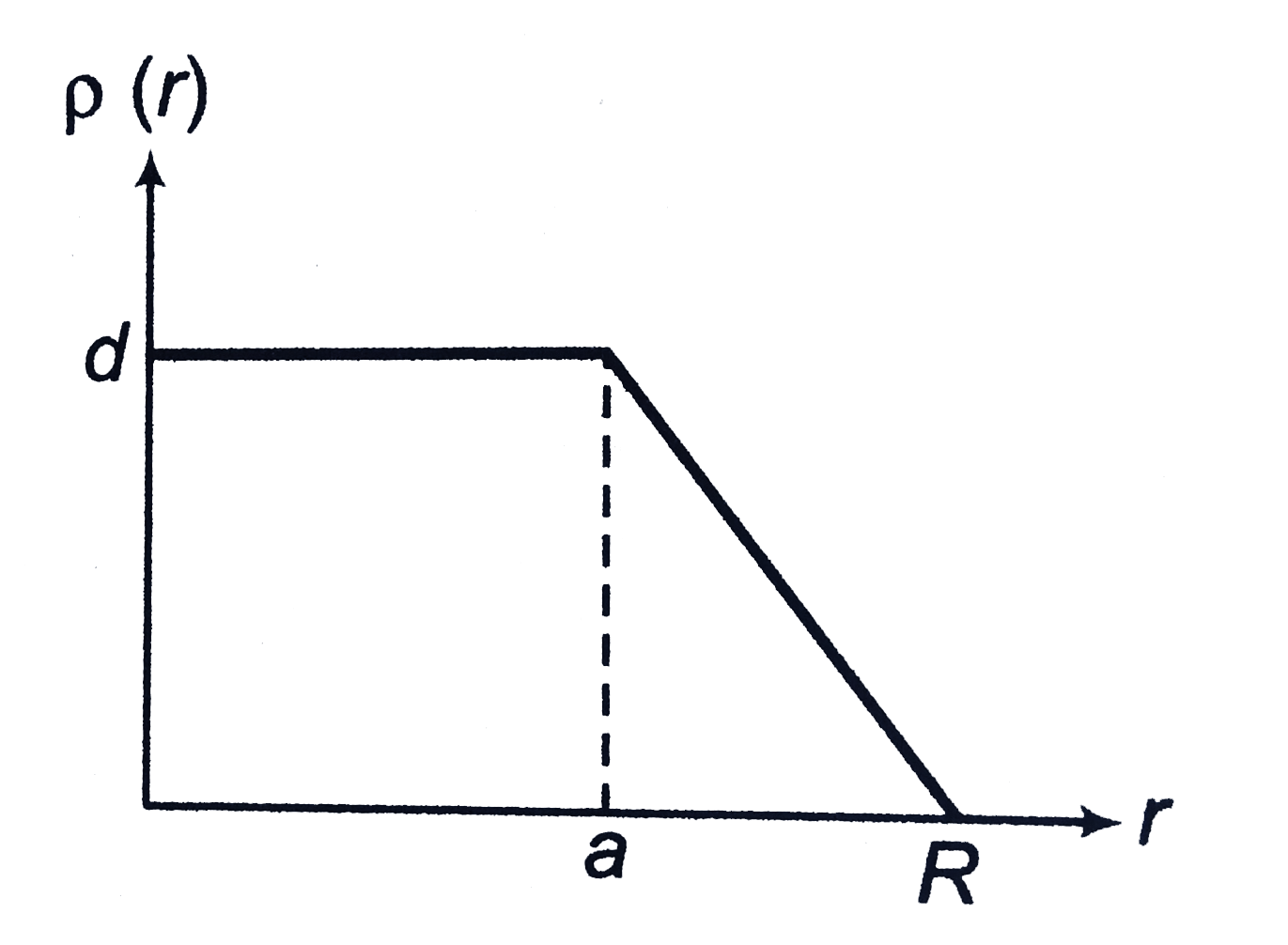
The nuclear charge (`Ze`) is non uniformlly distribute with in a nucleus of radius `r`. The charge density `rho(r)` (charge per unit volume) is dependent only on the radial distance r form the centre of the nucleus s shown in figure. The electric field is only along the radial direction.

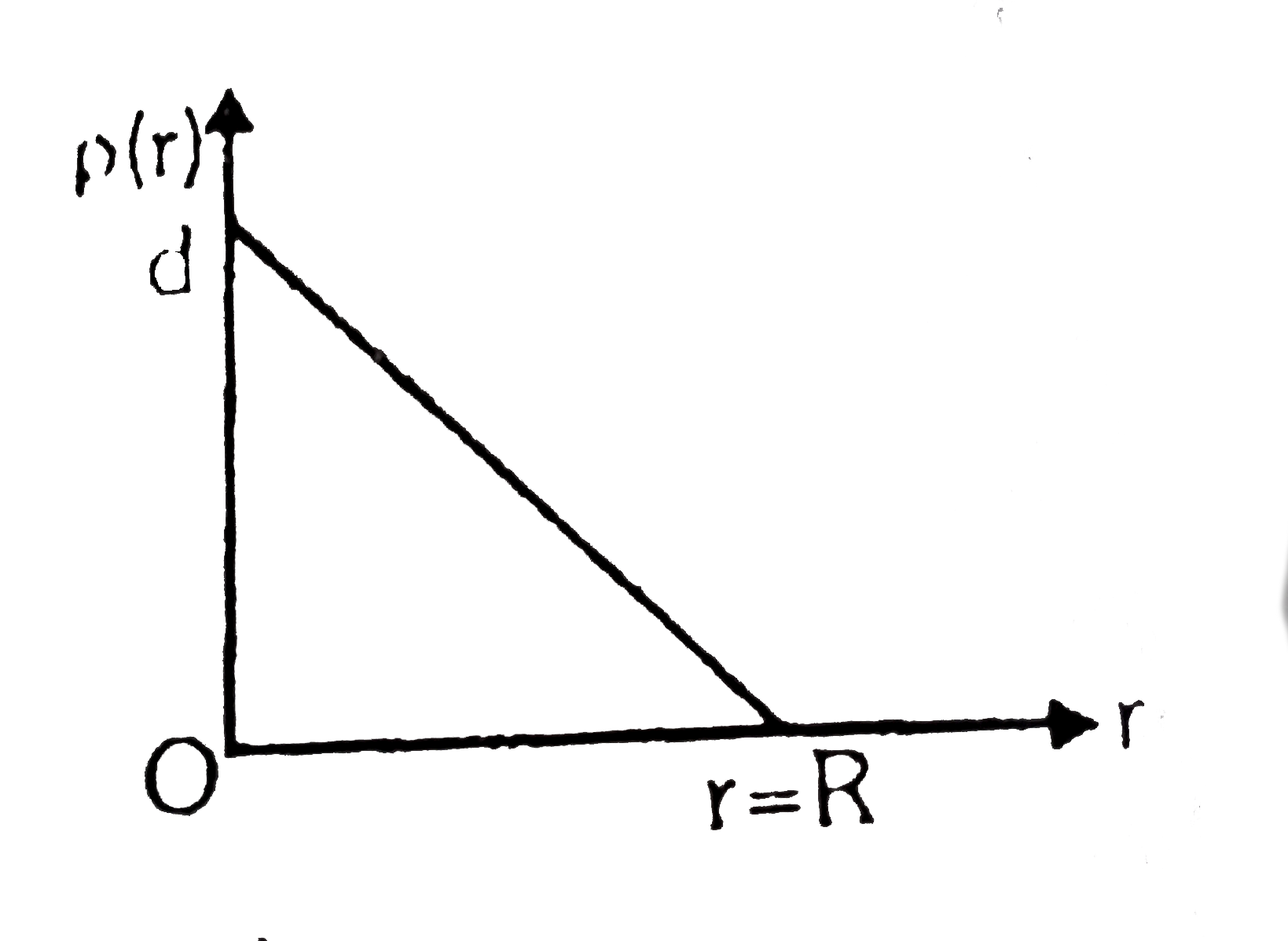
For a=0 the value of d (maximum value of `rho` as shown in the figure) is

A

`(3Ze)/(4pi R^(2))`

B

`(3Ze)/(pi R^(3))`

C

`(4Ze)/(3pi R^(3))`

D

`(Ze)/(3pi R^(3))`

Text Solution

Verified by Experts

The correct Answer is:
B

`:' rho/d+r/R=1`
`:. rho=(1-r/R)d`
Charge contained
`=Ze=underset(0)overset(R)(int)(4pi r^(2)dr)(1-r/R)d`
`=4pid underset(0)overset(R)(int)(r^(2)-r^(3)/R)dr=4pid(R^(3)/3-r^(4)/(4R))`
`=4pid(R^(2)/12)=(pidR^(3))/3rArrd=(3Ze)/(piR^(3))`
Promotional Banner

Topper's Solved these Questions

  • MISCELLANEOUS

    ALLEN |Exercise SUBJECTIVE QUESTION|9 Videos
  • MISCELLANEOUS

    ALLEN |Exercise PHY|68 Videos
  • MISCELLANEOUS

    ALLEN |Exercise MATCH THE COLUME TYPE|1 Videos
  • KINEMATICS (MOTION ALONG A STRAIGHT LINE AND MOTION IN A PLANE)

    ALLEN |Exercise BEGINNER S BOX-7|8 Videos
  • PHYSICAL WORLD, UNITS AND DIMENSIONS & ERRORS IN MEASUREMENT

    ALLEN |Exercise EXERCISE-IV|7 Videos

Similar Questions

Explore conceptually related problems

The nuclear charge ( Ze ) is non uniformlly distribute with in a nucleus of radius r. The charge density rho(r) (charge per unit volume) is dependent only on the radial distance r form the centre of the nucleus s shown in figure. The electric field is only along the radial direction. The electric field at r=R is

The nuclear charge ( Ze ) is non uniformlly distribute with in a nucleus of radius r. The charge densilty rho(r) (charge per unit volume) is dependent only on the radial distance r form the centre of the nucleus s shown in figure. The electric field is only along the radial direction. The electric field within the nucleus is generaly observed to be linearly dependent on r. This implies

A positive charge Q is uniformly distribut along a circular ring of radius R. A small tc charge q is placed at the centre of the ring per figure, Then

An infinite, uniformly charged sheet with surface charge density sigma cuts through a spherical Gaussian surface of radius R at a distance X from its center, as shown in the figure. The electric flux Phi through the Gaussian surface is .

Let P(r)=(Q)/(piR^4)r be the charge density distribution for a solid sphere of radius R and total charge Q. For a point 'p' inside the sphere at distance r_1 from the centre of the sphere, the magnitude of electric field is:

An electric dipole is kept on the axis of a uniformly charged ring at distance from the centre of the ring. The direction of the dipole moment is along the axis. The dipole moment is p , charge of the ring is Q & radius of the ring is R . The force on the dipole is

A solid sphere of radius R has a charge Q distributed in its volume with a charge density rho=kr^a , where k and a are constants and r is the distance from its centre. If the electric field at r=(R)/(2) is 1/8 times that r=R , find the value of a.

Figure shows a uniformly charged hemisphere of radius R. It has a volume charge density rho . If the electric field at a point 2R, above the its center is E, then what is the electric field at the point 2R below its center?

A time varying uniform magnetic field passes through a circular region of radius R. The magnetic field is directed outwards and it is a function of radial distance 'r' and time 't' according to relation B-B_(0)rt. The induced electric field strength at a radial distance R//2 from the centre will be.

The dependence of acceleration due to gravity g on the distance r from the centre of the earth, assumed to be a sphere of radius R of uniform density is as shown in Fig. below: The correct figure is

