Home
Class 11
PHYSICS
Four point charges +8muC,-1muC,-1muC and...

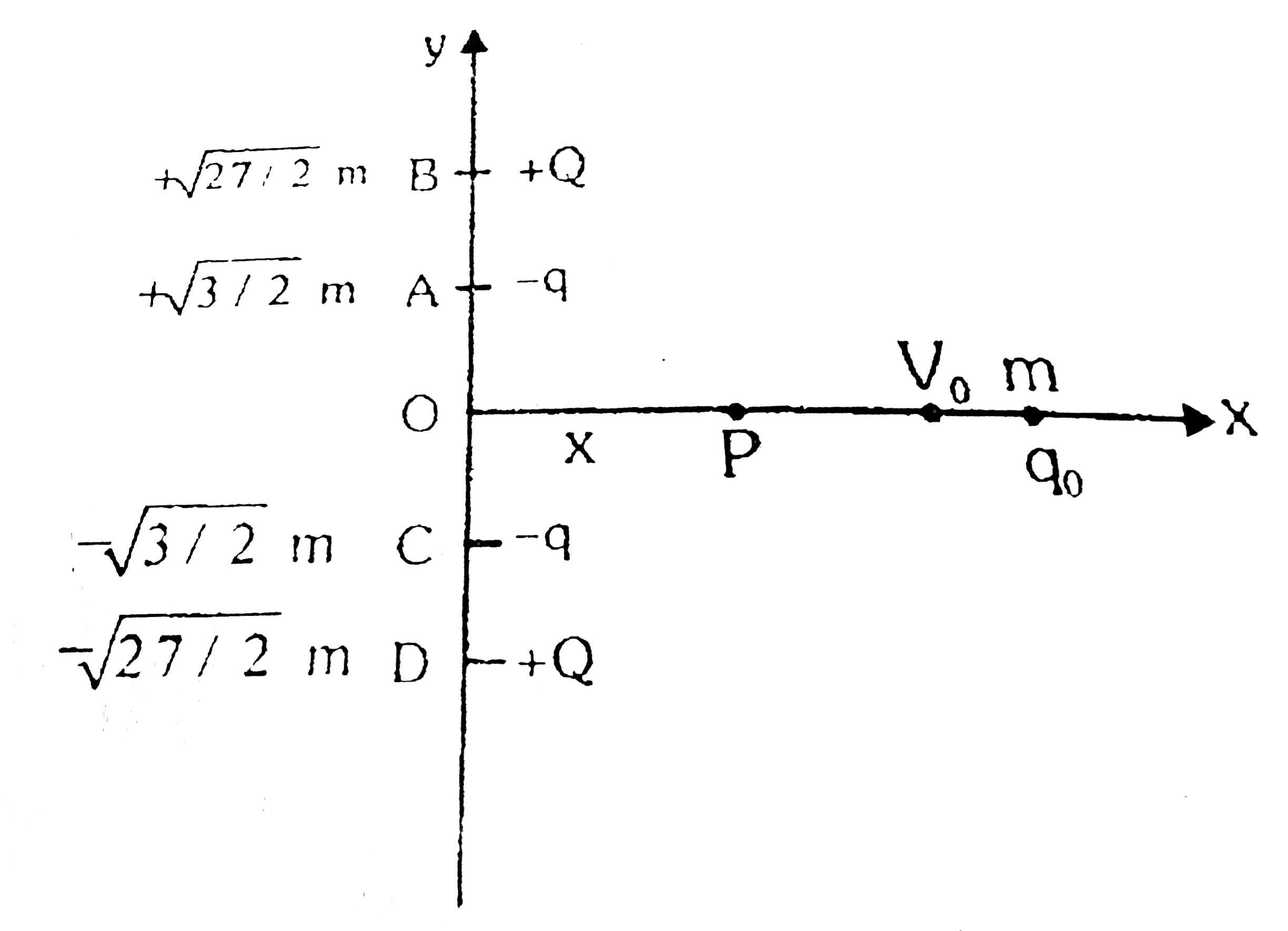
Four point charges `+8muC,-1muC,-1muC` and , `+8muC` are fixed at the points `-sqrt(27//2)m,-sqrt(3//2)m,+sqrt(3//2)m`
and `+sqrt(27//2)m` respectively on the y-axis. A particle of mass `6xx10^(-4)kg` and `+0.1muC` moves along the x-direction. Its speed at `x=+ infty` is `v_(0)`. find the least value of `v_(0)` for which the particle will cross the origin. find also the kinetic energy of the particle at the origin in tyhis case. Assume that there is no force part from electrostatic force.

Text Solution

Verified by Experts

The correct Answer is:
`(v_(0))_("min")=3 m//s, K=3xx10^(-4) J`

In the figure

`q=1 muC=10^(-6)C, q_(0)=+0.1 muC=10^(-7) C`
and
`m=6xx10^(-4) kg` and `Q=8 muC=8cc10^(-6) C`
Let P be any point at a distance x from origin O. Then
`AP=CP=sqrt(3/2+x^(2))`
`BP=DP=sqrt(27/2+x^(2))`
Electric potential at point P will be
`V=(2KQ)/(BP)-(2Kq)/(AP)`
where `K=1/(4pi epsilon_(0))=9xx10^(9) N//m^(2)//C^(2)`
`:. V=2xx9xx10^(9)[(8xx10^(-6))/sqrt(27/2+x^(2))-10^(-6)/sqrt(3/2+x^(2))]`
`V=1.8xx10^(4)[8/sqrt(27/2+x^(2))-1/sqrt(3/2+x^(2))]` ...(i)
`:.` Electric field at P is
`E=-(dV)/(dx)=1.8xx10^(4)`
`[(8)((-1)/2)(27/2+x^(2))^(-3/2)-(-1/2)(3/2+x^(2))^(-3/2)](2x)`
`E=0` on x-axis where `-x=0` or
`8/((27/2+x^(2))^(3//2))=(1)/((3/2+x^(2))^(3//2))`
`rArr ((4)^(3//2))/((27/2+x^(2))^(3//2))=1/((3/2+x^(2))^(3//2))`
`rArr (27/2+x^(2))=4(3/2+x^(2))`
This equation gives `x=+-sqrt(5/2)m`
The least value of kinetic energy of the particle at infinity should be enough to take particle upto
`x=+ sqrt(5/2)m` because at `x=+sqrt(5/2)m, E=0`
`rArr` Electrotatic force on charge q is zero or `F_(e)=0`. For at `x gt sqrt(5/2)m`, E is repulsive (towards x-axis) and for `x lt sqrt(5/2) m`, E is attractive (towards negative x-axis).
Now, from Eq. (i) potential at `x=sqrt(5/2) m`
`v=1.8xx10^(4)[8/sqrt(27/2+5/2)-1/sqrt(3/2+5/2)]`
`rArr V=2.7xx10^(4)` volt
Applying energy conservation at `x=oo` and `x=sqrt(5/2)m, 1/2 mv_(0)^(2)=q_(0)V` ...(ii)
`:. v_(0)=sqrt((2q_(0)V)/m)`
Substituting the values
`v_(0)=sqrt((2xx10^(-7)xx2.7xx10^(4))/(6xx10^(-4)))rArr v_(0)=3 m//s`
`:.` Minimum value of `v_(0)` is `3 m//s`
From eq. (i) potential at origin `(x=0)` is
`V_(0)=1.8xx10^(4)[8/sqrt(27/2)-1/sqrt(3/2)]~~2.4xx10^(4) V`
Let K be the kinetic energy of the particle at origin. Applying energy conservation at x=0 and `x=oo`
`K+q_(0)V_(0)=1/2 mv_(0)^(2)` But `1/2 mv_(0)^(2)=q_(0)V` [from Eq. (ii)]
`K=q_(0)(V-V_(0))=(10^(-7))(2.7xx10^(4)-2.4xx10^(4))`
`rArr K=3xx10^(-4) J`
Promotional Banner

Topper's Solved these Questions

  • MISCELLANEOUS

    ALLEN |Exercise PHY|68 Videos
  • MISCELLANEOUS

    ALLEN |Exercise EXERCISE-1|121 Videos
  • MISCELLANEOUS

    ALLEN |Exercise LINKED COMPREHENSION TYPE|3 Videos
  • KINEMATICS (MOTION ALONG A STRAIGHT LINE AND MOTION IN A PLANE)

    ALLEN |Exercise BEGINNER S BOX-7|8 Videos
  • PHYSICAL WORLD, UNITS AND DIMENSIONS & ERRORS IN MEASUREMENT

    ALLEN |Exercise EXERCISE-IV|7 Videos

Similar Questions

Explore conceptually related problems

A particle moves on x-axis such that its KE varies as a relation KE= 3t^(2) then the average kinetic energy of a particle in 0 to 2 sec is given by :

V_(x) is the velocity of a particle of a particle moving along the x- axis as shown. If x=2.0m at t=1.0s , what is the position of the particle at t=6.0s ?

A particle starts from the origin, goes along the X-axis to the pont (20m, 0) and then returns along the same line to the point (-20m,0). Find the distance and displacement of the particle during the trip.

If the velocity of the particle is given by v=sqrt(x) and initially particle was at x=4m then which of the following are correct.

The particles of mass m_(1),m_(2) and m_(3) are placed on the vertices of an equilateral triangle of sides .a.. Find the centre of mass of this system with respect to the position of particle of mass m_(1) .

The velocity of a particle moving in the positive direction of the x axis varies as v=5sqrtx , assuming that at the moment t=0 the particle was located at the point x=0 , find acceleration of the particle.

A particle with the potentila energy shown in the graph is moving to the right. It has 1.0J of kinetic energy at x=1.0m. Where the particle reverses its direction of motion?

If the pair of lines sqrt(3)x^2-4x y+sqrt(3)y^2=0 is rotated about the origin by pi/6 in the anticlockwise sense, then find the equation of the pair in the new position.

A particle of mass m and charge enters the region between the two charged plates initally moving along x axis with speed v_(x) the length of plate is l and an uniform vertical deflectio of the particle at the far edge of the plate is qEL^(2)//2mv_(x)^(2) compare this motion with motion of a projectile in gravitational field

A particle of mass m, moving in a cicular path of radius R with a constant speed v_2 is located at point (2R,0) at time t=0 and a man starts moving with a velocity v_1 along the +ve y-axis from origin at time t=0 . Calculate the linear momentum of the particle w.r.t. the man as a function of time.

