Home
Class 12
PHYSICS
An object is moving in a straight line. ...

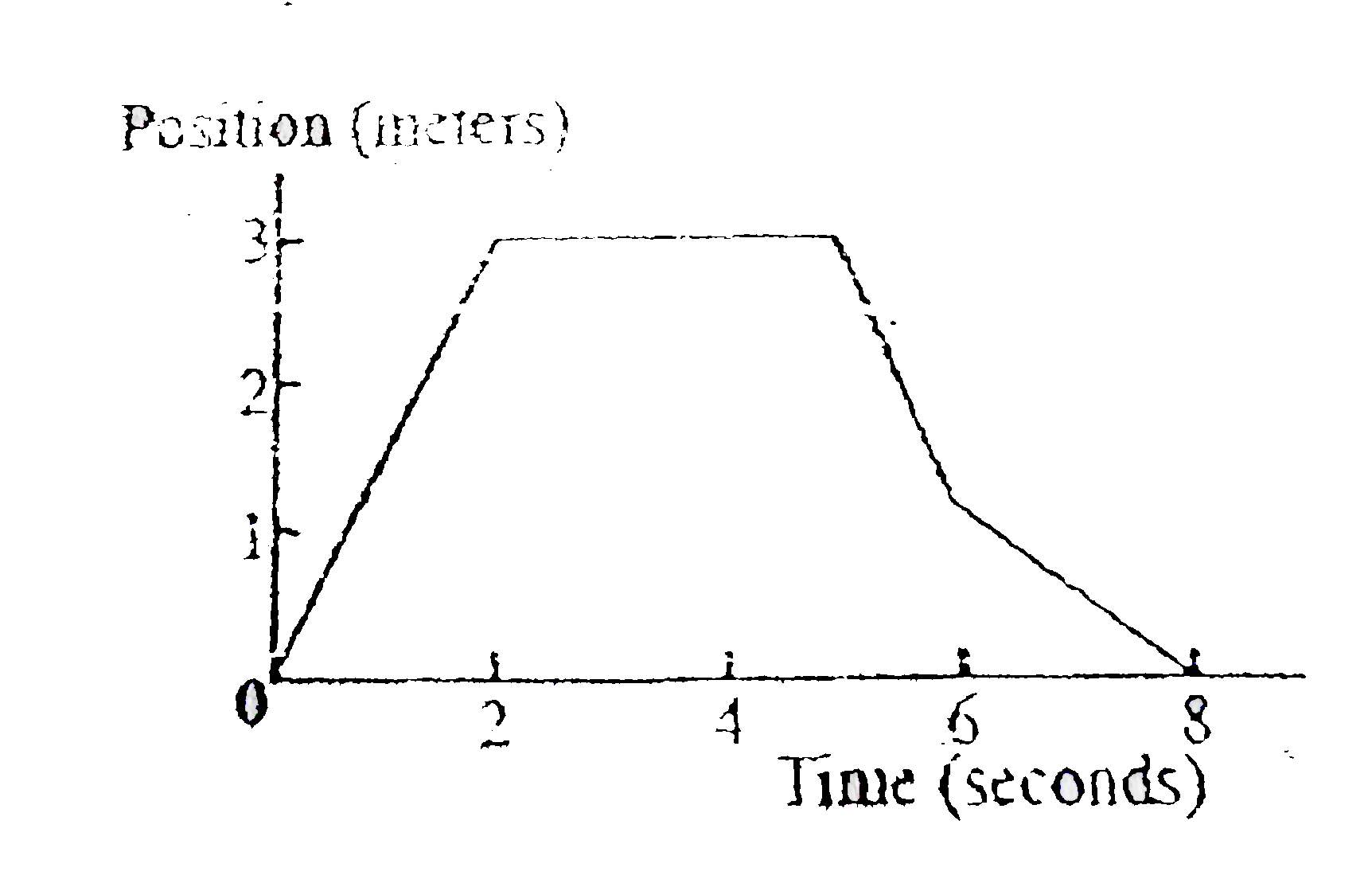
An object is moving in a straight line. Its position versus time graph is shown below. There is a detector at origin which analyze the motion of object between `t=6` and `t=8` seconds, which statement describes the motion shown in the graph.

A

detector observes the object to be moving towards origin.

B

detector observes the object to be moving away from origin.

C

Detector observes the motion at decreasing speed.

D

Detector observes the motion at increasting speed.

Text Solution

Verified by Experts

The correct Answer is:

A

From `t=6 sec` to `t=8 sec`. Velocity of partcle is towards `-ve` `x-` axis and position is positive so object is moving towards origin.
Promotional Banner

Topper's Solved these Questions

Similar Questions

Explore conceptually related problems

A particle moves in a straight line and its position x at time t is given by x^(2)=2+t . Its acceleration is given by :-

A particle starts motion from rest and moves along a straight line. Its acceleration-time graph is shown. Find out speed of particle at t=2s and at t=3s.

In the figure given below, the position time graph of a particle of mass 0.1kg is shown. The impulse at t=2 sec is

A graph of x versus t is shown in figure. Choose correct alternatives given below.

A particle moves in a straight line from origin. Its velocity time curve is shown. Find the distance of particle at the =8sec. From the origin and the distance travelled by the particle during first 8 seconds.

For an object moving on a straight line, draw xtot graphs for : (i) When it is rest. (ii) When it is moving with constant velocity in positive direction. (III) When it is moving with constant velocity in · negative direction. (iv) When it performs non-uniform motion.

A particle moves along a straight line and its position as a function of time is given by x = t6(3) - 3t6(2) +3t +3 , then particle

A car is moving on a straight road. The velocity of the car varies with time as shown in the figure. Initially (at t=0), the car was at x=0 , where, x is the position of the car at any time 't'. The maximum displacement from the starting position will be :-

What can you say about the motion of an object whose distance-time graph is a straight line parallel to the time axis ?
