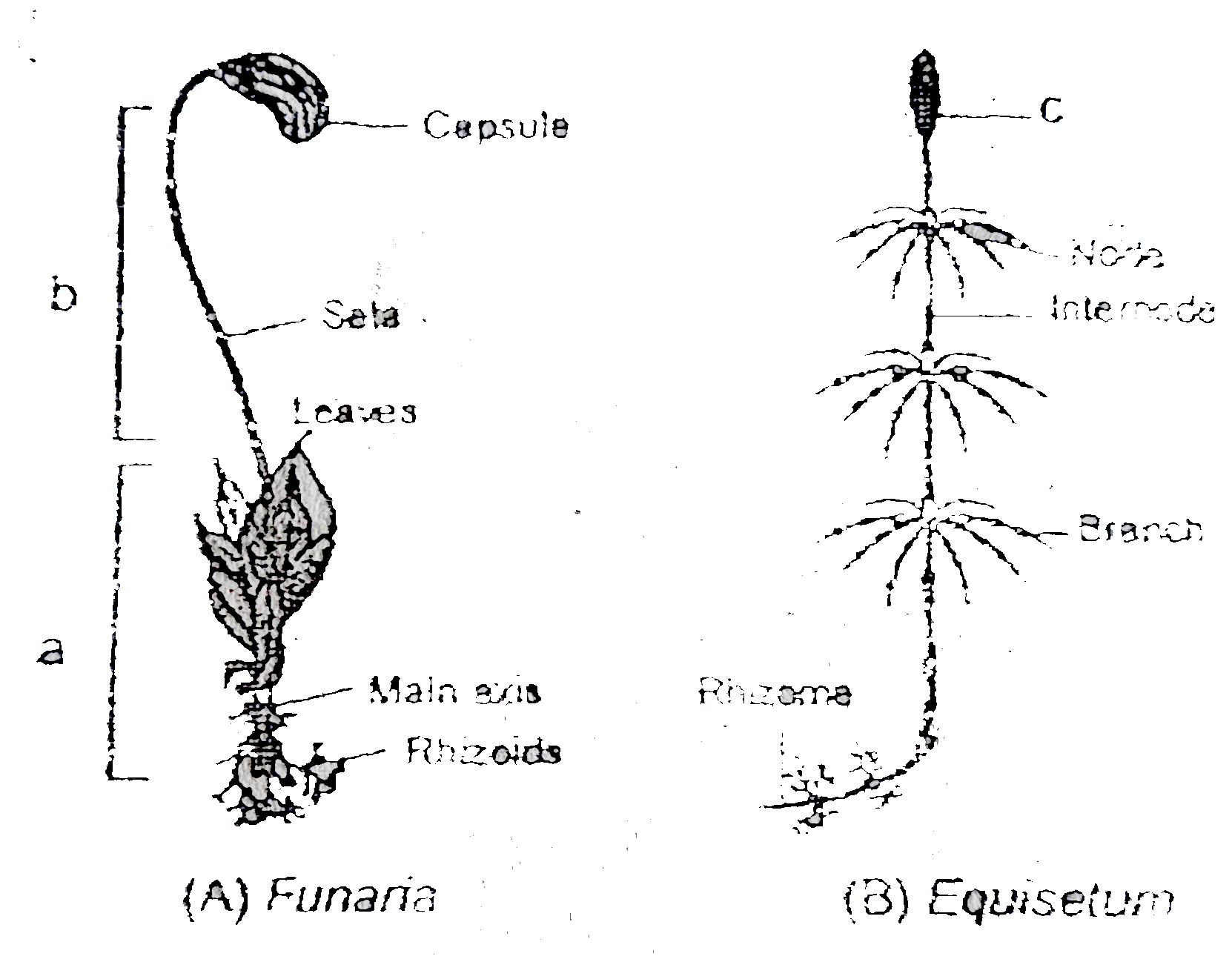
Observe the above diagrams of Funaria (moss) and Equisetum (horse tail) plants belonging to bryophyia and pteridophiya respectively Identify the structure `'a'` and `'b'` from the Funaria and `'c'` from the Equisetum `:-`
Observe the above diagrams of Funaria (moss) and Equisetum (horse tail) plants belonging to bryophyia and pteridophiya respectively Identify the structure `'a'` and `'b'` from the Funaria and `'c'` from the Equisetum `:-`
A
`a-`Strobillus, `b-`Gametophy, `c-` Sporophyte
B
`a-`Gametophtic, `b-`Strobillus, `c-`Sporophyte
C
`a-`Gametophyte, `b-`Sporophyte. `c-`Strobillus
D
`a-`Sporophyte, `b-`Gametophyte, `c-`Strobillus
Text Solution
Verified by Experts
The correct Answer is:
C
`N//A`



Similar Questions
Explore conceptually related problems
Carefully observe the given diagram and answer the questions related with it: Identify 'c' and state from which it originates.
A company has three plants at which it produces a certain item. 30% are produced at plant A, 50% at plant B and remaining at plant C. Suppose that 1% , 4% and 3% of the items produced at plants A, B and C respectively are defective. If an item is selected at random from all of those produced, what is the probability that item was produced at plant B is defective ?
Carefully observe the given diagram and answer the questions related with it: Identify 'c' and mention from where is it released and by which process does it reach here.
A company has three plants at which it produces a certain item. 30% are produced at plant A, 50% at plant B and 20% at plant C. Suppose that 1%, 4% and 3% of the items produced at plants A, B and C respectively are defective. If an item is selected at random from all those produced, what is the probability that the item is defective ?
Two blocks of mass m_(1)=10kg and m_(2)=5kg connected to each other by a massless inextensible string of length 0.3m are placed along a diameter of the turntable. The coefficient of friction between the table and m_(1) is 0.5 while there is no friction between m_(2) and the table. the table is rotating with an angular velocity of 10rad//s . about a vertical axis passing through its center O . the masses are placed along the diameter of the table on either side of the center O such that the mass m_(1) is at a distance of 0.124m from O . the masses are observed to be at a rest with respect to an observed on the tuntable (g=9.8m//s^(2)) . (a) Calculate the friction on m_(1) (b) What should be the minimum angular speed of the turntable so that the masses will slip from this position? (c ) How should the masses be placed with the string remaining taut so that there is no friction on m_(1) .
On a long horizontally moving belt (From figure) a child runs to and fro with a speed 9 kmh^(-1) (with respect to the belt) between his father and mother located 50 m apart on the moving belt. The belt moves with a speed of 4 kmh-l. For an observer on a stationary platform outside, what is the (a) Speed of the child running in the direction of motion of the belt ? (b) Speed of the child running opposite to the direction of motion of the belt ? (c) Time taken by the child in (a) and (b) ? Which of the answers alter if motion is viewed by one of the parents ?
Answer the following questions based on the P - T phase diagram of CO_(2) : (a) CO_(2) at 1 atm pressure and temperature -60^(@)C is compressed isothermally. Does it go through a liquid phase ? (b) What happens when CO_(2) at 4 atm pressure is cooled from room temperature at constant pressure ? (c) Describe qualitatively the changes in a given mass of solid CO_(2) at 10 atm pressure and temperature -65^(@)C as it is heated up to room temperature at constant pressure. (d) CO_(2) is heated to a temperature 70^(@)C and compressed isothermally. What changes in its properties do you expect to observe ?
A Rajput soldier sits on a horse next to a river. Across the river there is a hill and atop the hill is a fortress. He sees a Mughal. Sitting on the fortress's top wall. There is a full moon, so he angrily shoots an arrow at an angle 53^(@) relative to the horizontal. The arrow hits Mughal after a 2 second flight. The horizontal distance from Rajput to Mughal is 30 meters. The arrow is 3 meters above the river when Rajput shoots it. (a) What is the original velocity , vec(V) , of the arrow when Rajput shoots it ? (b) What is Mughal elevation above the river ? (c) What is the flight direction of the arrow the instant before it strikes Mughal, i.e., what is the angle, theta , between its direction and the horizontal when it skins into Mughal's tender flesh ?
A point sources S emitting light of wavelength 600nm is placed at a very small height h above the flat reflecting surface AB (see figure).The intensity of the reflected light is 36% of the intensity.interference firnges are observed on a screen placed parallel to the reflecting surface a very large distance D from it. (A)What is the shape of the interference fringes on the screen? (B)Calculate the ratio of the minimum to the maximum to the maximum intensities in the interference fringes fromed near the point P (shown in the figure) (c) if the intenstities at point P corresponds to a maximum,calculate the minimum distance through which the reflecting surface AB should be shifted so that the intensity at P again becomes maximum.
It is a common observation that rain clouds can be at about a kilometer altitude above the ground. (a) If a rain drop falls from such a height freely under gravity, what will be its speed? Also calculate in km/h (g = 10 m//s^(2) ). (b) A typical rain drop is about 4 mm diameter. Momentum is mass x speed in magnitude. Estimate its momentum when it hits ground. (c) Estimate the time required to flatten the drop. (d) Rate of change of momentum is force. Estimate how much force such a drop would exert on you. (e) Estimate the order of magnitude force on umbrella. Typical lateral separation between two rain drops is 5 cm. (Assume that umbrella is circular and has a diameter of 1 m and cloth is not pierced through.)
Recommended Questions
- Observe the above diagrams of Funaria (moss) and Equisetum (horse tail...
Text Solution
|
- The archegonia of Funaria is distinguished from that of Pinus of the s...
Text Solution
|
- In archaegonium of moss (Funaria) plant, the number of neck canal cell...
Text Solution
|
- Main plant of Funaria belongs to phase
Text Solution
|
- funaria is a moss.
Text Solution
|
- The plant body of moss (Funaria) is
Text Solution
|
- A common example of moss is Funaria.
Text Solution
|
- Equisetum belongs to class
Text Solution
|
- How many of the following belong to Kingdom pteridophyta ? Psilotum , ...
Text Solution
|