Home
Class 12
PHYSICS
Determine the time in which the smaller ...

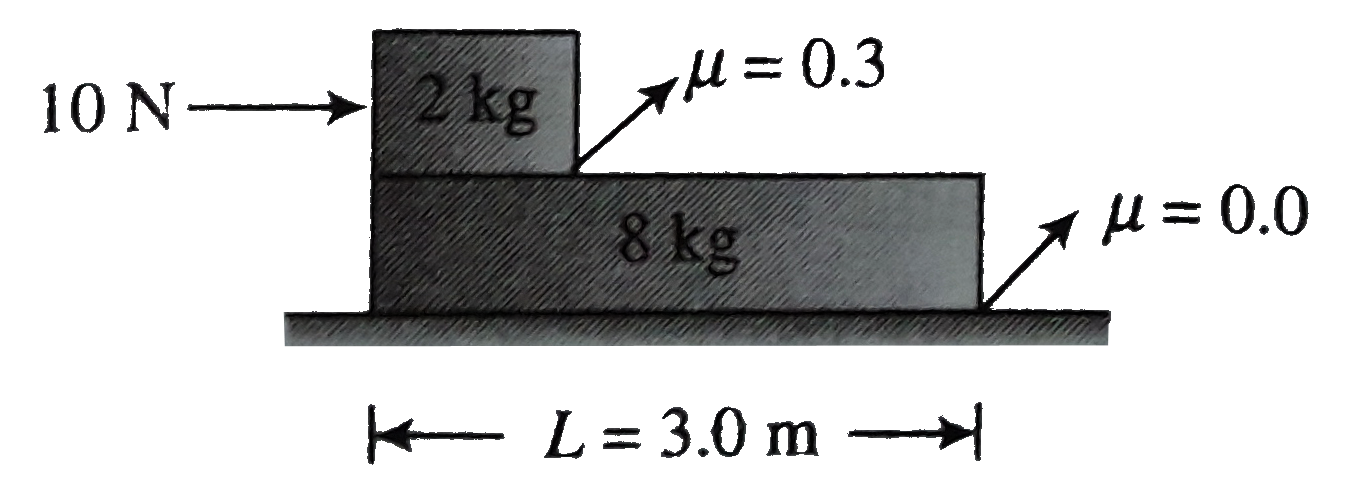
Determine the time in which the smaller block reaches other end of bigger block in figure

A

`4` s

B

`8` s

C

`3.6` s

D

`2.19` s

Text Solution

Verified by Experts

The correct Answer is:
D


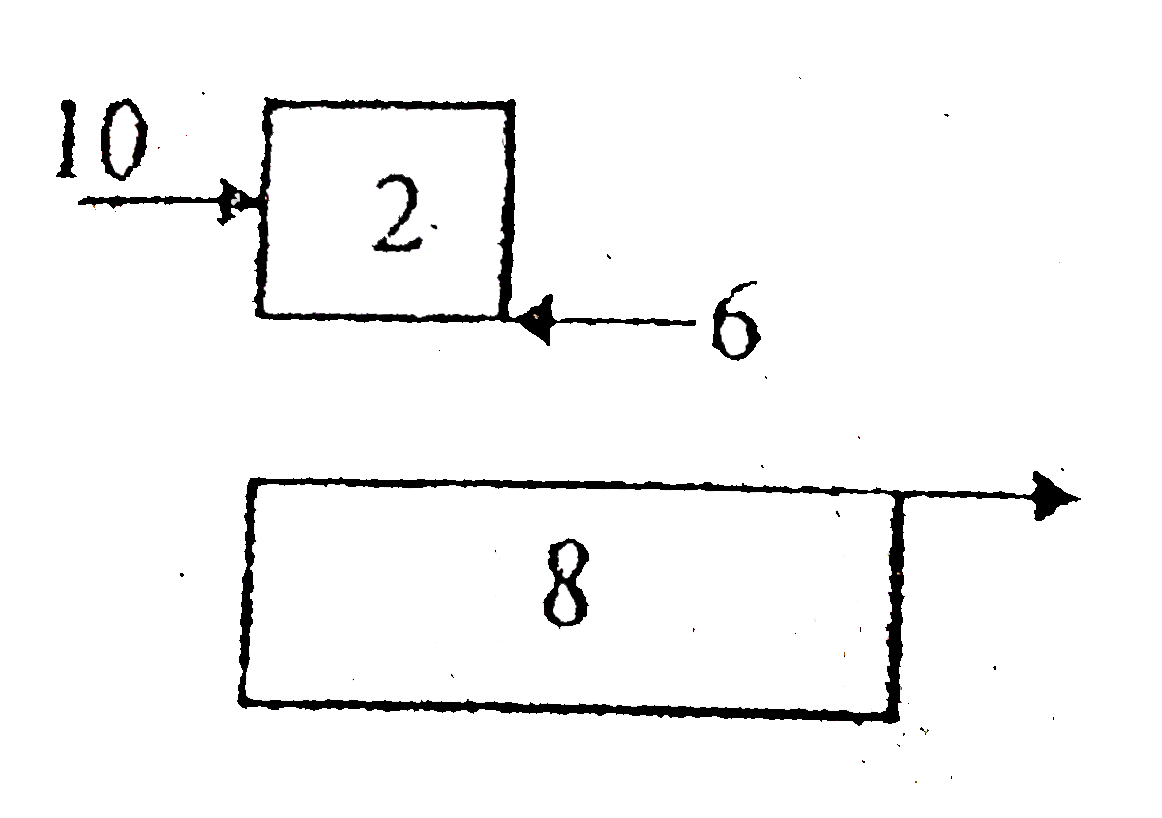
`d_(1)=(4)/(2)=2m//sec^(2)`
`d_(2)=(6)/(8)=(3)/(4)=2m//sec^(2)`
Promotional Banner

Topper's Solved these Questions

Similar Questions

Explore conceptually related problems

Two blocks of masses m and M are held against a compressed spring on a frictionless horizontal floor with the help of a light thread. When the thread is cut, the smaller block leaves the spring with a velocity u relative to the larger block. Find the recoil velocity of the larger block.

Block A of mass 5kg is placed on long block B having a mass of 5kg . The coefficient of friction between two block is 0.4 . There is no friction between the ground and lower block. The upper block is given a sudden velocity of 10m//s . The upper block slides toward right, so friction force acting on it will be toward left. Its reaction wall act on the lower block, which will act forward . The friction force absorbs x mechanical energy from upper block but supply only y mechanical energy to lower block. Due to friction the velocity of upper block reduces and velocity of lower block increases. This will continue till velocity of both the block get equal. Which curve shows the correct variation of velocity of each block v//s time?

The coefficient of static and kinetic friction between the two blocks and also between the lower block and the ground are mu_(s)=0.6 and mu_(k)=0.4 Find the value of tension T applied on the lower block at which the upper block begins to slip relative to lower block.

Block A of mass 5kg is placed on long block B having a mass of 5kg . The coefficient of friction between two block is 0.4 . There is no friction between the ground and lower block. The upper block is given a sudden velocity of 10m//s . The upper block slides toward right, so friction force acting on it will be toward left. Its reaction wall act on the lower block, which will act forward . The friction force absorbs x mechanical energy from upper block but supply only y mechanical energy to lower block. Due to friction the velocity of upper block reduces and velocity of lower block increases. This will continue till velocity of both the block get equal. The net energy loss due to friction in the entire process is

A block of mass m is placed on a smooth horizontal floor is attached to one end of spring. The other end of the spring is attached to fixed support. When spring is vertical it is relaxed. Now the block is pulled to wards right by a force F, which is being increased gradually. When the speing makes angle 53^(@) with the vertical, block leaves the floor. When blocks leaves the table, the normal force on it from table is

In the figure, a block slides along a track from one level to a higher level, by inoving through an intermediate valley. The track is frictionless untill the block reaches the higher level. There a frictional force stops the block in a distance d. The block's initial speed v_(0) is 8 m/s, the height difference h is 2 m and the coefficient of kinetic friction mu is 0.3. The value of d is

The maximum F which will not cause motion of any of the blocks is

A block of mass m is placed on a smooth horizontal floor is attached to one end of spring. The other end of the spring is attached to fixed support. When spring is vertical it is relaxed. Now the block is pulled to wards right by a force F, which is being increased gradually. When the speing makes angle 53^(@) with the vertical, block leaves the floor. When the block leaves the table, the force F is :-

A block of mass m is pulled by a uniform chain of mass m tied to it by applying a force F at the other end of the chain.The tension at a point P which is at a distance of quarter of the length of the chain from the free end,will be

ALLEN -TEST PAPER-Exercise (Physics)
  1. A block of mass 2kg is pushed down an inclined plane of angle 37^(@) a...

    Text Solution

    |

  2. Rank in order, from largest to smallest, the sizes of the friction for...

    Text Solution

    |

  3. Determine the time in which the smaller block reaches other end of big...

    Text Solution

    |

  4. Sixteen beads in a string are placed on a smooth inclined plane to inc...

    Text Solution

    |

  5. A pebbel is thrown horizantally from the top of a 20 m high tower with...

    Text Solution

    |

  6. A stone is thrown at an angle theta to the horizontal reaches a maximu...

    Text Solution

    |

  7. A particle travels with speed 100m//s from the print (10, 20) in a dir...

    Text Solution

    |

  8. The motion of a particle is defined by the position vector vec(r)=(c...

    Text Solution

    |

  9. A car goes A to B along the path with constant accelertion "a" as show...

    Text Solution

    |

  10. A ball is thrown vertically upwards with a velocity v and an initial k...

    Text Solution

    |

  11. In a second ODI match between England and India Bhuwnesh kumar bowled ...

    Text Solution

    |

  12. In a second ODI match between England and India Bhuwnesh kumar bowled ...

    Text Solution

    |

  13. In a second ODI match between England and India Bhuwnesh kumar bowled ...

    Text Solution

    |

  14. A particle is projected vertically upwards with a speed of 16ms^-1. Af...

    Text Solution

    |

  15. The potential energy between two atoms in a molecule is given by U=a...

    Text Solution

    |

  16. An elevator with passengers has a total mass of 800 kg and moves slowl...

    Text Solution

    |

  17. A uniform chain of mass M and length L is lying on a frictionless tabl...

    Text Solution

    |

  18. A body of mass 2 kg is kept on a rough horizontal surface as shown in ...

    Text Solution

    |

  19. A body displaced from (1,1) to (2,2) along the line y=x under the forc...

    Text Solution

    |

  20. A point mass of 0.5 kg is moving along x- axis as x=t^(2)+2t , where, ...

    Text Solution

    |

