Home
Class 12
PHYSICS
A mass m is attached to a spring. The sp...

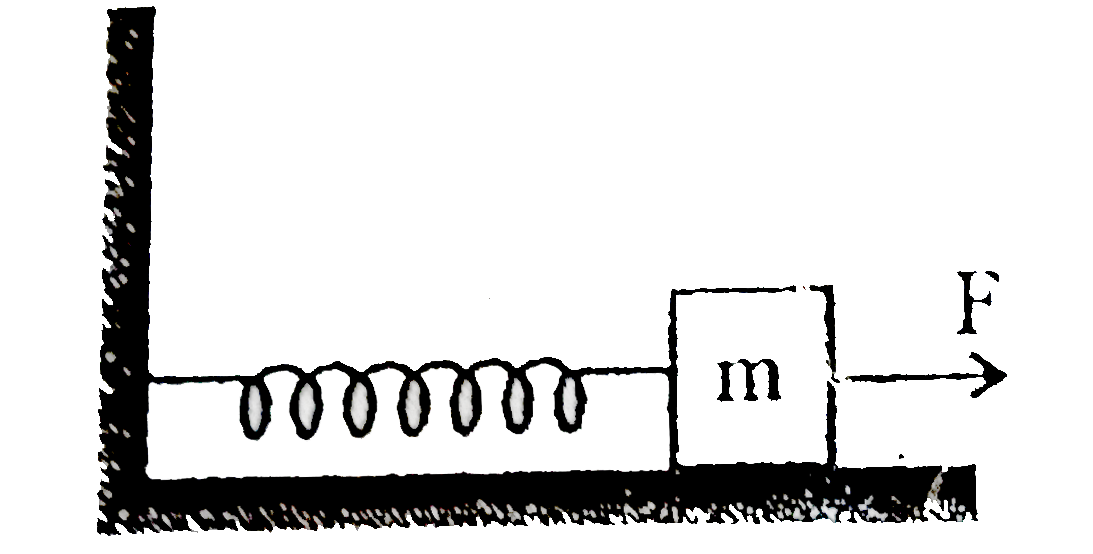
A mass `m` is attached to a spring. The spring is stretched to `x` by a force `F` and refeased. After being released, the mass comes to rest at the initial equilibrium position. The coeffiecient of friction, `mu_(k)` , is `:-`

A

`mu_(k)=(2Kx)/(mg)`

B

`mu_(k)=(2mg)/(F)`

C

`mu_(k)=(F)/(2mg)`

D

`mu_(k)=(mg)/(2Kx)`

Text Solution

Verified by Experts

The correct Answer is:

C

By using work energy theorm, `W=DeltaKE`
`Fx-mu_(k)mgx-mu_(k)mgx=0rArrmu_(k)=(F)/(2mg)`
Promotional Banner

Topper's Solved these Questions

Similar Questions

Explore conceptually related problems

A mass m is attached with rods as shown in figure. This mass is slightly stretched and released whether the motion of mass is S.H.M. if yes then find out the time period.

A spring with one end attached to a mass and the other to a rigid support is stretched and released.

A block of mass M is attached to the lower end of a vertical spring. The spring is hung from a ceiling and has force constant value k. The mass is released from rest with spring initially unstretched. The maximum extension produced in the length of the spring will be............

When body of mass m is suspended from a spiral spring and spring gets stretched through a distance 20 cm if it is stretched below 20 cm and leave then what is period of oscillation?

A block whose mass is 1 kg is fastened to a spring. The spring has a spring constant of 50 N m^(-1) . The block is pulled to a distance x = 10 cm from its equilibrium position at x = 0 on a frictionless surface from rest at t = 0. Calculate the kinetic, potential and total energies of the block when it is 5 cm away from the mean position.

A particle of mass m is attached to one end of a mass-less spring of force constant k, lying on a frictionless horizontal plane. The other end of the spring is fixed. The particle starts moving horizontally from its equilibrium position at time t=0 with an initial velocity u_0 . when the speed of the particle is 0.5u_0 , it collides elastically with a rigid wall. After this collision

Find the minimum value of horizontal force (F) required on the block of mass m to keep it at rest on the wall. Given the coefficient of friction between the surfaces is mu .

An object of mass m is attached to a spring. The restroing force of the spring is F - lambdax^(3) , where x is the displacement. The oscillation period depends on the mass, l mabd and oscillation amplitude. Suppose the object is initially at rest. If the initial displacement is D then its period is tau . If the initial displacement is 2D , find the period.

A mass 2kg is attached to the spring of spring constant 50 Nm^(-1) . The block is pulled to a distance of 5 cm from its equilibrium position at x= 0 on a horizontal frictionless surface from rest at t=0. Write the expression for its displacement at anytime t.

ALLEN -TEST PAPER-Exercise (Physics)
  1. A body displaced from (1,1) to (2,2) along the line y=x under the forc...

    Text Solution

    |

  2. A point mass of 0.5 kg is moving along x- axis as x=t^(2)+2t , where, ...

    Text Solution

    |

  3. A mass m is attached to a spring. The spring is stretched to x by a fo...

    Text Solution

    |

  4. A block of mass m is pushed up against a spring, compressing it to a d...

    Text Solution

    |

  5. A body of mass 0.5 kg travels in a straight line with velocity v = ax^...

    Text Solution

    |

  6. One end of a light spring of spring constant k is fixed to a wall and ...

    Text Solution

    |

  7. Select the correct alternative.

    Text Solution

    |

  8. A constant force produces maximum velocity V on the block connected to...

    Text Solution

    |

  9. A particle with total energy E moves in one dimensional region where t...

    Text Solution

    |

  10. In the figure, block A is released from rest when the spring is its na...

    Text Solution

    |

  11. A body of mass 2.0 kg, force to travel in the x-direction, is subjecte...

    Text Solution

    |

  12. The potential energy for a force filed vecF is given by U(x,y)=cos(x+y...

    Text Solution

    |

  13. A particle of mass 5kg moving in the X-Y plane has its potential energ...

    Text Solution

    |

  14. As a particle moves along the x-axis, it is acted upon by a conservati...

    Text Solution

    |

  15. Water is flowing in a river at 2 ms^(-1). The river is 50 m wide and h...

    Text Solution

    |

  16. Which of the following statemente is / are INCORRECT? (a) Mechanical...

    Text Solution

    |

  17. Consider the following sketch of potential energy for a particle as a ...

    Text Solution

    |

  18. The potential energy of a 1 kg particle free to move along the x- axis...

    Text Solution

    |

  19. The figure below shows a graph of potential energy U(x) verses positio...

    Text Solution

    |

  20. A force F acting on a body depends on its displacement x as Fpropx^(a)...

    Text Solution

    |
