Home
Class 12
PHYSICS
In the figure, block A is released from ...

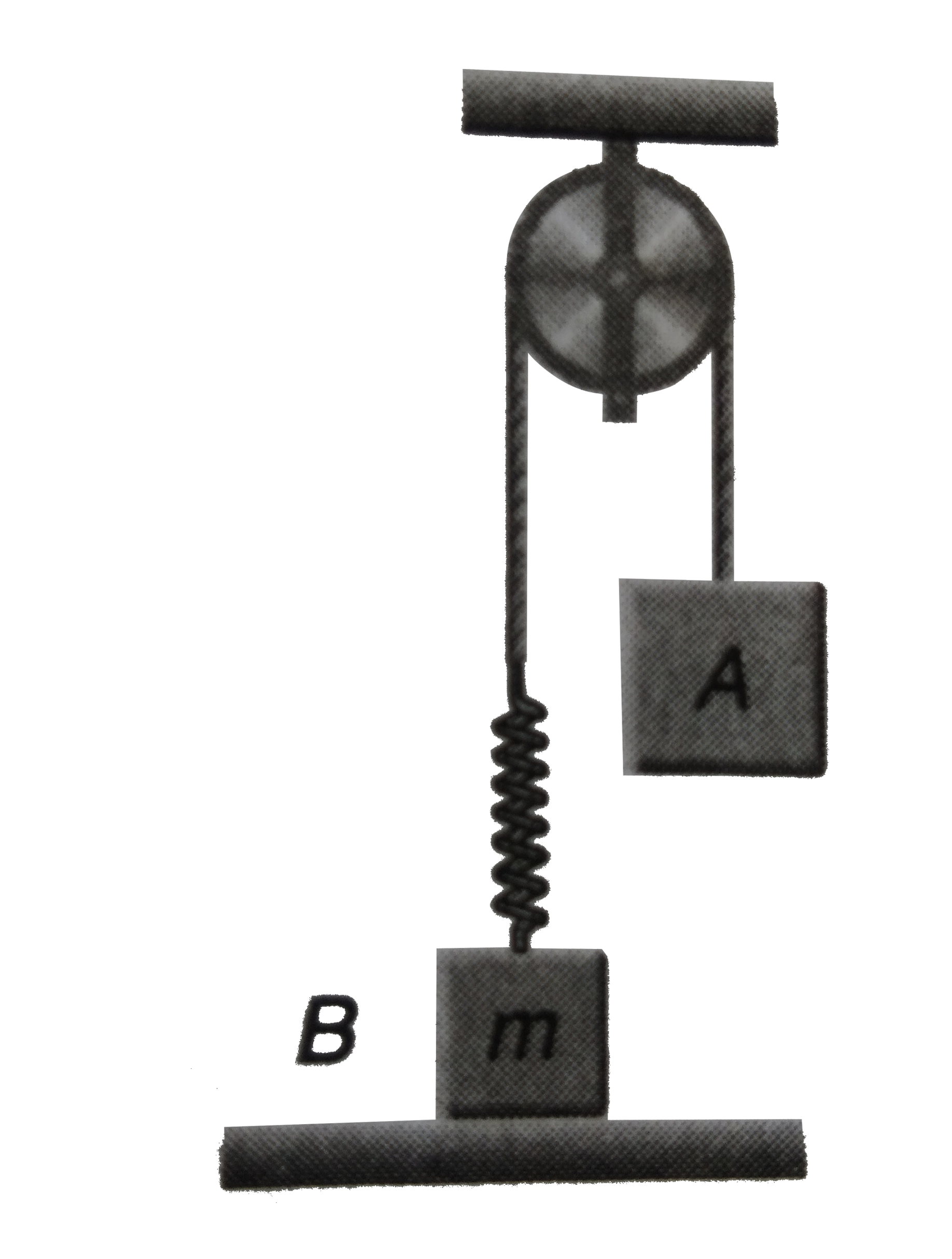
In the figure, block A is released from rest when the spring is its natural length for the block B of mass m to leave contact with the ground at some stage what should be the minimum mass of block A?
.

A

`2m`

B

`m`

C

`m//2`

D

A function of `m` and the force constant of the spring.

Text Solution

Verified by Experts

The correct Answer is:

C

The spring will exert the maximum force when the ball is at its lowest postion. If the ball has descended through a distance `x` to reach this position, `mgx=(1)/(2)kx^(2)`. Where `k` is the force constant of the spring. For the block `B` to leave contact, spring force `=kx=Mg`
Promotional Banner

Topper's Solved these Questions

Similar Questions

Explore conceptually related problems

A 1 kg block situated on a rough incline is connected to a spring constant 100 Nm^(-1) as shown in figure . The block is released from rest with the spring in the unstretched position . The block moves 10 cm down the incline before coming to rest . Find the coefficient of friction between the block and the incline .Assume that the spring has a negligible mass and the pulley is frictionless.

Block A in the figure is released from the rest when the extension in the spring is x_(0) . The maximum downward displacement of the block will be :

A spring of force constant k is kept in the compressesd condition between two blocks masses m and M on the smooth surface of a table as shown in figure .When the spring is released , both the blocks move in opposite directions .When the spring attains the orginal (normal ) position . both blocks lose the constacts with the spring . If x is the intial compression of the spring find the speeds of block while getting detached from the spring .

Two blocks A and B, each of mass m, are connected by a masslesss spring of natural length L and spring constant K. The blocks are initially resting on a smooth horizontal floor with the spring at its natural length, as shown in fig. A third identical block C, also of mass m, moves on the floor with a speed v along the line joining A and B, and collides elastically with A. Then

Two block A and B of masses m and 2m respectively are connected by a spring of spring cosntant k. The masses are moving to the right with a uniform velocity v_(0) each, the heavier mass leading the lighter one. The spring is of natural length during this motion. Block B collides head on with a thrid block C of mass 2m . at rest, the collision being completely inelastic. The velocity of centre of mass of system of block A, B, & C is -

Two block A and B of masses m and 2m respectively are connected by a spring of spring cosntant k. The masses are moving to the right with a uniform velocity v_(0) each, the heavier mass leading the lighter one. The spring is of natural length during this motion. Block B collides head on with a thrid block C of mass 2m . at rest, the collision being completely inelastic. The velocity of block B just after collision is -

Two block A and B of masses m and 2m respectively are connected by a spring of spring cosntant k. The masses are moving to the right with a uniform velocity v_(0) each, the heavier mass leading the lighter one. The spring is of natural length during this motion. Block B collides head on with a thrid block C of mass 2m . at rest, the collision being completely inelastic. The maximum compression of the spring after collision is -

In the figure, what should be mass m so that block A slides up with a constant velocity ?

A disc of mass m and radius r is free to rotate about its centre as shown in the figure. A string is wrapped over its rim and a block of mass m is attached to the free end of the string. The system is released from rest. The speed of the block as it descends through a height h, is :-

In the shown figure, the heavu block of mass 2 kg rests on the horizontal surface and the lighter block of mass 1 kg is dropped from a height of 0.9 m . At the instant the string gets taut, find the upwards speed (in m//s ) of the heavy block.

ALLEN -TEST PAPER-Exercise (Physics)
  1. A constant force produces maximum velocity V on the block connected to...

    Text Solution

    |

  2. A particle with total energy E moves in one dimensional region where t...

    Text Solution

    |

  3. In the figure, block A is released from rest when the spring is its na...

    Text Solution

    |

  4. A body of mass 2.0 kg, force to travel in the x-direction, is subjecte...

    Text Solution

    |

  5. The potential energy for a force filed vecF is given by U(x,y)=cos(x+y...

    Text Solution

    |

  6. A particle of mass 5kg moving in the X-Y plane has its potential energ...

    Text Solution

    |

  7. As a particle moves along the x-axis, it is acted upon by a conservati...

    Text Solution

    |

  8. Water is flowing in a river at 2 ms^(-1). The river is 50 m wide and h...

    Text Solution

    |

  9. Which of the following statemente is / are INCORRECT? (a) Mechanical...

    Text Solution

    |

  10. Consider the following sketch of potential energy for a particle as a ...

    Text Solution

    |

  11. The potential energy of a 1 kg particle free to move along the x- axis...

    Text Solution

    |

  12. The figure below shows a graph of potential energy U(x) verses positio...

    Text Solution

    |

  13. A force F acting on a body depends on its displacement x as Fpropx^(a)...

    Text Solution

    |

  14. If vec(A)=2hat(i)+hat(j)+hat(k) and vec(B)=hat(i)+2hat(j)+2hat(k), fi...

    Text Solution

    |

  15. An insect starts from (2,3,4) and travels along (hat(i)+2hat(j)+2hat(k...

    Text Solution

    |

  16. For the given vector vec(A)=3hat(i)-4hat(j)+10hat(k), the ratio of mag...

    Text Solution

    |

  17. In the arrangement shown in figure coefficient of friction between 5kg...

    Text Solution

    |

  18. A block is kept at the corner of two walls and force 3N is applied on ...

    Text Solution

    |

  19. A plank of mass 2 kg and length 1 m is placed on horizontal floor.A sm...

    Text Solution

    |

  20. A block is moving along y-axis with velocity vec(v)(A)=4hat(j) on a pl...

    Text Solution

    |
