Home
Class 12
PHYSICS
Consider the following sketch of potenti...

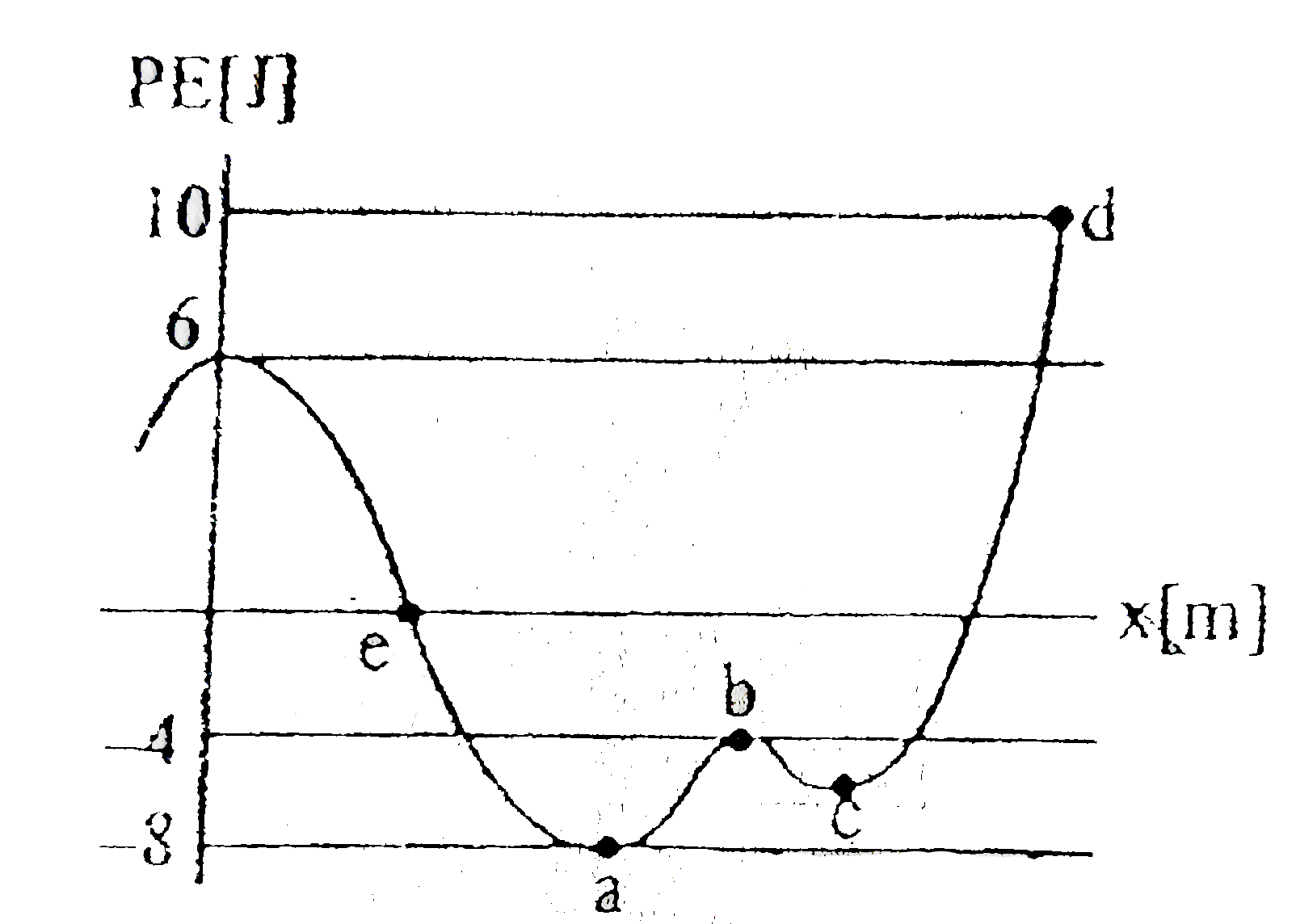
Consider the following sketch of potential energy for a particle as a function of position. There are no dissipative forces or internal sources of energy.

What is the minimum total mechanical energy that the particle can have if you know that it has travelled over the entire region of `X` shown?

A

`-8`

B

`6`

C

`10`

D

It depends on direction of travel

Text Solution

Verified by Experts

The correct Answer is:

C

If particle can reach point '`d`', then it can travel over the entire region.
Promotional Banner

Topper's Solved these Questions

Similar Questions

Explore conceptually related problems

Potential energy curve U of a particle as function of the position of a particle is shown. The particle has total mechanical energy E of 3.0 joules. Then select correct alternative.

A potential energy curve U(x) is shown in the figure. What value must the mechanical energy E_(mec) of the particle not exceed, if the particle is to be trapped within the region shown in graph? .

The potential energy U(x) of a particle moving along x- axis is shown in figure. Which one of the following graphs represents the variation of kinetic energy of this particle if its total mechanical enery is E_(0)

Consider the folllowing graph of potential energy (U) vs position (x) for a particle travelling along x- axis. No other contact force exists, as shown in figure. which of the following graph represents teh force corresponding to the given potential ?

Given in figure are examples of some potential energy functions in one dimension. The total energy of the aprticle is indicated by a cross on the ordinate axis . In each case , specify the regions ,if any , in which the particle cannot be found for the given energy .Also , indicate the minimum total energy the particle must have in each case . Think of simple physical contexts for which these potential energy shapes are relvant .

The potential energy of a particle of mass 1 kg moving along x-axis given by U(x)=[(x^(2))/(2)-x]J . If total mechanical energy of the particle is 2J then find the maximum speed of the particle. (Assuming only conservative force acts on particle)

The figure below shows a graph of potential energy U(x) verses position x for a particle executing one dimensional motion along the x axis. The total mechanical energy of the system is indicated by the dashed line. At t=0 the particle is somewhere between points A and G. For later times choose the correct statement:-

Two stars bound together by gravity orbit othe because of their mutual attraction. Such a pair of stars is referred to as a binary star system. One type of binary system is that of a black hole and a companion star. The black hole is a star that has cullapsed on itself and is so missive that not even light rays can escape its gravitational pull therefore when describing the relative motion of a black hole and companion star, the motion of the black hole can be assumed negligible compared to that of the companion. The orbit of the companion star is either elliptical with the black hole at one of the foci or circular with the black hole at the centre. The gravitational potential energy is given by U=-GmM//r where G is the universal gravitational constant, m is the mass of the companion star, M is the mass of the black hole, and r is the distance between the centre of the companion star and the centre of the black hole. Since the gravitational force is conservative. The companion star and the centre of the black hole, since the gravitational force is conservative the companion star's total mechanical energy is a constant. Because of the periodic nature of of orbit there is a simple relation between the average kinetic energy ltKgt of the companion star Two special points along the orbit are single out by astronomers. Parigee isthe point at which the companion star is closest to the black hole, and apogee is the point at which is the farthest from the black hole. Q. For circular orbits the potential energy of the companion star is constant throughout the orbit. if the radius of the orbit doubles, what is the new value of the velocity of the companion star?

Two stars bound together by gravity orbit othe because of their mutual attraction. Such a pair of stars is referred to as a binary star system. One type of binary system is that of a black hole and a companion star. The black hole is a star that has cullapsed on itself and is so missive that not even light rays can escape its gravitational pull therefore when describing the relative motion of a black hole and companion star, the motion of the black hole can be assumed negligible compared to that of the companion. The orbit of the companion star is either elliptical with the black hole at one of the foci or circular with the black hole at the centre. The gravitational potential energy is given by U=-GmM//r where G is the universal gravitational constant, m is the mass of the companion star, M is the mass of the black hole, and r is the distance between the centre of the companion star and the centre of the black hole. Since the gravitational force is conservative. The companion star and the centre of the black hole, since the gravitational force is conservative the companion star's total mechanical energy is a constant. Because of the periodic nature of of orbit there is a simple relation between the average kinetic energy ltKgt of the companion star Two special points along the orbit are single out by astronomers. Parigee isthe point at which the companion star is closest to the black hole, and apogee is the point at which is the farthest from the black hole. Q. Which of the following prevents the companion star from leaving its orbit and falling the black hole?

Separation of Motion of a system of particles into motion of the centre of mass and motion about the centre of mass : (a) Show p=p_(i).+m_(i)V where p_(i) is the momentum of the ith particle (of mass m_(i) ) and p_(i).=m_(i)v_(i). . Note v_(i). is the velocity of the i^(th) particle relative to the centre of mass Also, prove using the definition of the centre of mass Sigmap_(i).=0 (b) Show K=K.+(1)/(2)MV^(2) where K is the total kinetic energy of the system of particles, K. is the total kinetic energy of the system when the particle velocities are taken with respect to the centre of mass and (1)/(2)MV^(2) is the kinetic energy of the translation of the system as a whole (i.e. of the centre of mass motion of the system). The result has been used in Sec. 7.14). (c ) Show vecL=vecL.+vecRxxvec(MV) where vecL.=Sigmavec(r_(i)).xxvec(p_(i)). is the angular momentum of the system about the centre of mass with velocities taken relative to the centre of mass. Remember vec(r._(i))=vec(r_(i))-vecR , rest of the notation is the velcities taken relative to the centre of mass. Remember vec(r._(i))=vec(r_(i))-vecR rest of the notation is the standard notation used in the chapter. Note vecL , and vec(MR)xxvecV can be said to be angular momenta, respectively, about and of the centre of mass of the system of particles. (d) Show vec(dL.)/(dt)=sumvec(r_(i).)xxvec(dp.)/(dt) Further, show that vec(dL.)/(dt)=tau._(ext) where tau._(ext) is the sum of all external torques acting on the system about the centre of mass. (Hint : Use the definition of centre of mass and Newton.s Thrid Law. Assume the internal forces between any two particles act along the line joining the particles.)

ALLEN -TEST PAPER-Exercise (Physics)
  1. Water is flowing in a river at 2 ms^(-1). The river is 50 m wide and h...

    Text Solution

    |

  2. Which of the following statemente is / are INCORRECT? (a) Mechanical...

    Text Solution

    |

  3. Consider the following sketch of potential energy for a particle as a ...

    Text Solution

    |

  4. The potential energy of a 1 kg particle free to move along the x- axis...

    Text Solution

    |

  5. The figure below shows a graph of potential energy U(x) verses positio...

    Text Solution

    |

  6. A force F acting on a body depends on its displacement x as Fpropx^(a)...

    Text Solution

    |

  7. If vec(A)=2hat(i)+hat(j)+hat(k) and vec(B)=hat(i)+2hat(j)+2hat(k), fi...

    Text Solution

    |

  8. An insect starts from (2,3,4) and travels along (hat(i)+2hat(j)+2hat(k...

    Text Solution

    |

  9. For the given vector vec(A)=3hat(i)-4hat(j)+10hat(k), the ratio of mag...

    Text Solution

    |

  10. In the arrangement shown in figure coefficient of friction between 5kg...

    Text Solution

    |

  11. A block is kept at the corner of two walls and force 3N is applied on ...

    Text Solution

    |

  12. A plank of mass 2 kg and length 1 m is placed on horizontal floor.A sm...

    Text Solution

    |

  13. A block is moving along y-axis with velocity vec(v)(A)=4hat(j) on a pl...

    Text Solution

    |

  14. A block is projected up along the line of greatest slope of an incline...

    Text Solution

    |

  15. A metal block is resting on a rough wooden surface. A horizontal force...

    Text Solution

    |

  16. A Body intially at rest, starts moving along x-axis in such a way so t...

    Text Solution

    |

  17. A particle is shifted from A to B and then from B to C where A,B and C...

    Text Solution

    |

  18. Velocity of a stone projected, 2 second before it reaches he maximum h...

    Text Solution

    |

  19. A particle is moving along x-axis whose position is given by x=4-9t+(t...

    Text Solution

    |

  20. A particle moves 21m along the vector 6hat(i)+2hat(j)+3hat(k) , then 1...

    Text Solution

    |
