Home
Class 12
PHYSICS
A rectangular farm house has a 1km diffe...

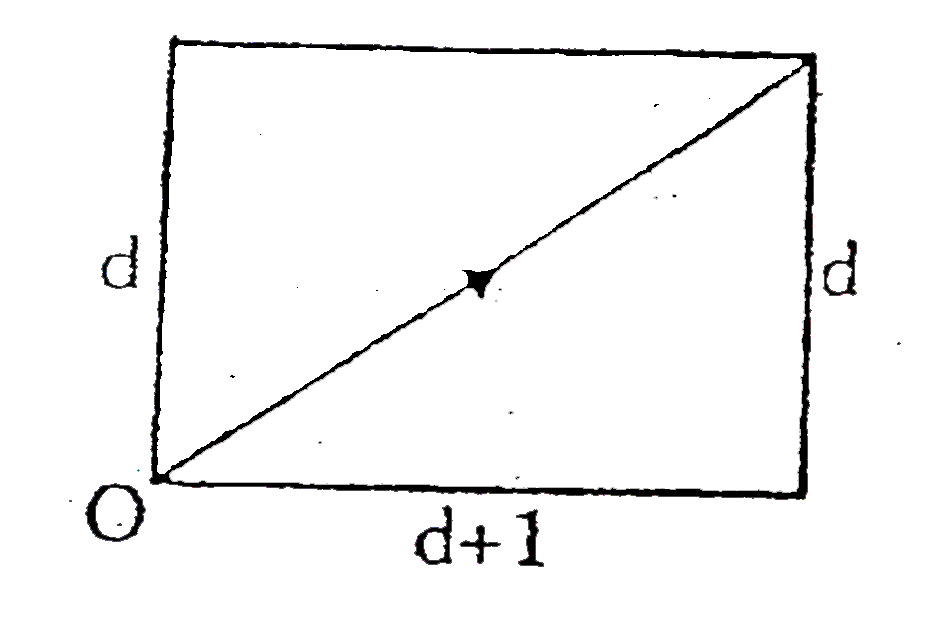
A rectangular farm house has a `1km` difference between its sides. Two farmers simultaneously leave one of the vertex of the rectangle for a point at the opposite vertex. One farmer crosses the farmhouse along its diagonal and other walks along the edge. The speed of each farmer is `4km//hr`. If one of them arrives half an hour earlier then the other then the size of farmhouse is .

A

`12kmxx13km`

B

`4kmxx5km`

C

`3kmxx4km`

D

None of these

Text Solution

Verified by Experts

The correct Answer is:
C


According to given condition
`(d+1+d)/(4)=sqrt((d+1)^(2)+d^(2))/(4)=(1)/(2)`
`rArr2d1=sqrt((d^(2)+(d+1)))gtd=3km`
`rArr` size of farm house `3kmxx4km`
Promotional Banner

Topper's Solved these Questions

Similar Questions

Explore conceptually related problems

Two oppositive verticies of rectangle are (-3,1) and (1,1) . Also equation of one side is along the line 4x+7y + 5=0 . Find equation of other sides of rectangle.

Two motor cars start from A simultaneously & reach B after 2 hour. The first car travelled half the distance at a speed of v_(1)=30 km hr^(-1) & the other half at a speed of v_(2)=60 km hr^(-1) . The second car covered the entire with a constant acceleration. At what instant of time, were the speeds of both the vehicles same? Will one of them overtake the other enroute?

Consider a disc rotating in the horizontal plane with a constant angular speed omega about its centre O . The disc has a shaded region on one side of the diameter and an unshaded region on the other side as shown in the figure. When the disc is in the orientation as shown, two pebbles P and Q are simultaneously projected at an angle towards R. The velocity of projection is in the y-z plane and is same for both pebbles with respect to the disc. Assume that (i) they land back on the disc before the disc has completed (1)/(8) rotation, (ii) their range is less than half the disc radius, and (iii) w remains constant throughout. Then

Represent the following situations in the form of quadratic eqautions : (1) The area of a rectangular plot is 528 m^(2) . The length of the plot (in metres) is one more than twice its breadth. We need to find the length and breadth of the plot. (2) The product of two consecutive positive integers is 306. We need to find the integers. (3) Rohan's mother is 26 years older than him. The product of their ages (in years) 3 years from now will be 360. We would like to find Rohan's present age. (4) A train travels a distance of 480 km at a uniform speed. If the speed had been 8km/h less, it would have taken 3 hours more to cover the same distance. We need to find the speed of the train.

Thin films, including soap bubbles and oil show patterns of alternative dark and bright regions resulting from interference among the reflected light waves. If two waves are in phase, their crests and troughs will coincide. The interference will be constructive and the amplitude of resultant wave will be greater then either of constituent waves. If the two wave are not of phase by half a wavelength (180^(@)) , the crests of one wave will coincide width the troughs of the other wave. The interference will be destructive and the amplitude of the resultant wave will be less than that of either constiuent wave. 1. When incident light I, reaches the surface at point a, some of the light is reflected as ray R_(a) and some is refracted following the path ab to the back of the film. 2. At point b, some of the light is refracted out of the film and part is reflected back through the film along path bc. At point c, some of the light is reflected back into the film and part is reflected out of the film as ray R_(c) . R_(a) and R_(c) are parallel. However, R_(c) has traveled the extra distance within the film of abc. If the angle of incidence is small, then abc is approximately twice the film's thickness . If R_(a) and R_(c) are in phase, they will undergo constructive interference and the region ac will be bright. If R_(a) and R_(c) are out of phase, they will undergo destructive interference and the region ac will be dark. I. Refraction at an interface never changes the phase of the wave. II. For reflection at the interfere between two media 1 and 2, if n_(1) gt n_(2) , the reflected wave will change phase. If n_(1) lt n_(2) , the reflected wave will not undergo a phase change. For reference, n_(air) = 1.00 . III. If the waves are in phase after reflection at all intensities, then the effects of path length in the film are: Constrictive interference occurs when 2 t = m lambda // n, m = 0, 1,2,3 ,... Destructive interference occurs when 2 t = (m + (1)/(2)) (lambda)/(n) , m = 0, 1, 2, 3 ,... If the waves are 180^(@) out of the phase after reflection at all interference, then the effects of path length in the film area: Constructive interference occurs when 2 t = (m + (1)/(2)) (lambda)/(n), m = 0, 1, 2, 3 ,... Destructive interference occurs when 2 t = (m lambda)/(n) , m = 0, 1, 2, 3 ,... 72. A film with index of refraction 1.50 coats a glass lens with index of refraction 1.80. What is the minimum thickness of the thin film that will strongly reflect light with wavelength 600 nm?

Thin films, including soap bubbles and oil show patterns of alternative dark and bright regions resulting from interference among the reflected ligth waves. If two waves are in phase, their crests and troughs will coincide. The interference will be cosntructive and the amlitude of resultant wave will be greater then either of constituent waves. If the two wave are not of phase by half a wavelength (180^(@)) , the crests of one wave will coincide width the troughs of the other wave. The interference will be destructive and the ampliutde of the resultant wave will be less than that of either consituent wave. 1. When incident light I, reaches the surface at point a, some of the ligth is reflected as ray R_(a) and some is refracted following the path ab to the back of the film. 2. At point b, some of the light is refracted out of the film and part is reflected back through the film along path bc. At point c, some of the light is reflected back into the film and part is reflected out of the film as ray R_(c) . R_(a) and R_(c) are parallel. However, R_(c) has travelled the extra distance within the film fo abc. If the angle of incidence is small, then abc is approxmately twice the film's thickness . If R_(a) and R_(c) are in phase, they will undergo constructive interference and the region ac will be bright. If R_(a) and R_(c) are out of phase, they will undergo destructive interference and the region ac will be dark. I. Refraction at an interface never changes the phase of the wave. II. For reflection at the interfere between two media 1 and 2, if n_(1) gt n_(2) , the reflected wave will change phase. If n_(1) lt n_(2) , the reflected wave will not undergo a phase change. For reference, n_(air) = 1.00 . III. If the waves are in phase after reflection at all intensities, then the effects of path length in the film are: Constrictive interference occurs when 2 t = m lambda // n, m = 0, 1,2,3 ,... Destrcutive interference occurs when 2 t = (m + (1)/(2)) (lambda)/(n) , m = 0, 1, 2, 3 ,... If the waves are 180^(@) out of the phase after reflection at all interference, then the effects of path length in the film ara: Constructive interference occurs when 2 t = (m + (1)/(2)) (lambda)/(n), m = 0, 1, 2, 3 ,... Destructive interference occurs when 2 t = (m lambda)/(n) , m = 0, 1, 2, 3 ,... A thin film with index of refraction 1.33 coats a glass lens with index of refraction 1.50. Which of the following choices is the smallest film thickness that will not reflect light with wavelength 640 nm?

Thin films, including soap bubbles and oil show patterns of alternative dark and bright regions resulting from interference among the reflected ligth waves. If two waves are in phase, their crests and troughs will coincide. The interference will be cosntructive and the amlitude of resultant wave will be greater then either of constituent waves. If the two wave are not of phase by half a wavelength (180^(@)) , the crests of one wave will coincide width the troughs of the other wave. The interference will be destructive and the ampliutde of the resultant wave will be less than that of either consituent wave. 1. When incident light I, reaches the surface at point a, some of the ligth is reflected as ray R_(a) and some is refracted following the path ab to the back of the film. 2. At point b, some of the light is refracted out of the film and part is reflected back through the film along path bc. At point c, some of the light is reflected back into the film and part is reflected out of the film as ray R_(c) . R_(a) and R_(c) are parallel. However, R_(c) has travelled the extra distance within the film fo abc. If the angle of incidence is small, then abc is approxmately twice the film's thickness . If R_(a) and R_(c) are in phase, they will undergo constructive interference and the region ac will be bright. If R_(a) and R_(c) are out of phase, they will undergo destructive interference and the region ac will be dark. I. Refraction at an interface never changes the phase of the wave. II. For reflection at the interfere between two media 1 and 2, if n_(1) gt n_(2) , the reflected wave will change phase. If n_(1) lt n_(2) , the reflected wave will not undergo a phase change. For reference, n_(air) = 1.00 . III. If the waves are in phase after reflection at all intensities, then the effects of path length in the film are: Constrictive interference occurs when 2 t = m lambda // n, m = 0, 1,2,3 ,... Destrcutive interference occurs when 2 t = (m + (1)/(2)) (lambda)/(n) , m = 0, 1, 2, 3 ,... If the waves are 180^(@) out of the phase after reflection at all interference, then the effects of path length in the film ara: Constructive interference occurs when 2 t = (m + (1)/(2)) (lambda)/(n), m = 0, 1, 2, 3 ,... Destructive interference occurs when 2 t = (m lambda)/(n) , m = 0, 1, 2, 3 ,... A soap film of thickness t is surrounded by air and is illuminated at near normal incidence by monochromatic light wavelength lambda in the film. With respect to the wavelength of the monochromatic ligth in the film, what film thickness will produce maximum consturctive interference

Two train travelling in opposite directions at 126 km/hr each, cross other while one of them is whistling if the frequency of the node is 2.22 kHz find the apparent frequency as head by an observer in the other train : (a) Before the trains cross each other (b) After the trains have crossed each other (V_("sound") = 335 m//sec)

Form the pair of linear equations in the following problems and find their solutions (if they exist) by any algebraic method: Places A and B are 100 km apart on a highway. One car starts from A and another from B at the same time. If the cars travel in the same direction at different speeds, they meet in 5 hours. If they travel towards each other, they meet in 1 hour. What are the speeds of the two cars?

Einstein in 1905 proppunded the special theory of relativity and in 1915 proposed the general theory of relativity. The special theory deals with inertial frames of reference. The general theory of relativity deals with problems in which one frame of reference. He assumed that fixed frame is accelerated w.r.t. another frame of reference of reference cannot be located. Postulated of special theory of realtivity ● The laws of physics have the same form in all inertial systems. ● The velocity light in empty space is a unicersal constant the same for all observers. ● Einstein proved the following facts based on his theory of special relativity. Let v be the velocity of the speceship w.r.t a given frame of reference. The obserations are made by an observer in that reference frame. ● All clocks on the spaceship wil go slow by a factor sqrt(1-v^(2)//c^(2)) ● All objects on the spaceship will have contracted in length by a factor sqrt(1-v^(2)//c^(2)) ● The mass of the spaceship increases by a factor sqrt(1-v^(2)//c^(2)) ● Mass and energy are interconvertable E = mc^(2) The speed of a meterial object can never exceed the velocity of light. ● If two objects A and B are moving with velocity u and v w.r.t each other along the x -axis, the relative velocity of A w.r.t. B = (u-v)/(1-uv//v^(2)) One cosmic ray particle appraches the earth along its axis with a velocity of 0.9c towards the north the and another one with a velocity of 0.5c towards the south pole. The relative speed of approcach of one particle w.r.t. another is-

ALLEN -TEST PAPER-Exercise (Physics)
  1. If momentum (P), area (A) and time (T) are taken to be fundamental qun...

    Text Solution

    |

  2. In ancient time, deffernt system of units was following in which unit ...

    Text Solution

    |

  3. A rectangular farm house has a 1km difference between its sides. Two f...

    Text Solution

    |

  4. The graph shown the variation with times t of the velocity v of an obj...

    Text Solution

    |

  5. A ball is released from point A. During its motion ball takes two seco...

    Text Solution

    |

  6. Velocity v//s Position graph of a particle performing curvilinear moti...

    Text Solution

    |

  7. Two identical blocks A and B each of weight 20N are placed on a fricti...

    Text Solution

    |

  8. Figure shows an At wood machine in which m(1)+m(2)=M is constant. Now ...

    Text Solution

    |

  9. As shown in the figure, Tarzan travels from one place to another by sw...

    Text Solution

    |

  10. Two equal rods joined at one end are kept on a smooth surface as shown...

    Text Solution

    |

  11. A three part rocket begins intact as a single object in distant outer ...

    Text Solution

    |

  12. A three part rocket begins intact as a single object in distant outer ...

    Text Solution

    |

  13. Five uniform circular plates, each of diameter b and mass m are laid o...

    Text Solution

    |

  14. In the figure, the L-shaped shaded piece is cut from a metal plate of ...

    Text Solution

    |

  15. The centre of mass of a non uniform rod of length L whoose mass per un...

    Text Solution

    |

  16. Find the center of mass(x,y,z) of the following structure of four iden...

    Text Solution

    |

  17. A thick uniform wire is bent into the shape of the letter "U" as shown...

    Text Solution

    |

  18. In the given figure four rods AB,BC,CD and DA have mass m, 2m, 3m and ...

    Text Solution

    |

  19. A uniformly thick plate in the shape of an arrow head has dimensions a...

    Text Solution

    |

  20. An object comprises of a uniform ring of radius R and its uniform chor...

    Text Solution

    |

