Home
Class 12
PHYSICS
Two identical ball bearings in contact w...

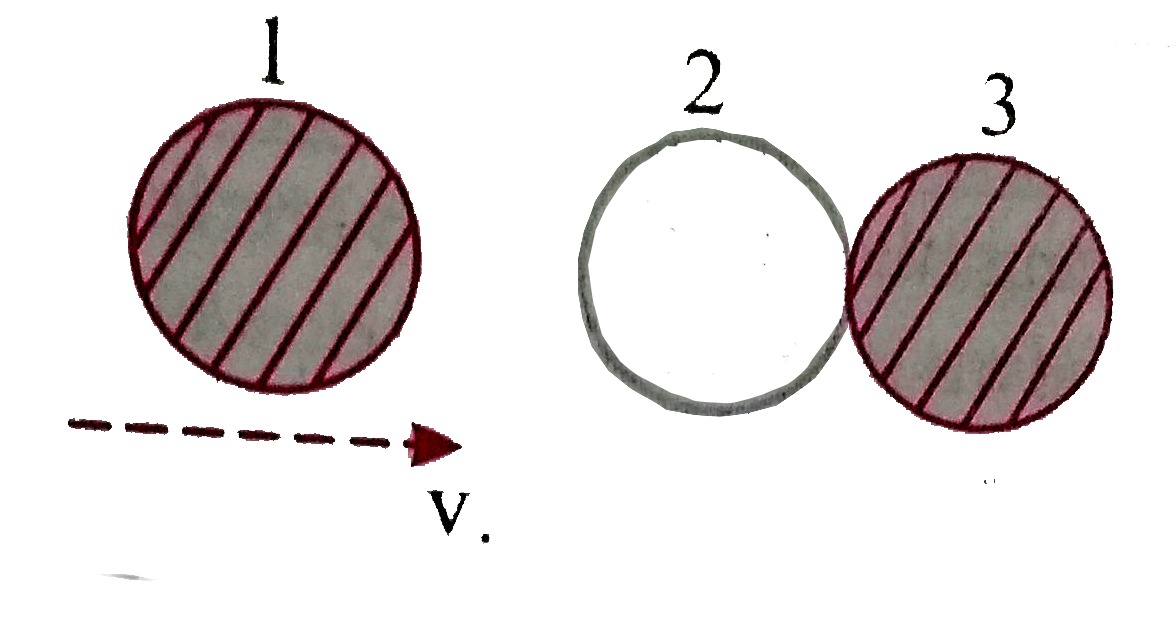
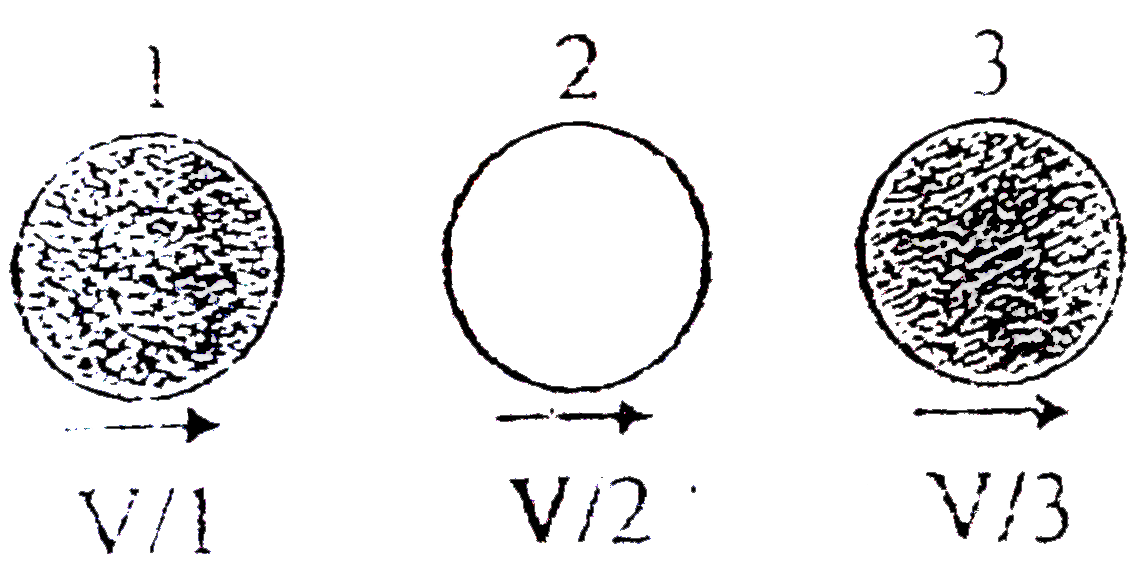
Two identical ball bearings in contact with each other and resting on a frictionless table are hit heat-on by another ball bearing of the same mass moving initially with a speed `V` as shown in figure.

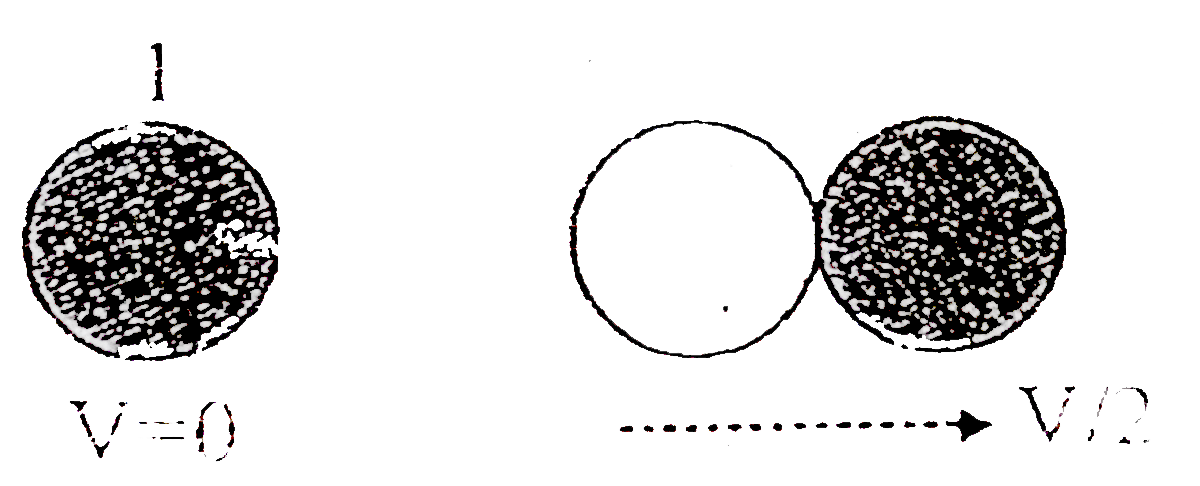
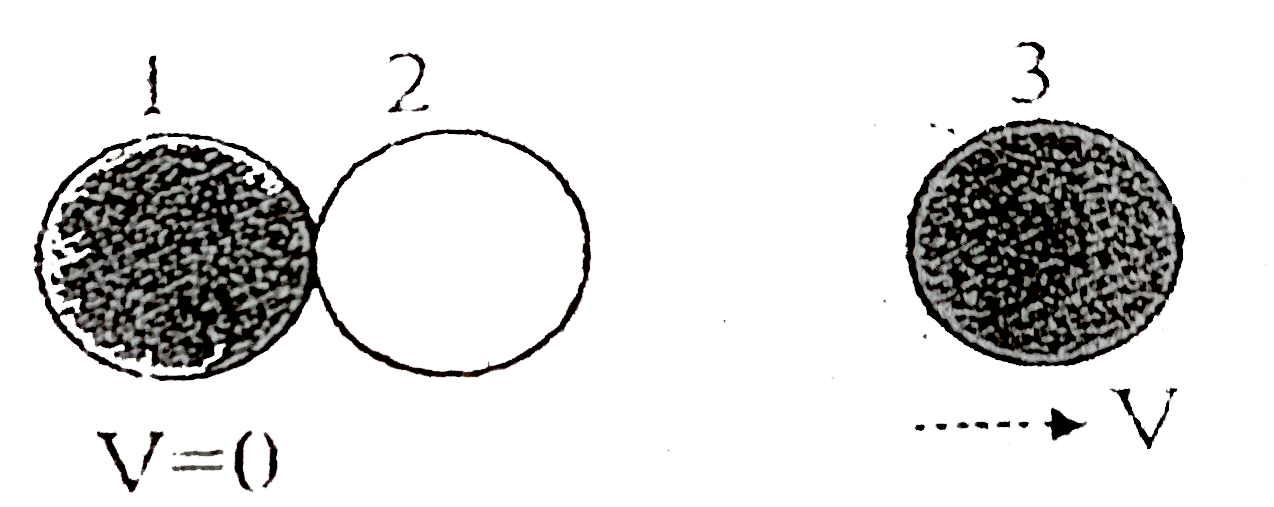
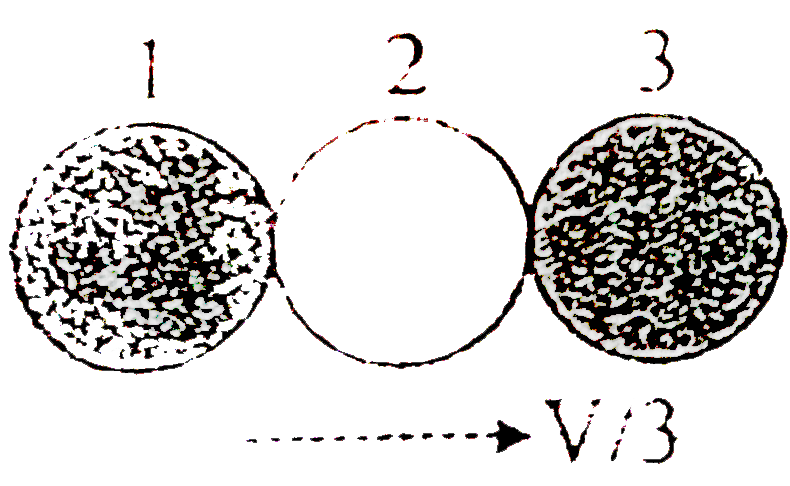
If the collision is elastic, which of the following (figure) is a possible result after collision ?

A

B

C

D

Text Solution

Verified by Experts

The correct Answer is:

B

Ans. (2)
Momentum of first ball bearing is transfer to second & this momentum is finally transfer to 3rd.
Ball bearing (see "Newton's cradle' for details)
Promotional Banner

Topper's Solved these Questions

Similar Questions

Explore conceptually related problems

Two identical ball bearing in contact each other and resting on a frictionless table are hit head - on by another ball bearing of the same mass moving intially with a speed c as shown in figure . If the collision is elastic mwhich of the following (figure ) is a possible result after collision ?

Two identical ball bearings in contact with each other and resting on a frictionless table are hit head - on by another ball bearing of the same mass moving initially with a speed V. If the collision is elastic , which of the following fgures is a possible result after collision ?

The bob A of a pendulum released from 30^(@) to the vertical hits another bob B of the same mass at rest on a table as shown in figure . How high does the bob A rise after the collision ? Neglect the size of the bobs and assume the collision to be elastic .

The bob A of a simple pendulum released from 30^(@) to the vertical hits another bobo B of the same mass at rest on a table as shown in figure. How high does the bob A rise after the collision ? Neglect the size of the bobs and assume the collision to be elastic.

Two billiard balls A and B, each of mass 50g and moving in opposite directions with speed of 5 ms^(1) each, collide and rebound with the same speed. If the collision lasts for 10^(-3) s, which of the following statements are true ?

A ball moving with a velocity of 12ms^(-1) collides with another identical stationary ball . After the collision they move as shown in figure . Find the speed of the balls after the collision . Also , decide whether the condition is elastic or not .

Two identical balls moving in opposite directions in free space collide head on. How they will move after the impact, is decided by coefficient of restitution. For different coeffecients of restiution, few possible outcomes are shown in the following figures. Which of the above outcomes are physically possible for a collision?

A ball of mass 2kg moving with speed 5m/s collides directly with another ball of mass 3kg moving in the same direction with speed 4m/s. The coefficient os restitution is 2/3. Find the velocities of both ball after the collision.

A body of mass 'm' moving with velocity v_(1) along X - axis undergo elastic collision with another body of same mass 'm' moving velocity v_(2) along X - axis . The velocity of second body after collision is equal to

ALLEN -TEST PAPER-Exercise (Physics)
  1. A particle of mass 4 m which is at rest explodes into masses m, m & 2m...

    Text Solution

    |

  2. Two girls of equal mass m jump off from the border line of a stationar...

    Text Solution

    |

  3. Two identical ball bearings in contact with each other and resting on ...

    Text Solution

    |

  4. Three different projectiles, each with the same mass, are fired with s...

    Text Solution

    |

  5. Three bodies are moving as shown below. The total kinetic energy of th...

    Text Solution

    |

  6. Two particles are projected at the same instant with speeds v(1) and v...

    Text Solution

    |

  7. Two particles of equal masses moving with same collide perfectly inela...

    Text Solution

    |

  8. The linear density of a non-uniform rod of length 2m is given by lamda...

    Text Solution

    |

  9. If the volume of a sphere increases at constant rate ((dv)/(dt)=4). I...

    Text Solution

    |

  10. Potential Energy U(x) and associated force F(x) bears the relation F(x...

    Text Solution

    |

  11. Electric current in a wire is time rate of flow of charge. The charge ...

    Text Solution

    |

  12. A metal rod extends on the x-axis from x=0m to x=4m. Its linear densit...

    Text Solution

    |

  13. An airplane takes off at an angle 30^(@) with the horizontal ground tr...

    Text Solution

    |

  14. If vectors vec(A)=(hat(i)+2hat(j)+3hat(k))m and vec(B)=(hat(i)-hat(j)...

    Text Solution

    |

  15. Position of a particle moving along straight line is given by x(t)=(A)...

    Text Solution

    |

  16. Acceleration time graph of a particle moving along a straight line is ...

    Text Solution

    |

  17. Two smooth sphere each of radius 5cm and weight W rest one on the othe...

    Text Solution

    |

  18. The position of a particle moving along x-axis varies with time t acco...

    Text Solution

    |

  19. A particle of mass m is moving with constant speed in a vertical circl...

    Text Solution

    |

  20. The relation between time t and distance x of a particle is given by t...

    Text Solution

    |
