Home
Class 12
PHYSICS
Two particles are projected at the same ...

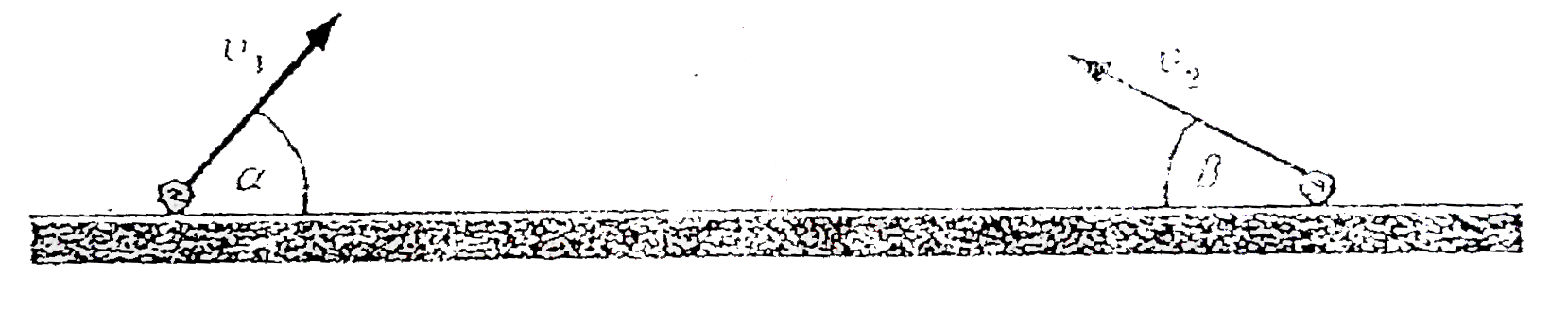
Two particles are projected at the same instant with speeds `v_(1)` and `v_(2)` making angles `alpha` and `beta` with the horizontal as shown in the figure. Nelecting air resistance, the trajectory of the mass center the two particles

A

can be a vertical straight line

B

can be a horizontal straight line

C

is a straight line

D

is a parabola

Text Solution

Verified by Experts

The correct Answer is:

A

Ans. (1)
If `m_(1)v_(1)cosalphanem_(2)v_(2)`, then centre of mass will move in a parabola.
If `m_(1)v_(1)cosalpha=m_(2)v_(2)`, then centre of mass will move in straight line.
Promotional Banner

Topper's Solved these Questions

Similar Questions

Explore conceptually related problems

Two projectiles are thrown simultaneously in the same plane from the same point. If their velocities are v_(1) and v_(2) at angles theta_(1) and theta_(2) respectively from the horizontal, then ansewer the following questions The trajectory of particle 1 with respect to particle 2 wil be

Two particles A and B are projected from the same point in different direction in such a manner that their velocity vectors are shown in the diagram :- .

Two bodies are thrown with the same initial speed at angles alpha and (90^(@) -alpha) with the horizontal. What will be the ratio of maximum heights attained by them

A particle of mass m is projected from the ground with an initial speed u_0 at an angle alpha with the horizontal. At the highest point of its trajectory, it makes a completely inelastic collision with another identical particle, which was thrown vertically upward from the ground with the same initial speed u_0. The angle that the composite system makes with the horizontal immediately after the collision is

A large , heavy box is sliding without friction down a smooth plane of inclination theta . From a point P on the bottom of the box , a particle is projected inside the box . The initial speed of the particle with respect to the box is u , and the direction of projection makes an angle alpha with the bottom as shown in Figure . (a) Find the distance along the bottom of the box between the point of projection p and the point Q where the particle lands . ( Assume that the particle does not hit any other surface of the box . Neglect air resistance .) (b) If the horizontal displacement of the particle as seen by an observer on the ground is zero , find the speed of the box with respect to the ground at the instant when particle was projected .

Three particles A, B and C are projected from the same point with the same initial speeds making angles 30^(@), 45^(@) and 60^(@) respectively with the horizontal. Which of the following statement is correct?

Two bodies are thrown with the same initial speed at angles alpha and (90^(@) -alpha) with the horizontal. What will be the ratio of (a) maximum heights attained by them and (b) horizontal ranges ?

A particle A is projected with speed v_(A) from a point making an angle 60^(@) with the horizontal. At the same instant, a second particle B is thrown vertically upwards from a point directly below the maximum hieght point of parabolic path of A with velocity v_(B) . If the two particles collide then the ratio of v_(A)//v_(B) should be

A particle of mass m is projected with speed u at an angle theta with the horizontal. Find the torque of the weight of the particle about the point of projection when the particle is at the highest point.

A particle is projected from a point P with a velocity v at an angle theta with horizontal. At a certain point Q it moves at right angles to its initial direction. Then

ALLEN -TEST PAPER-Exercise (Physics)
  1. Three different projectiles, each with the same mass, are fired with s...

    Text Solution

    |

  2. Three bodies are moving as shown below. The total kinetic energy of th...

    Text Solution

    |

  3. Two particles are projected at the same instant with speeds v(1) and v...

    Text Solution

    |

  4. Two particles of equal masses moving with same collide perfectly inela...

    Text Solution

    |

  5. The linear density of a non-uniform rod of length 2m is given by lamda...

    Text Solution

    |

  6. If the volume of a sphere increases at constant rate ((dv)/(dt)=4). I...

    Text Solution

    |

  7. Potential Energy U(x) and associated force F(x) bears the relation F(x...

    Text Solution

    |

  8. Electric current in a wire is time rate of flow of charge. The charge ...

    Text Solution

    |

  9. A metal rod extends on the x-axis from x=0m to x=4m. Its linear densit...

    Text Solution

    |

  10. An airplane takes off at an angle 30^(@) with the horizontal ground tr...

    Text Solution

    |

  11. If vectors vec(A)=(hat(i)+2hat(j)+3hat(k))m and vec(B)=(hat(i)-hat(j)...

    Text Solution

    |

  12. Position of a particle moving along straight line is given by x(t)=(A)...

    Text Solution

    |

  13. Acceleration time graph of a particle moving along a straight line is ...

    Text Solution

    |

  14. Two smooth sphere each of radius 5cm and weight W rest one on the othe...

    Text Solution

    |

  15. The position of a particle moving along x-axis varies with time t acco...

    Text Solution

    |

  16. A particle of mass m is moving with constant speed in a vertical circl...

    Text Solution

    |

  17. The relation between time t and distance x of a particle is given by t...

    Text Solution

    |

  18. Velocity of a boat relative to river current and river current velocit...

    Text Solution

    |

  19. Potential energy curve U of a particle as function of the position of ...

    Text Solution

    |

  20. Block A of mass 5kg is placed on long block B having a mass of 5kg. Th...

    Text Solution

    |
