Home
Class 12
PHYSICS
Two 20g worms climb over a 10cm high, ve...

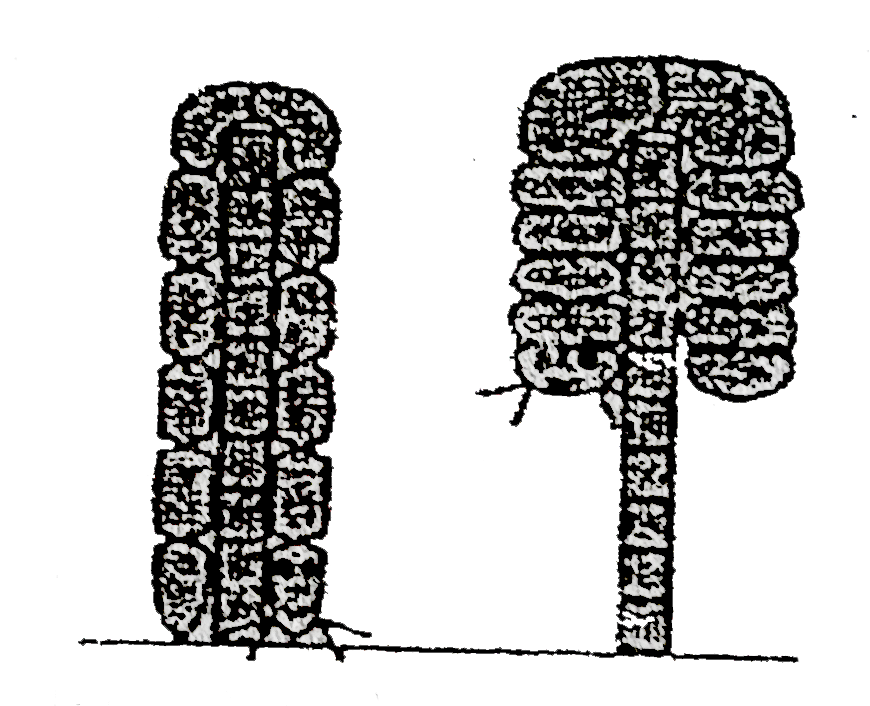
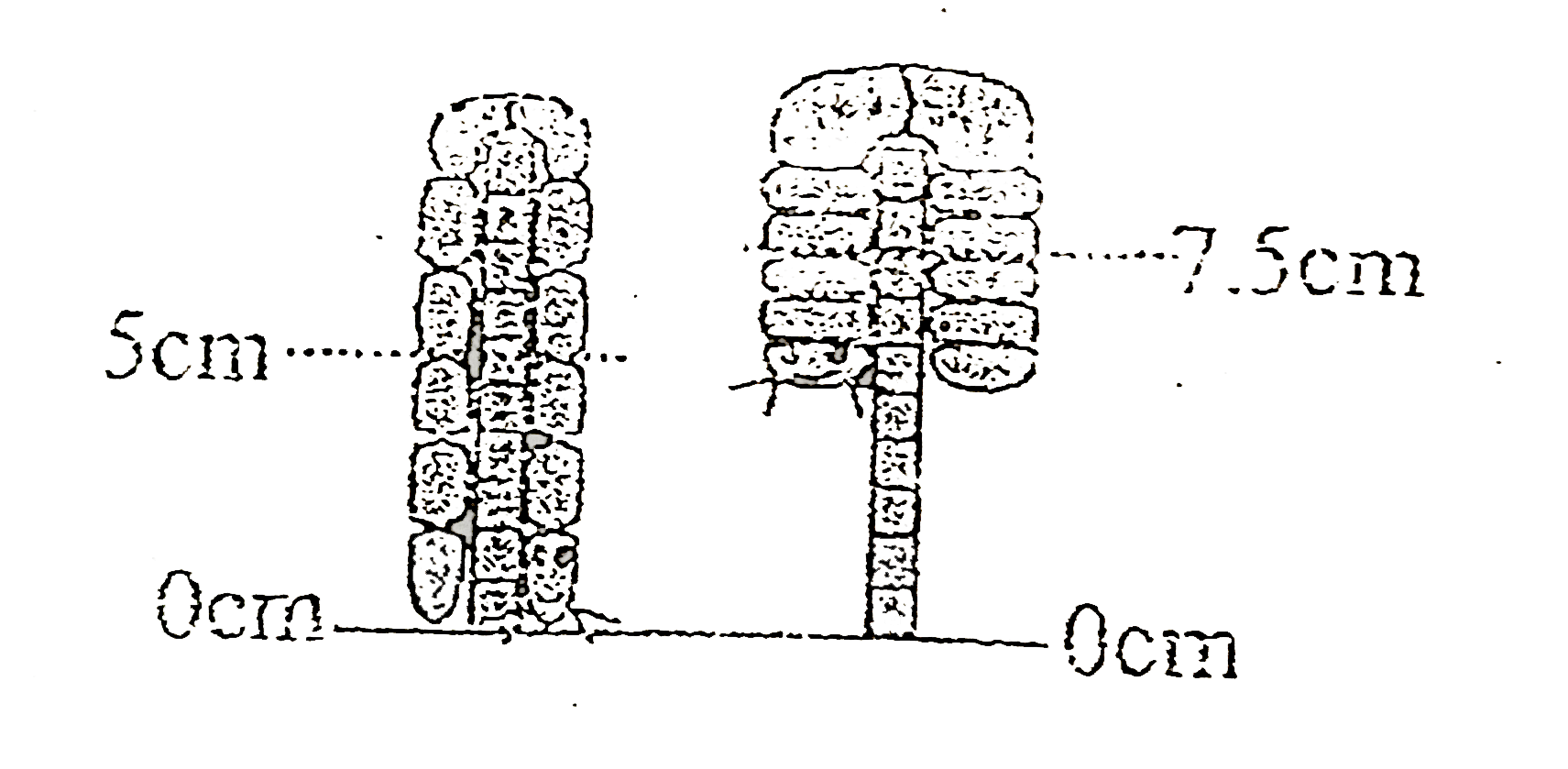
Two `20g` worms climb over a `10cm` high, very then wall. One worm is thin and `20cm` long the other is fat and only `10cm` long. What is the ratio of the potential energy (w.r.t. the base of wall) of the thin worm as comparses to that of the fat worm when each is half way over the top of the wall as shown?

A

`1:1`

B

`2:1`

C

`2:3`

D

`1:2`

Text Solution

Verified by Experts

The correct Answer is:
C

Ans.(3)

Required ratio`=(5cm)/(7.5cm)=(2)/(3)`
Promotional Banner

Topper's Solved these Questions

Similar Questions

Explore conceptually related problems

Scientists are working hard to develop nuclear fusion reactor Nuclei of heavy hydrogen, _(1)^(2)H , known as deuteron and denoted by D , can be thought of as a candidate for fusion rector . The D-D reaction is _(1)^(2) H + _(1)^(2) H rarr _(2)^(1) He + n+ energy. In the core of fusion reactor, a gas of heavy hydrogen of _(1)^(2) H is fully ionized into deuteron nuclei and electrons. This collection of _1^2H nuclei and electrons is known as plasma . The nuclei move randomly in the reactor core and occasionally come close enough for nuclear fusion to take place. Usually , the temperature in the reactor core are too high and no material will can be used to confine the to plasma for a time t_(0) before the particles fly away from the core. If n is the density (number volume ) of deuterons , the product nt_(0) is called Lawson number. In one of the criteria , a reactor is termed successful if Lawson number is greater then 5 xx 10^(14) s//cm^(2) it may be helpfull to use the following boltzmann constant lambda = 8.6 xx 10^(-5)eV//k, (e^(2))/(4 pi s_(0)) = 1.44 xx 10^(-9) eVm Assume that two deuteron nuclei in the core of fusion reactor at temperature energy T are moving toward each other, each with kinectic energy 1.5 kT , when the seperation between them is large enough to neglect coulomb potential energy . Also neglate any interaction from other particle in the core . The minimum temperature T required for them to reach a separation of 4 xx 10^(-15) m is in the range

Scientists are working hard to develop nuclear fusion reactor Nuclei of heavy hydrogen, _(1)^(2)H , known as deuteron and denoted by D , can be thought of as a candidate for fusion rector . The D-D reaction is _(1)^(2) H + _(1)^(2) H rarr _(2)^(1) He + n+ energy. In the core of fusion reactor, a gas of heavy hydrogen of _(1)^(2) H is fully ionized into deuteron nuclei and electrons. This collection of _1^2H nuclei and electrons is known as plasma . The nuclei move randomly in the reactor core and occasionally come close enough for nuclear fusion to take place. Usually , the temperature in the reactor core are too high and no material will can be used to confine the to plasma for a time t_(0) before the particles fly away from the core. If n is the density (number volume ) of deuterons , the product nt_(0) is called Lawson number. In one of the criteria , a reactor is termed successful if Lawson number is greater then 5 xx 10^(14) s//cm^(2) it may be helpfull to use the following boltzmann constant lambda = 8.6 xx 10^(-5)eV//k, (e^(2))/(4 pi s_(0)) = 1.44 xx 10^(-9) eVm Assume that two deuteron nuclei in the core of fusion reactor at temperature energy T are moving toward each other, each with kinectic energy 1.5 kT , when the seperation between them is large enough to neglect coulomb potential energy . Also neglate any interaction from other particle in the core . The minimum temperature T required for them to reach a separation of 4 xx 10^(-15) m is in the range

A uniform thin cylindrical disk of mass M and radius R is attaached to two identical massless springs of spring constatn k which are fixed to the wall as shown in the figure. The springs are attached to the axle of the disk symmetrically on either side at a distance d from its centre. The axle is massless and both the springs and the axle are in horizontal plane. the unstretched length of each spring is L. The disk is initially at its equilibrium position with its centre of mass (CM) at a distance L from the wall. The disk rolls without slipping with velocity vecV_0 = vacV_0hati. The coefficinet of friction is mu. The centre of mass of the disk undergoes simple harmonic motion with angular frequency omega equal to -

A closed cubical box is made of perfectly insulating material and the only way for heat to enter or leave the box is through two solid cylindrical metal plugs, each of cross sectional area 12cm^(2) and length 8cm fixed in the opposite walls of the box. The outer surface of one plug is kept at a temperature of 100^(@)C . while the outer surface of the plug is maintained at a temperature of 4(@)C . The thermal conductivity of the material of the plug is 2.0Wm^(-1).^(@)C^(-1) . A source of energy generating 13W is enclosed inside the box. Find the equilibrium temperature of the inner surface of the box assuming that it is the same at all points on the inner surface.

A uniform thin cylindrical disk of mass M and radius R is attaached to two identical massless springs of spring constatn k which are fixed to the wall as shown in the figure. The springs are attached to the axle of the disk symmetrically on either side at a distance d from its centre. The axle is massless and both the springs and the axle are in horizontal plane. the unstretched length of each spring is L. The disk is initially at its equilibrium position with its centre of mass (CM) at a distance L from the wall. The disk rolls without slipping with velocity vecV_0 = vacV_0hati. The coefficinet of friction is mu. The net external force acting on the disk when its centre of mass is at displacement x with respect to its equilibrium position is.

An experimental setup of verification of photoelectric effect is shown in the diagram. The voltage across the electrode is measured with the help of an ideal voltmetar, and which can be varied by moving jockey 'J' on the potentiometer wire. The battery used in potentiometer circuit is of 20 V and its internal resistance is 2omega . The resistance of 100 cm long potentiometer wire is 8 omega . The photo current is measured with the help of an ideal ammeter. Two plates of potassium oxide of area 50 cm^(2) at separation 0.5 mm are used in the vacuum tube. Photo current in the circuit is very small so we can treat potentiometer circuit an indepdent circuit. The wavelength of various colours is as follows : |{:("Light",underset("Violet")(1),underset("Blue")(2),underset("Green")(3),underset("Yellow")(4),underset("Orange")(5),underset("Red")(6)),(lambda "in" Årarr,4000-4500,4500-5000,5000-5500,5500-6000,6000-6500,6500-7000):}| It is found that ammeter current remians unchanged (2muA) even when the jockey is moved from the 'P' to the middle point of the potentiometer wire. Assuming all the incident photons eject electron and the power of the light incident is 4 xx 10^(-6) W . Then colour of the incident light is :

An experimental setup of verification of photoelectric effect is shown in the diagram. The voltage across the electrode is measured with the help of an ideal voltmetar, and which can be varied by moving jockey 'J' on the potentiometer wire. The battery used in potentiometer circuit is of 20 V and its internal resistance is 2omega . The resistance of 100 cm long potentiometer wire is 8 omega . The photo current is measured with the help of an ideal ammeter. Two plates of potassium oxide of area 50 cm^(2) at separation 0.5 mm are used in the vacuum tube. Photo current in the circuit is very small so we can treat potentiometer circuit an indepdent circuit. The wavelength of various colours is as follows : |{:("Light",underset("Violet")(1),underset("Blue")(2),underset("Green")(3),underset("Yellow")(4),underset("Orange")(5),underset("Red")(6)),(lambda "in" Årarr,4000-4500,4500-5000,5000-5500,5500-6000,6000-6500,6500-7000):}| When other light falls on the anode plate the ammeter reading remains zero till, jockey till, jockey is moved from the end P to the middle point on the wire PQ. Thereafter the deflection is recorded in the ammeter. The maximum kinetic energy of the emitted electron is :

One end of a long string of linear mass density 8.0 xx 10^(-3) kg m^(-1) is connected to an electrically driven tuning fork of frequency 256Hz. The other end passes over a pulley and is tied to a pan containing a mass of 90kg. The pulley end absorbs all the incoming energy so that reflected waves at this end have negligible amplitude. At t=0, the left end (fork end) of the string x=0 has zero transverse displacement (y=0) and is moving along positive y-direction. The amplitude of the wave is 5.0 cm. Write down the transverse displacement y as function of x and t that describes the wave on the string.

Consider a coin of Question 20. It is electrically neutral and contains equal amounts of positive and negative charge of magnitude 34.8 kC. Suppose that these equal charges were concentrated in two point charges separated by: (i) 1 cm (-1/2) xx displacement of the one paisa coin) (ii) 100 m (-length of a long building) (iii) 10^(6) m (radius of the earth). Find the force on each such point charge in each of the three cases. What do you conclude from these results ?

ALLEN -TEST PAPER-Exercise (Physics)
  1. A helicopter of mass M is lowering a truck of mass m onto the deck of ...

    Text Solution

    |

  2. A box with weight 10N rests on a horizontal surface. A person pulls ho...

    Text Solution

    |

  3. Two 20g worms climb over a 10cm high, very then wall. One worm is thin...

    Text Solution

    |

  4. Three particles of masses 1 kg, 2 kg and 3 kg are situated at the corn...

    Text Solution

    |

  5. A particle is thrown vertically upward with a speed u from the top of ...

    Text Solution

    |

  6. Find the x coordinate of the centre of mass of the bricks shown in fig...

    Text Solution

    |

  7. From a circular disc of radius R, a triangular portion is cut (see fig...

    Text Solution

    |

  8. A sector cut from a uniform disk of radius 12cm and a uniform rod of t...

    Text Solution

    |

  9. If the center of mass of a system of three particles of masses 1kg,2k...

    Text Solution

    |

  10. A machinist starts with three identical square plates but cuts one cor...

    Text Solution

    |

  11. Pull down in the middle a heavy chain, fixed at both ends, in such a w...

    Text Solution

    |

  12. Particle of masses m, 2m,3m,…,nm grams are placed on the same line at ...

    Text Solution

    |

  13. To form a jeep, two squares of side length 10cm & 20cm and two circles...

    Text Solution

    |

  14. Three rods of the same mass are placed as shown in the figure. Calcula...

    Text Solution

    |

  15. A uniform wire frame ABC is in the shape of an equilateral triangle in...

    Text Solution

    |

  16. The figure below depicts the paths of two colliding steel balls, A and...

    Text Solution

    |

  17. A uniform chain of mass m and length l hangs on a thread and touches t...

    Text Solution

    |

  18. Two forces F(1) and F(2) are applied simultaneously on a 2kg block res...

    Text Solution

    |

  19. A 6.0kg mass is moving to the right at 10 m//s. A 0.25kg mass is fired...

    Text Solution

    |

  20. Two identical balls moving in opposite directions in free space collid...

    Text Solution

    |

