Home
Class 12
PHYSICS
In figure, determine the character of th...

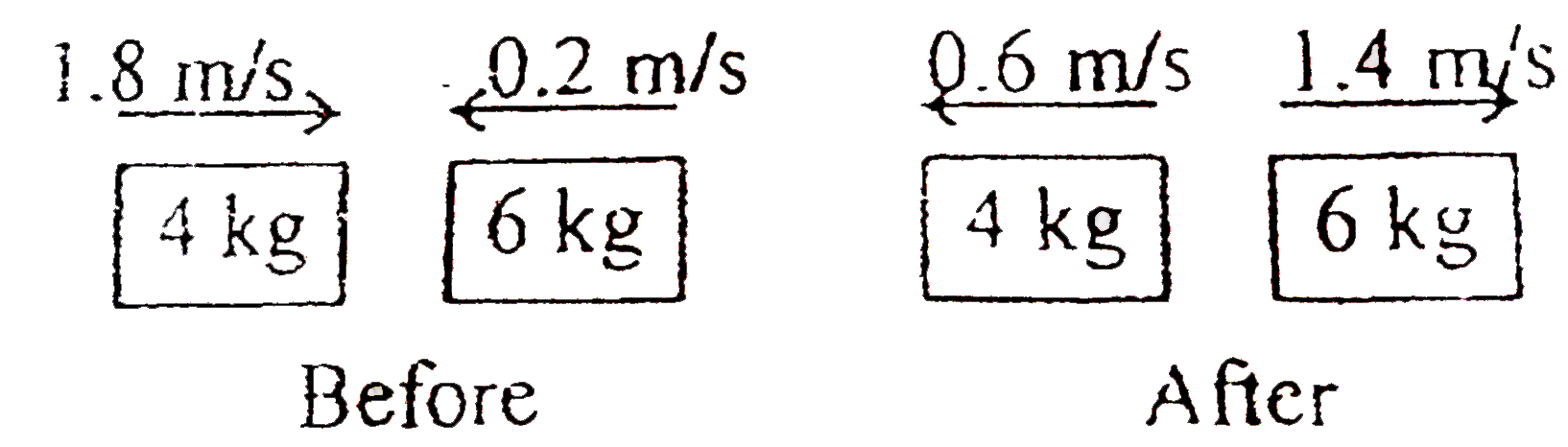
In figure, determine the character of the collision. The masses of the blocks, and the velocities before and after are given. The collision is

A

perfectly elastic

B

Partially inelastic

C

Completely inelastic

D

This collision is not possible

Text Solution

Verified by Experts

The correct Answer is:

A

Ans.(1)
Linear momentum is conserverd and
`e=("Speed of separation")/("Speed of approach")=(1.4+0.6)/(1.8+0.2)=1`
So, collision of perfectly elastic.
Promotional Banner

Topper's Solved these Questions

Similar Questions

Explore conceptually related problems

A ball hits the floor and rebounds after an inelastic collision. In this case

On a smooth carrom board. A coin located at (4,6) is moving in negative y- direction with speed 3m//s is being hit at that point by a striker moving along negative x- axis . The line joining centre of the coin and striker just before the collision is parallel to x- axis. After collision the coin goes into the hole located at origin. Mass of the striker and the coin is equal. Considering the collision to be elastic, find the velocity ( in vector form ) of the stricker before the collision and after the collision.

In a collinear collision a particle with an intial speed v_(0) strike a stationary particle of the same mass. If the final total kinetic energy is 50 % greater than the original kinetic energy the magnitude of the relative velocity between the two particles after collision is .

A ball moving with a velocity of 12ms^(-1) collides with another identical stationary ball . After the collision they move as shown in figure . Find the speed of the balls after the collision . Also , decide whether the condition is elastic or not .

Two fixed, identical conducting plates (a and (3), each of surface area S are charged to - Q and q, respectively, where Q > q > 0. A third identical plate ( lambda ), free to move Is located on the other side of the plate with charge q at a distance d as per figure. The third plate is released and collides with the plate f_3 . Assume the collision is elastic and the time of collision is sufficient to redistribute charge amongst beta and gamma . (a) Find the electric field acting on the plate gamma before collision. (b) Find the charges on beta and gamma after the collision. (c) Find the velocity of the plate gamma after the collision and at a distance d from the plate beta

Figure shows the velocity-time graph for two masses R and S that collided elastically. Which of the following statements is true? i. R and S moved in the same direction after the collision. ii. The velocities of R and S were equal at the mid time of the collision. iii. The mass of R was greater than mass of S . Which of the following is true?

A particle of mass m moving in the x - direction with speed 2c is hit by another particle of mass 2m moving in the y - direction with with speed v . If the collision is perfectly inelastic , the percentage loss in the enrgy during the collision is close to .

A ball of mass 2kg moving with speed 5m/s collides directly with another ball of mass 3kg moving in the same direction with speed 4m/s. The coefficient os restitution is 2/3. Find the velocities of both ball after the collision.

A block of mass 5 kg moves from left to right with a velocity of 2ms^(-1) and collides with another block of mass 3 kg moving along the same line in the opposite direction with velocity 4 ms^(-1) . (i) If the collision is perfectly elastic, determine velocities of both the blocks after their collision. (ii) If coefficient of restitution is 0.6, determine velocities of both the blocks after their collision.

ALLEN -TEST PAPER-Exercise (Physics)
  1. A 6.0kg mass is moving to the right at 10 m//s. A 0.25kg mass is fired...

    Text Solution

    |

  2. Two identical balls moving in opposite directions in free space collid...

    Text Solution

    |

  3. In figure, determine the character of the collision. The masses of the...

    Text Solution

    |

  4. A rod has non uniform mass distribution. The mass increases uniformly ...

    Text Solution

    |

  5. A solid hemisphere and a hemisphereical shell are joined as shown. Bot...

    Text Solution

    |

  6. In a system of four thin uniform rods are each of mass inas shown. If ...

    Text Solution

    |

  7. A vertical rectangular door with its centre of gravity at O (see figur...

    Text Solution

    |

  8. A rectangular metal plate ABCD is supported by two hinges P(1) and P(2...

    Text Solution

    |

  9. A uniform beam of weight W is attached to a verical wall by a hings H....

    Text Solution

    |

  10. A body is free to rotate about an axis parallel to y-axis. A force of ...

    Text Solution

    |

  11. A disc of radius R=2m starts rotating wth constant angular acceleratio...

    Text Solution

    |

  12. In the balance machine shown in the figures. Which arm will move downw...

    Text Solution

    |

  13. A uniform disc of mass M =2.50 kg and radius R = 0.20 m is mounted on ...

    Text Solution

    |

  14. A car runs at constant speed around the horizontal race track shown in...

    Text Solution

    |

  15. A man M slides down a curved frictionless track, starting from rest. ...

    Text Solution

    |

  16. An object moves counter-clockwise along the circular path shown below....

    Text Solution

    |

  17. A girl finds herself stuck with her back to the wall of a cylinder rot...

    Text Solution

    |

  18. A puck of mass m is moving in a circle at constant speed on a friction...

    Text Solution

    |

  19. A simple pendulum of bob of mass m and length L has one of its ends fi...

    Text Solution

    |

  20. A small disc can slide in a circular path on a frictionless inclined p...

    Text Solution

    |
