Home
Class 12
PHYSICS
Two pucks are initially moving along a f...

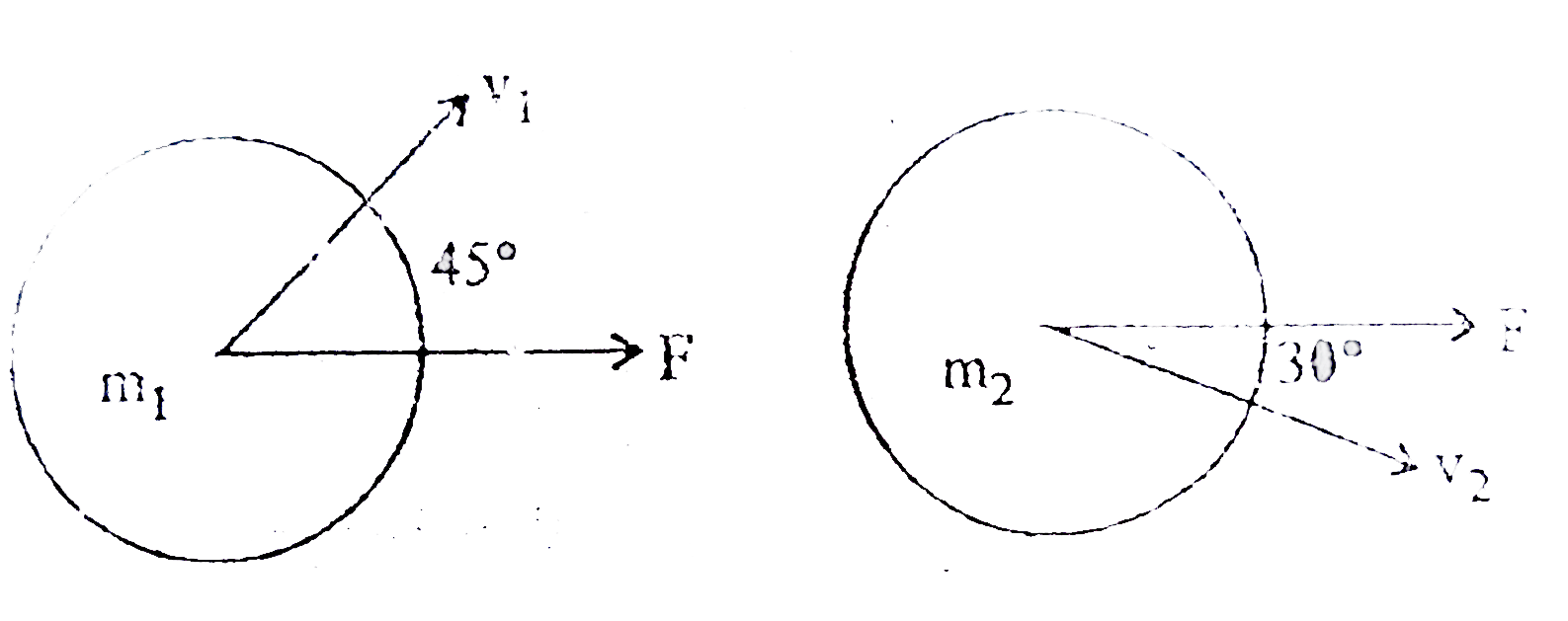
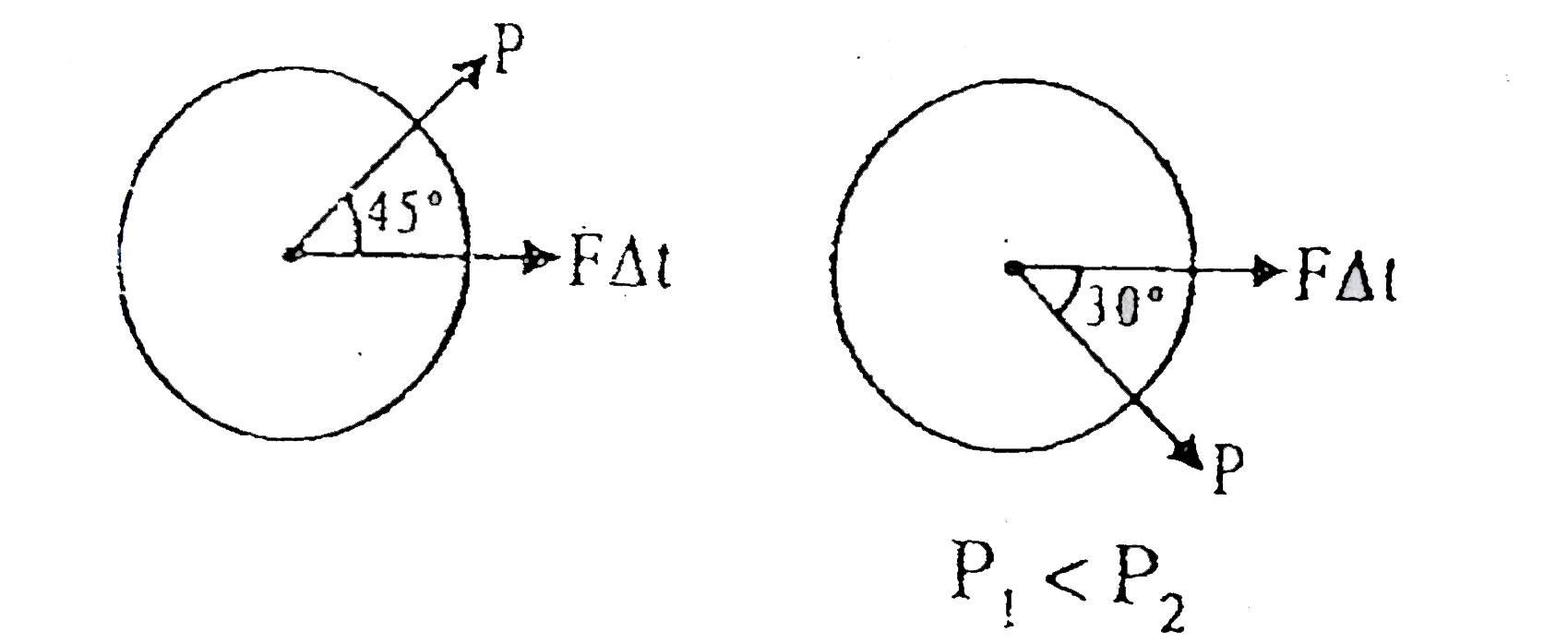
Two pucks are initially moving along a frictionless surface as shown in the diagram. The pucks have mass `m_(1)ltm_(2)` and begin with equal magnitude of momentum. A constant force `vec(F)` is applied to each puck direactly to the right for the same amount of nonzero time. After the pushes are complete, what is the relationship for the size of the moments of pucks (`p_(1)` and `p_(2)`) ?

A

`P_(1)ltP_(2)`

B

`P_(1)=P_(2)`

C

`P_(1)gtP_(2)`

D

More information about the masses, speeds, force and time are required to answer the question

Text Solution

Verified by Experts

The correct Answer is:
A

`P_(1)ltP_(2)`
Promotional Banner

Topper's Solved these Questions

Similar Questions

Explore conceptually related problems

A small puck is sliding to the right with momentum vec(P)_(1) on a horizontal, frictionless surface, as shown in figure. A force is applied to the puck for a short time and its momentum afterward is vec(P)_(f) . Which lettered arrow shows the direction of the impulse that was delovered to the puck ?

A uniform rod of mass M and length L lies flat on a frictionless horizantal surface. Two forces F and 2F are applied along the length of the rod as shown. The tension in the rod at point P is

An accelration produces a narrow beam of protons, each having an initial speed of v_(0) . The beam is directed towards an initially uncharges distant metal sphere of radius R and centered at point O. The initial path of the beam is parallel to the axis of the sphere at a distance of (R//2) from the axis, as indicated in the diagram. The protons in the beam that collide with the sphere will cause it to becomes charged. The subsequentpotential field at the accelerator due to the sphere can be neglected. The angular momentum of a particle is defined in a similar way to the moment of a force. It is defined as the moment of its linear momentum, linear replacing the force. We may assume the angular momentum of a proton about point O to be conserved. Assume the mass of the proton as m_(P) and the charge on it as e. Given that the potential of the sphere increases with time and eventually reaches a constant velue. After a long time, when the potential of the sphere reaches a constant value, the trajectory of proton is correctly sketched as

An accelration produces a narrow beam of protons, each having an initial speed of v_(0) . The beam is directed towards an initially uncharges distant metal sphere of radius R and centered at point O. The initial path of the beam is parallel to the axis of the sphere at a distance of (R//2) from the axis, as indicated in the diagram. The protons in the beam that collide with the sphere will cause it to becomes charged. The subsequentpotential field at the accelerator due to the sphere can be neglected. The angular momentum of a particle is defined in a similar way to the moment of a force. It is defined as the moment of its linear momentum, linear replacing the force. We may assume the angular momentum of a proton about point O to be conserved. Assume the mass of the proton as m_(P) and the charge on it as e. Given that the potential of the sphere increases with time and eventually reaches a constant velue. One the potential of the sphere has reached its final, constant value, the minimum speed v of a proton along its trajectory path is given by

An accelration produces a narrow beam of protons, each having an initial speed of v_(0) . The beam is directed towards an initially uncharges distant metal sphere of radius R and centered at point O. The initial path of the beam is parallel to the axis of the sphere at a distance of (R//2) from the axis, as indicated in the diagram. The protons in the beam that collide with the sphere will cause it to becomes charged. The subsequentpotential field at the accelerator due to the sphere can be neglected. The angular momentum of a particle is defined in a similar way to the moment of a force. It is defined as the moment of its linear momentum, linear replacing the force. We may assume the angular momentum of a proton about point O to be conserved. Assume the mass of the proton as m_(P) and the charge on it as e. Given that the potential of the sphere increases with time and eventually reaches a constant velue. If the initial kinetic energy of a proton is 2.56 ke V , then the final potential of the sphere is

An accelration produces a narrow beam of protons, each having an initial speed of v_(0) . The beam is directed towards an initially uncharges distant metal sphere of radius R and centered at point O. The initial path of the beam is parallel to the axis of the sphere at a distance of (R//2) from the axis, as indicated in the diagram. The protons in the beam that collide with the sphere will cause it to becomes charged. The subsequentpotential field at the accelerator due to the sphere can be neglected. The angular momentum of a particle is defined in a similar way to the moment of a force. It is defined as the moment of its linear momentum, linear replacing the force. We may assume the angular momentum of a proton about point O to be conserved. Assume the mass of the proton as m_(P) and the charge on it as e. Given that the potential of the sphere increases with time and eventually reaches a constant velue. The limiting electric potential of the sphere is

An accelration produces a narrow beam of protons, each having an initial speed of v_(0) . The beam is directed towards an initially uncharges distant metal sphere of radius R and centered at point O. The initial path of the beam is parallel to the axis of the sphere at a distance of (R//2) from the axis, as indicated in the diagram. The protons in the beam that collide with the sphere will cause it to becomes charged. The subsequentpotential field at the accelerator due to the sphere can be neglected. The angular momentum of a particle is defined in a similar way to the moment of a force. It is defined as the moment of its linear momentum, linear replacing the force. We may assume the angular momentum of a proton about point O to be conserved. Assume the mass of the proton as m_(P) and the charge on it as e. Given that the potential of the sphere increases with time and eventually reaches a constant velue. The total energy (E) of a proton in the beam travelling with seed v at a distance of r (r ge R) from point O. Assuming that the sphere has acquired an electrostatic charge Q is

A uniform solid disc of mass 1 kg and radius 1m is kept on a rough horizontal surface. Two forces of magnitude 2N and 4N have been applied on the disc as shown in the figure. Linear acceleration of the center of mass of the disc is if there is no slipping is

Separation of Motion of a system of particles into motion of the centre of mass and motion about the centre of mass : (a) Show p=p_(i).+m_(i)V where p_(i) is the momentum of the ith particle (of mass m_(i) ) and p_(i).=m_(i)v_(i). . Note v_(i). is the velocity of the i^(th) particle relative to the centre of mass Also, prove using the definition of the centre of mass Sigmap_(i).=0 (b) Show K=K.+(1)/(2)MV^(2) where K is the total kinetic energy of the system of particles, K. is the total kinetic energy of the system when the particle velocities are taken with respect to the centre of mass and (1)/(2)MV^(2) is the kinetic energy of the translation of the system as a whole (i.e. of the centre of mass motion of the system). The result has been used in Sec. 7.14). (c ) Show vecL=vecL.+vecRxxvec(MV) where vecL.=Sigmavec(r_(i)).xxvec(p_(i)). is the angular momentum of the system about the centre of mass with velocities taken relative to the centre of mass. Remember vec(r._(i))=vec(r_(i))-vecR , rest of the notation is the velcities taken relative to the centre of mass. Remember vec(r._(i))=vec(r_(i))-vecR rest of the notation is the standard notation used in the chapter. Note vecL , and vec(MR)xxvecV can be said to be angular momenta, respectively, about and of the centre of mass of the system of particles. (d) Show vec(dL.)/(dt)=sumvec(r_(i).)xxvec(dp.)/(dt) Further, show that vec(dL.)/(dt)=tau._(ext) where tau._(ext) is the sum of all external torques acting on the system about the centre of mass. (Hint : Use the definition of centre of mass and Newton.s Thrid Law. Assume the internal forces between any two particles act along the line joining the particles.)

A circus wishes to develop a new clown act. Fig. (1) shows a diagram of the proposed setup. A clown will be shot out of a cannot with velocity v_(0) at a trajectory that makes an angle theta=45^(@) with the ground. At this angile, the clown will travell a maximum horizontal distance. The cannot will accelerate the clown by applying a constant force of 10, 000N over a very short time of 0.24s . The height above the ground at which the clown begins his trajectory is 10m . A large hoop is to be suspended from the celling by a massless cable at just the right place so that the clown will be able to dive through it when he reaches a maximum height above the ground. After passing through the hoop he will then continue on his trajectory until arriving at the safety net. Fig (2) shows a graph of the vertical component of the clown's velocity as a function of time between the cannon and the hoop. Since the velocity depends on the mass of the particular clown performing the act, the graph shows data for serveral different masses. If a clown holds on to hoop instead of passing through it, what is the position of the cable so that he doesn't hit his head on the ceiling as he swings upward?

ALLEN -TEST PAPER-Exercise (Physics)
  1. A machinst starts with three identical square plates but cuts one corn...

    Text Solution

    |

  2. A block of mass m lies on a horizontal frictionless surface and is att...

    Text Solution

    |

  3. Two pucks are initially moving along a frictionless surface as shown i...

    Text Solution

    |

  4. Three particles with equal mass move with equal speed v along the medi...

    Text Solution

    |

  5. A canon shell moving along a straight line bursts into two parts. Just...

    Text Solution

    |

  6. Assertion :- velocity time graph of two paticles undergoing head-on co...

    Text Solution

    |

  7. Statement-1 : For any collision, coefficient of restitution (e0 lies ...

    Text Solution

    |

  8. Assertion :- To observe the motion of planets, the sun may be assumed ...

    Text Solution

    |

  9. Assertion :- The mechanical energy of earth-moon system remains same w...

    Text Solution

    |

  10. The average velocity of a particle moving on a straight line is zero i...

    Text Solution

    |

  11. Assertion:- A body may gain kinetic energy and potential energy simult...

    Text Solution

    |

  12. Assertion :- Newton's first law defines inertial frame of reference. ...

    Text Solution

    |

  13. A man of mass 80kg pushes box of mass 20kg horizontaly. The man moves ...

    Text Solution

    |

  14. Assertion :- A particle has positive acceleration it means that its sp...

    Text Solution

    |

  15. Assertion :- The shape of trajactory depends on the acceleration and i...

    Text Solution

    |

  16. Assertion :- In projectile motion a particle is projected at some angl...

    Text Solution

    |

  17. Assertion :- A block is hanged from spring. Spring force on block grav...

    Text Solution

    |

  18. Assertion :- Tension in massless string may be different at different ...

    Text Solution

    |

  19. Assertion :- Work done by frictional force may be sometimes path indep...

    Text Solution

    |

  20. Assertion :- Work done is positive when force acts in the direction of...

    Text Solution

    |

