Home
Class 12
PHYSICS
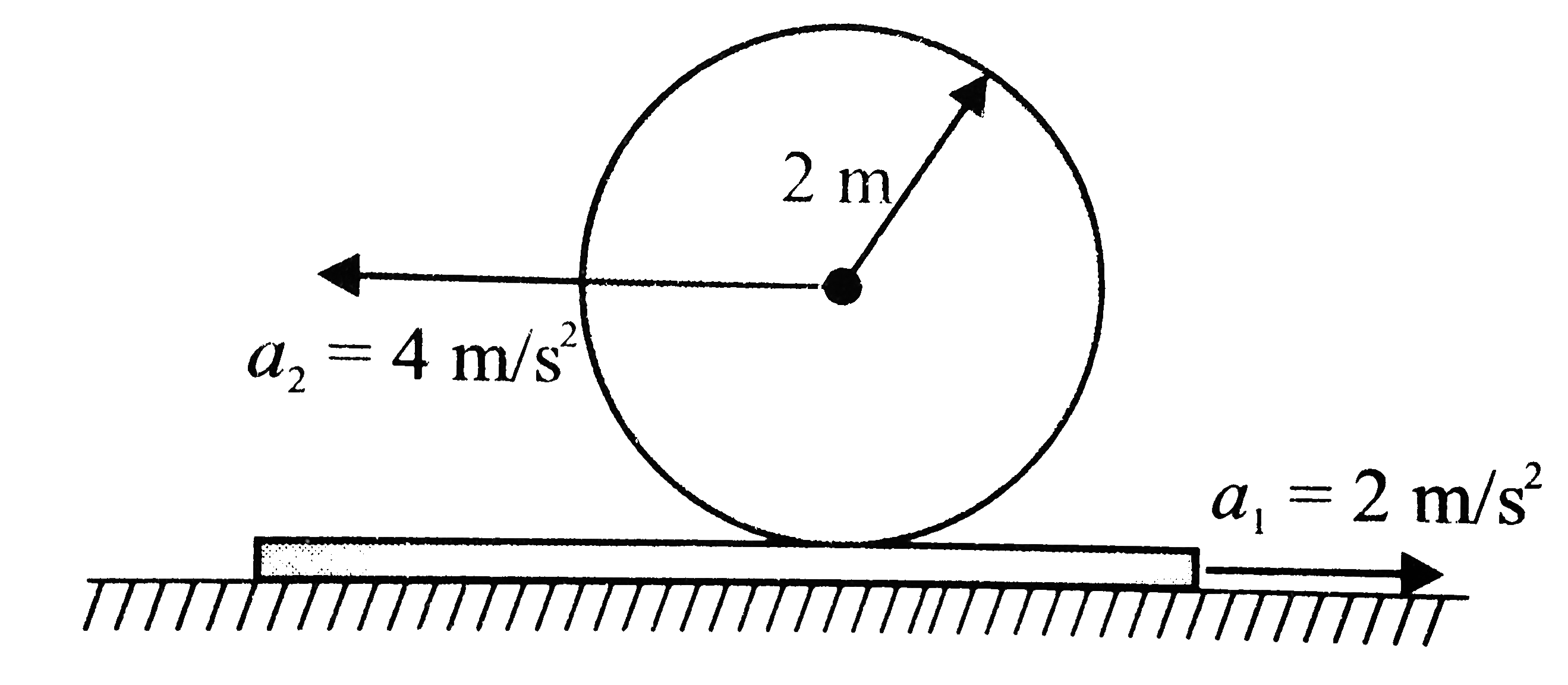
In Fig a sphere of radius 2 m rolls on a...

In Fig a sphere of radius `2 m` rolls on a plank. The accelerations of the sphere and the plank are indicated. The value of `alpha` is

A

`4 rad//s^(2)`

B

`3 rad//s^(2)`

C

`2 rad//s^(2)`

D

`4 rad//s^(2)`

Text Solution

Verified by Experts

The correct Answer is:

A
Promotional Banner

Topper's Solved these Questions

Similar Questions

Explore conceptually related problems

In the following figure, a sphere of radius 3m rolls on a plank. The accelerations of the sphere and the plank are indicated. The value of alpha is

Find the volume of a sphere of radius 11.2 cm.

Find the volume of sphere of radius 6.3 cm

A spherical capacitor has an inner sphere of radius 12 cm and an outer sphere of radius 13 cm. The outer sphere is earthed and the inner sphere is given a charge of 2.5 µC. The space between the concentric spheres is filled with a liquid of dielectric constant 32. (a) Determine the capacitance of the capacitor. (b) What is the potential of the inner sphere? (c) Compare the capacitance of this capacitor with that of an isolated sphere of radius 12 cm. Explain why the latter is much smaller.

A conducting sphere of radius R is given a charge Q. The electric potential and the electric field at the centre of the sphere respectively are

An accelration produces a narrow beam of protons, each having an initial speed of v_(0) . The beam is directed towards an initially uncharges distant metal sphere of radius R and centered at point O. The initial path of the beam is parallel to the axis of the sphere at a distance of (R//2) from the axis, as indicated in the diagram. The protons in the beam that collide with the sphere will cause it to becomes charged. The subsequentpotential field at the accelerator due to the sphere can be neglected. The angular momentum of a particle is defined in a similar way to the moment of a force. It is defined as the moment of its linear momentum, linear replacing the force. We may assume the angular momentum of a proton about point O to be conserved. Assume the mass of the proton as m_(P) and the charge on it as e. Given that the potential of the sphere increases with time and eventually reaches a constant velue. After a long time, when the potential of the sphere reaches a constant value, the trajectory of proton is correctly sketched as

An accelration produces a narrow beam of protons, each having an initial speed of v_(0) . The beam is directed towards an initially uncharges distant metal sphere of radius R and centered at point O. The initial path of the beam is parallel to the axis of the sphere at a distance of (R//2) from the axis, as indicated in the diagram. The protons in the beam that collide with the sphere will cause it to becomes charged. The subsequentpotential field at the accelerator due to the sphere can be neglected. The angular momentum of a particle is defined in a similar way to the moment of a force. It is defined as the moment of its linear momentum, linear replacing the force. We may assume the angular momentum of a proton about point O to be conserved. Assume the mass of the proton as m_(P) and the charge on it as e. Given that the potential of the sphere increases with time and eventually reaches a constant velue. One the potential of the sphere has reached its final, constant value, the minimum speed v of a proton along its trajectory path is given by

An accelration produces a narrow beam of protons, each having an initial speed of v_(0) . The beam is directed towards an initially uncharges distant metal sphere of radius R and centered at point O. The initial path of the beam is parallel to the axis of the sphere at a distance of (R//2) from the axis, as indicated in the diagram. The protons in the beam that collide with the sphere will cause it to becomes charged. The subsequentpotential field at the accelerator due to the sphere can be neglected. The angular momentum of a particle is defined in a similar way to the moment of a force. It is defined as the moment of its linear momentum, linear replacing the force. We may assume the angular momentum of a proton about point O to be conserved. Assume the mass of the proton as m_(P) and the charge on it as e. Given that the potential of the sphere increases with time and eventually reaches a constant velue. If the initial kinetic energy of a proton is 2.56 ke V , then the final potential of the sphere is

The radius of a sphere is 7 cm. Find its surface area.

ALLEN -TEST PAPER-Exercise (Physics)
  1. A small sphere of mass 1 kg is moving with a velocity (6hat(i)+hat(j)...

    Text Solution

    |

  2. A uniform solid sphere of mass M=1 kg and redius R=50 cm is projected ...

    Text Solution

    |

  3. In Fig a sphere of radius 2 m rolls on a plank. The accelerations of t...

    Text Solution

    |

  4. A thin uniform rod AB of mass 1 kg moves translationally with accelera...

    Text Solution

    |

  5. The figure shows an isosceles triangle plate of mass M and base L. T...

    Text Solution

    |

  6. The figure shows an isosceles triangle plate of mass M and base L. T...

    Text Solution

    |

  7. A pulley is connected to the ceiling of an elevator by a massless rod....

    Text Solution

    |

  8. Figure shows the variation of the moment of inertia of a uniform rod, ...

    Text Solution

    |

  9. Four rigid bodies, each with the same mass and radius, are spinning fr...

    Text Solution

    |

  10. Particles of masses m,2m,3m,…….nm grams are placed on the same line at...

    Text Solution

    |

  11. A disc of the radius R is confined to roll without slipping at A and B...

    Text Solution

    |

  12. A solid cylinder C and a hollow pipe P of same diameter are in contact...

    Text Solution

    |

  13. A ball of mass m collides horizontally with a stationary wedge on a ro...

    Text Solution

    |

  14. Shown in the figure is a system of three particles of mass 1 kg, 2 kg ...

    Text Solution

    |

  15. A particle of mass m moving with velocity v makes head-on elastic coll...

    Text Solution

    |

  16. which of the following forces can never, under any circumstances, does...

    Text Solution

    |

  17. A body (intially at rest is falling under gravity. When it loses a gra...

    Text Solution

    |

  18. Position time graph of a particle of mass 2 kg is shown in figrure. To...

    Text Solution

    |

  19. A block of mass m lies on a horizontal frictionless surface and is att...

    Text Solution

    |

  20. Block A of mass 1 kg is placed on the rough surface of block B of mass...

    Text Solution

    |
