Home
Class 12
PHYSICS
The figure shows an isosceles triangle p...

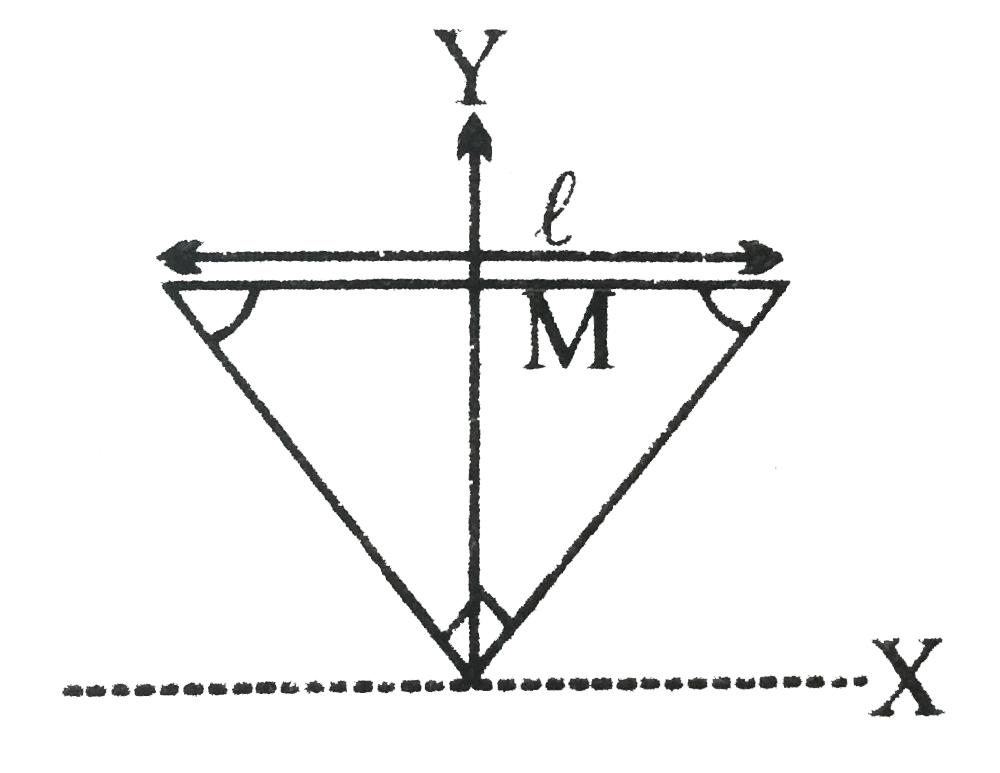
The figure shows an isosceles triangle plate of mass `M` and base `L`.
The angle at the apex is `90^@`. The apex lies at the origin and the base is parallel to `X-`axis.

The moment of inertia of the plate about the `y-`axis is

A

`(ML^(2))/(6)`

B

`(ML^(2))/(8)`

C

`(ML^(2))/(24)`

D

None of these

Text Solution

Verified by Experts

The correct Answer is:

A
Promotional Banner

Topper's Solved these Questions

Similar Questions

Explore conceptually related problems

The figure shows an isosceles triangle plate of mass M and base L . The angle at the apex is 90^@ . The apex lies at the origin and the base is parallel to X- axis. The moment of inertia of the plate about its base parallel to the x- axis is

A non-uniform rod of mass m , length l and radius r is having its centre of mass at a distance l//4 from the centre and lying on the axis of the cylinder. The cylinder is kept in a liquid of uniform density rho . The moment of inertia of the rod about the centre of mass is I . The angular acceleration of point A relative to point B just after the rod is released from the position as shown in the figure is

The base of an equilateral triangle with side 2a lies along the Y-axis such that the mid-point of the base is at the origin. Find vertices of the triangle.

The moment of inertia of a rod about an axis through its centre and perpendicular to it is (1)/(12)ML^(2) (where M is the mass and L, the length of the rod). The rod is bent in the middle so that the two halves make an angle 60^(@) . The moment of inertia of the bent rod about the same axis would be..........

The figure shows a uniform rod lying along the x -axis. The locus of all the points lying on the xy -plane, about which the moment of inearth, of the rod is same as that about O , is

Four spheres of diameter 2a and mass M are placed with their centres on the four corners of a square of side b. Then moment of inertia of the system about an axis about one of the sides of the square is :-

Two identical rings each of mass m with their planes mutually perpendicular, radius R are welded at their point of contact O . If the system is free to rotate about an axis passing through the point P perpendicular to the plane of the paper, then the moment of in inertia of the system about this axis is equal to

An accelration produces a narrow beam of protons, each having an initial speed of v_(0) . The beam is directed towards an initially uncharges distant metal sphere of radius R and centered at point O. The initial path of the beam is parallel to the axis of the sphere at a distance of (R//2) from the axis, as indicated in the diagram. The protons in the beam that collide with the sphere will cause it to becomes charged. The subsequentpotential field at the accelerator due to the sphere can be neglected. The angular momentum of a particle is defined in a similar way to the moment of a force. It is defined as the moment of its linear momentum, linear replacing the force. We may assume the angular momentum of a proton about point O to be conserved. Assume the mass of the proton as m_(P) and the charge on it as e. Given that the potential of the sphere increases with time and eventually reaches a constant velue. The limiting electric potential of the sphere is

An accelration produces a narrow beam of protons, each having an initial speed of v_(0) . The beam is directed towards an initially uncharges distant metal sphere of radius R and centered at point O. The initial path of the beam is parallel to the axis of the sphere at a distance of (R//2) from the axis, as indicated in the diagram. The protons in the beam that collide with the sphere will cause it to becomes charged. The subsequentpotential field at the accelerator due to the sphere can be neglected. The angular momentum of a particle is defined in a similar way to the moment of a force. It is defined as the moment of its linear momentum, linear replacing the force. We may assume the angular momentum of a proton about point O to be conserved. Assume the mass of the proton as m_(P) and the charge on it as e. Given that the potential of the sphere increases with time and eventually reaches a constant velue. If the initial kinetic energy of a proton is 2.56 ke V , then the final potential of the sphere is

ALLEN -TEST PAPER-Exercise (Physics)
  1. A thin uniform rod AB of mass 1 kg moves translationally with accelera...

    Text Solution

    |

  2. The figure shows an isosceles triangle plate of mass M and base L. T...

    Text Solution

    |

  3. The figure shows an isosceles triangle plate of mass M and base L. T...

    Text Solution

    |

  4. A pulley is connected to the ceiling of an elevator by a massless rod....

    Text Solution

    |

  5. Figure shows the variation of the moment of inertia of a uniform rod, ...

    Text Solution

    |

  6. Four rigid bodies, each with the same mass and radius, are spinning fr...

    Text Solution

    |

  7. Particles of masses m,2m,3m,…….nm grams are placed on the same line at...

    Text Solution

    |

  8. A disc of the radius R is confined to roll without slipping at A and B...

    Text Solution

    |

  9. A solid cylinder C and a hollow pipe P of same diameter are in contact...

    Text Solution

    |

  10. A ball of mass m collides horizontally with a stationary wedge on a ro...

    Text Solution

    |

  11. Shown in the figure is a system of three particles of mass 1 kg, 2 kg ...

    Text Solution

    |

  12. A particle of mass m moving with velocity v makes head-on elastic coll...

    Text Solution

    |

  13. which of the following forces can never, under any circumstances, does...

    Text Solution

    |

  14. A body (intially at rest is falling under gravity. When it loses a gra...

    Text Solution

    |

  15. Position time graph of a particle of mass 2 kg is shown in figrure. To...

    Text Solution

    |

  16. A block of mass m lies on a horizontal frictionless surface and is att...

    Text Solution

    |

  17. Block A of mass 1 kg is placed on the rough surface of block B of mass...

    Text Solution

    |

  18. One end of a light spring of natural length 4m and spring constant 170...

    Text Solution

    |

  19. A particle of mass 1 kg moves in a circular path of radius 1 m such th...

    Text Solution

    |

  20. Infinite rods of uniform mass density and length L,L/2,L/4….. Are plac...

    Text Solution

    |
