Home
Class 12
PHYSICS
N similar slabs of cubical shape of edge...

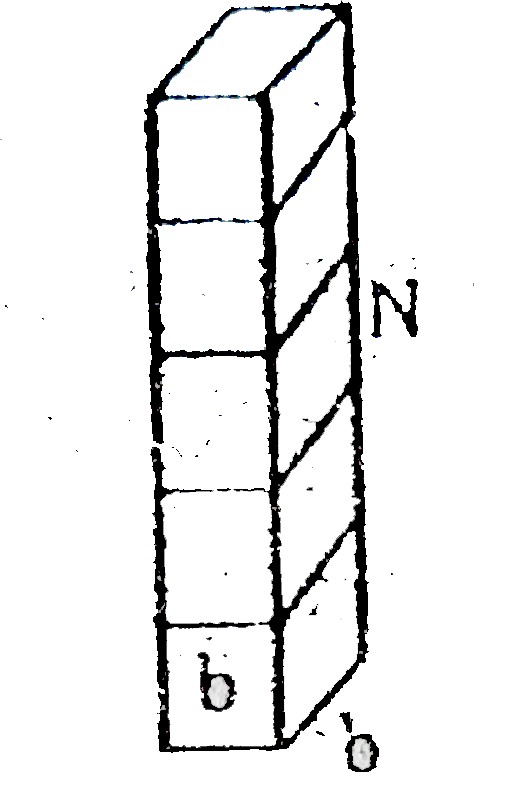
N similar slabs of cubical shape of edge b are lying on ground. Density of material of slab is p. Work done ot arrange them one over the other is -

A

`(N^(2)-1)b^(3)pg`

B

`(N-1)b^(4)pg`

C

`1//2(N^(2)-N)b^(4)pg`

D

`(N^(2)-N)b^(4)pg`

Text Solution

Verified by Experts

The correct Answer is:

C
Promotional Banner

Topper's Solved these Questions

Similar Questions

Explore conceptually related problems

There are two cylinder shaped wooden bullets, each having mass M, in a vertical wall sewage, which contains water in it. The two bullets have same size and same material , they touch each other and walls of sewage. One of them is totally under water, where the other one is immersed only half into water. Friction is negligible if density of wood is given by (3)/(x)p_(omega) (p_(omega) "is density of water") then find x

A cubical box of side 1 m contains helium gas (atomic weight 4) at a pressure of 100 N//m^2 . During an observation time of 1 second , an atom travelling with the root - mean - square speed parallel to one of the edges of the cube, was found to make 500 hits with a particular wall, without any collision with other atoms . Take R = (25)/3 j //mol - K and k = 1.38 xx 10^-23 J//K . (a) Evaluate the temperature of the gas. (b) Evaluate the total mass of helium gas in the box.

A cubical box of side 1 m contains helium gas (atomic weight 4) at a pressure of 100 N//m^2 . During an observation time of 1 second , an atom travelling with the root - mean - square speed parallel to one of the edges of the cube, was found to make 500 hits with a particular wall, without any collision with other atoms . Take R = (25)/3 j //mol - K and k = 1.38 xx 10^-23 J//K . (a) Evaluate the temperature of the gas. (b) Evaluate the average kinetic energy per atom. ( c) Evaluate the total mass of helium gas in the box.

(a) Pressure decreases as one ascends the atmosphere . If the density of air is rho ,what is the change in pressure dp over differential height dh ? (b) Considering the pressure P to be proportional to the density find the pressure P at a height h if the pressure on the surface of the earth is P_(o) . (c ) If P_(o)=1.03xx10^(5)N//m^(-2),rho_(o)=1.29kg//m^(3)andg=9.8m//s^(2) what height will the pressure frop to (1)/(10) the value at the surface of earth ? (d) This model of the atmosphere works for relatively small distance .Identify the underlying assumption that limits the model.

Scientists are working hard to develop nuclear fusion reactor Nuclei of heavy hydrogen, _(1)^(2)H , known as deuteron and denoted by D , can be thought of as a candidate for fusion rector . The D-D reaction is _(1)^(2) H + _(1)^(2) H rarr _(2)^(1) He + n+ energy. In the core of fusion reactor, a gas of heavy hydrogen of _(1)^(2) H is fully ionized into deuteron nuclei and electrons. This collection of _1^2H nuclei and electrons is known as plasma . The nuclei move randomly in the reactor core and occasionally come close enough for nuclear fusion to take place. Usually , the temperature in the reactor core are too high and no material will can be used to confine the to plasma for a time t_(0) before the particles fly away from the core. If n is the density (number volume ) of deuterons , the product nt_(0) is called Lawson number. In one of the criteria , a reactor is termed successful if Lawson number is greater then 5 xx 10^(14) s//cm^(2) it may be helpfull to use the following boltzmann constant lambda = 8.6 xx 10^(-5)eV//k, (e^(2))/(4 pi s_(0)) = 1.44 xx 10^(-9) eVm Assume that two deuteron nuclei in the core of fusion reactor at temperature energy T are moving toward each other, each with kinectic energy 1.5 kT , when the seperation between them is large enough to neglect coulomb potential energy . Also neglate any interaction from other particle in the core . The minimum temperature T required for them to reach a separation of 4 xx 10^(-15) m is in the range

Scientists are working hard to develop nuclear fusion reactor Nuclei of heavy hydrogen, _(1)^(2)H , known as deuteron and denoted by D , can be thought of as a candidate for fusion rector . The D-D reaction is _(1)^(2) H + _(1)^(2) H rarr _(2)^(1) He + n+ energy. In the core of fusion reactor, a gas of heavy hydrogen of _(1)^(2) H is fully ionized into deuteron nuclei and electrons. This collection of _1^2H nuclei and electrons is known as plasma . The nuclei move randomly in the reactor core and occasionally come close enough for nuclear fusion to take place. Usually , the temperature in the reactor core are too high and no material will can be used to confine the to plasma for a time t_(0) before the particles fly away from the core. If n is the density (number volume ) of deuterons , the product nt_(0) is called Lawson number. In one of the criteria , a reactor is termed successful if Lawson number is greater then 5 xx 10^(14) s//cm^(2) it may be helpfull to use the following boltzmann constant lambda = 8.6 xx 10^(-5)eV//k, (e^(2))/(4 pi s_(0)) = 1.44 xx 10^(-9) eVm Assume that two deuteron nuclei in the core of fusion reactor at temperature energy T are moving toward each other, each with kinectic energy 1.5 kT , when the seperation between them is large enough to neglect coulomb potential energy . Also neglate any interaction from other particle in the core . The minimum temperature T required for them to reach a separation of 4 xx 10^(-15) m is in the range

(a) Show that the normal component of electrostatic field has a discontinuity from one side of a charged surface to another given by (E_(2)-E_(1)).n = sigma/epsilon_(0) where hatn is a unit vector normal to the surface at a point and sigma is the surface charge density at that point. (The direction of hatn is from side 1 to side 2.) Hence, show that just outside a conductor, the electric field is sigma hatn //epsilon_(0) . (b) Show that the tangential component of electrostatic field is continuous from one side of a charged surface to another. [Hint: For (a), use Gauss’s law. For, (b) use the fact that work done by electrostatic field on a closed loop is zero.]

A parallel plate capacitor is made of two dielectric blocks in series. One of the blocks has thickness d_(1) and dielectric constant k_(1) and the other has thickness d_(2) and dielectric constant k_(2) as shown in figure. This arrangement can be thought as a dielectric slab of thickness d = ( d_(1) + d_(2) ) and effective dielectric constant k. The k is ...... (a) (K_(1)d_(1)+K_(2)d_(2))/(d_(1)+d_(2)) (b) (K_(1)d_(1)+K_(2)d_(2))/(K_(1)+K_(2)) (c) (K_(1)K_(2)(d_(1)+d_(2)))/((K_(1)d_(2)+K_(2)d_(1))) (d) (2K_(1)K_(2))/(K_(1)+K_(2))

A metal of mass 1 kg at constant atmospheric pressure and at initial temperature 20^@C is given a heat of 20000J. Find the following (a) change in temperature, (b) work done and (c) change in internal energy. (Given, specific heat =400J//kg-^@C , cofficient of cubical expansion, gamma=9xx10^-5//^@C , density rho=9000kg//m^3 , atmospheric pressure =10^5N//m^2 )

ALLEN -TEST PAPER-Exercise (Physics)
  1. Moment of inertia of a rigid body is expressed in units of kg m^(2). T...

    Text Solution

    |

  2. A mass m(1) moves with a great velocity. It strikes another mass m(2) ...

    Text Solution

    |

  3. N similar slabs of cubical shape of edge b are lying on ground. Densit...

    Text Solution

    |

  4. A ball collides elastically with a massive wall moving towards it with...

    Text Solution

    |

  5. A block of mass m=1/3 kg is kept on a rough horizontal plane. Friction...

    Text Solution

    |

  6. Consider two observers moving with respect to each other at a speed v ...

    Text Solution

    |

  7. Consider following statement (A) Work done by pseudo force in non-in...

    Text Solution

    |

  8. Forces acting on a particle have magnitude of 14N, 7N and 7N act in th...

    Text Solution

    |

  9. The graph below shows how the force on a mass depends on the position ...

    Text Solution

    |

  10. The kinetic energy of a particle continuously icreses with time

    Text Solution

    |

  11. The only force acting on a block is along x-axis is given by P=-((4)/(...

    Text Solution

    |

  12. In the figure, a block slides along a track from one level to a higher...

    Text Solution

    |

  13. A block of mass 2.0 kg is given an initial speed along the floor towar...

    Text Solution

    |

  14. A particle moves on x-axis such that its KE varies as a relation KE=3t...

    Text Solution

    |

  15. The potential energy (in joules ) function of a particle in a region o...

    Text Solution

    |

  16. AB is a quarter of a smooth horizontal circular track of radius R,A pa...

    Text Solution

    |

  17. The potential energy of a particle of mass 1 kg moving in X-Y plane is...

    Text Solution

    |

  18. A block of mass m is pushed up against a spring, compressing it a dist...

    Text Solution

    |

  19. A train of mass 100 metric tons is ascending uniformly on an incline o...

    Text Solution

    |

  20. in which of the following cases the centre of mass of a rod is certain...

    Text Solution

    |
