Home
Class 12
PHYSICS
In the following figure, a sphere of rad...

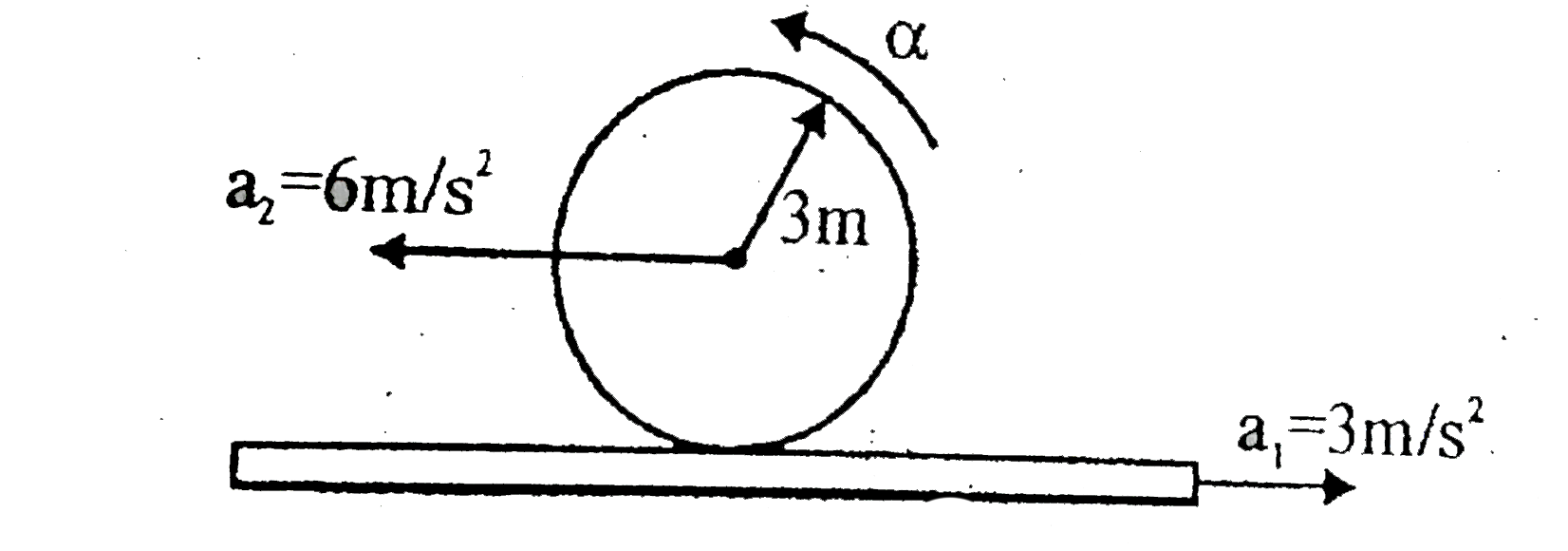
In the following figure, a sphere of radius 3m rolls on a plank. The accelerations of the sphere and the plank are indicated. The value of `alpha` is

A

`3rad//s^(2)`

B

`6rad//s^(2)`

C

`3rad//s^(2)` (opposite to the direction shown in figure)

D

`1rad//s^(2)`

Text Solution

Verified by Experts

The correct Answer is:

A
Promotional Banner

Topper's Solved these Questions

Similar Questions

Explore conceptually related problems

In Fig a sphere of radius 2 m rolls on a plank. The accelerations of the sphere and the plank are indicated. The value of alpha is

Find the volume of sphere of radius 6.3 cm

The radius of sphere is 3.5 cm Find its surface area and volume .

An accelration produces a narrow beam of protons, each having an initial speed of v_(0) . The beam is directed towards an initially uncharges distant metal sphere of radius R and centered at point O. The initial path of the beam is parallel to the axis of the sphere at a distance of (R//2) from the axis, as indicated in the diagram. The protons in the beam that collide with the sphere will cause it to becomes charged. The subsequentpotential field at the accelerator due to the sphere can be neglected. The angular momentum of a particle is defined in a similar way to the moment of a force. It is defined as the moment of its linear momentum, linear replacing the force. We may assume the angular momentum of a proton about point O to be conserved. Assume the mass of the proton as m_(P) and the charge on it as e. Given that the potential of the sphere increases with time and eventually reaches a constant velue. After a long time, when the potential of the sphere reaches a constant value, the trajectory of proton is correctly sketched as

An accelration produces a narrow beam of protons, each having an initial speed of v_(0) . The beam is directed towards an initially uncharges distant metal sphere of radius R and centered at point O. The initial path of the beam is parallel to the axis of the sphere at a distance of (R//2) from the axis, as indicated in the diagram. The protons in the beam that collide with the sphere will cause it to becomes charged. The subsequentpotential field at the accelerator due to the sphere can be neglected. The angular momentum of a particle is defined in a similar way to the moment of a force. It is defined as the moment of its linear momentum, linear replacing the force. We may assume the angular momentum of a proton about point O to be conserved. Assume the mass of the proton as m_(P) and the charge on it as e. Given that the potential of the sphere increases with time and eventually reaches a constant velue. One the potential of the sphere has reached its final, constant value, the minimum speed v of a proton along its trajectory path is given by

An accelration produces a narrow beam of protons, each having an initial speed of v_(0) . The beam is directed towards an initially uncharges distant metal sphere of radius R and centered at point O. The initial path of the beam is parallel to the axis of the sphere at a distance of (R//2) from the axis, as indicated in the diagram. The protons in the beam that collide with the sphere will cause it to becomes charged. The subsequentpotential field at the accelerator due to the sphere can be neglected. The angular momentum of a particle is defined in a similar way to the moment of a force. It is defined as the moment of its linear momentum, linear replacing the force. We may assume the angular momentum of a proton about point O to be conserved. Assume the mass of the proton as m_(P) and the charge on it as e. Given that the potential of the sphere increases with time and eventually reaches a constant velue. The limiting electric potential of the sphere is

An accelration produces a narrow beam of protons, each having an initial speed of v_(0) . The beam is directed towards an initially uncharges distant metal sphere of radius R and centered at point O. The initial path of the beam is parallel to the axis of the sphere at a distance of (R//2) from the axis, as indicated in the diagram. The protons in the beam that collide with the sphere will cause it to becomes charged. The subsequentpotential field at the accelerator due to the sphere can be neglected. The angular momentum of a particle is defined in a similar way to the moment of a force. It is defined as the moment of its linear momentum, linear replacing the force. We may assume the angular momentum of a proton about point O to be conserved. Assume the mass of the proton as m_(P) and the charge on it as e. Given that the potential of the sphere increases with time and eventually reaches a constant velue. If the initial kinetic energy of a proton is 2.56 ke V , then the final potential of the sphere is

A tangential force F acts at the top of a thin spherical shell of mass m and radius R . Find the acceleration of the shell if it rolls without slipping.

A circle is the locus of a point in a plane such that its distance from a fixed point in the plane is constant. Anologously, a sphere is the locus of a point in space such that its distance from a fixed point in space in constant. The fixed point is called the centre and the constant distance is called the radius of the circle/sphere. In anology with the equation of the circle |z-c|=a , the equation of a sphere of radius is |r-c|=a , where c is the position vector of the centre and r is the position vector of any point on the surface of the sphere. In Cartesian system, the equation of the sphere, with centre at (-g, -f, -h) is x^2+y^2+z^2+2gx+2fy+2hz+c=0 and its radius is sqrt(f^2+g^2+h^2-c) . Q. Radius of the sphere, with (2, -3, 4) and (-5, 6, -7) as xtremities of a diameter, is

A circle is the locus of a point in a plane such that its distance from a fixed point in the plane is constant. Anologously, a sphere is the locus of a point in space such that its distance from a fixed point in space in constant. The fixed point is called the centre and the constant distance is called the radius of the circle/sphere. In anology with the equation of the circle |z-c|=a , the equation of a sphere of radius is |r-c|=a , where c is the position vector of the centre and r is the position vector of any point on the surface of the sphere. In Cartesian system, the equation of the sphere, with centre at (-g, -f, -h) is x^2+y^2+z^2+2gx+2fy+2hz+c=0 and its radius is sqrt(f^2+g^2+h^2-c) . Q. The centre of the sphere (x-4)(x+4)+(y-3)(y+3)+z^2=0 is

ALLEN -TEST PAPER-Exercise (Physics)
  1. The potential energy (in joules ) function of a particle in a region o...

    Text Solution

    |

  2. AB is a quarter of a smooth horizontal circular track of radius R,A pa...

    Text Solution

    |

  3. The potential energy of a particle of mass 1 kg moving in X-Y plane is...

    Text Solution

    |

  4. A block of mass m is pushed up against a spring, compressing it a dist...

    Text Solution

    |

  5. A train of mass 100 metric tons is ascending uniformly on an incline o...

    Text Solution

    |

  6. in which of the following cases the centre of mass of a rod is certain...

    Text Solution

    |

  7. A man of mass 80 kg stands on a plank of mass 40 kg. The plank is lyin...

    Text Solution

    |

  8. A monkey of mass 20 kg rides on a 40 kg trolley moving at a constant s...

    Text Solution

    |

  9. A ball A moving with a velocity 5 m/s collides elastically with anothe...

    Text Solution

    |

  10. The angular speed of a star spinning about its axis increases as the s...

    Text Solution

    |

  11. A mass m=1 kg hangs from the wheel of radius R=1 m .When released fro...

    Text Solution

    |

  12. In the following figure, a sphere of radius 3m rolls on a plank. The a...

    Text Solution

    |

  13. Three parallel forces are acting on a rod at distances of 40 cm, 60 cm...

    Text Solution

    |

  14. A cylinder rolls up an inclined plane, reaches some height, and then r...

    Text Solution

    |

  15. Two blocks are resting on ground with masses 5 kg and 7 kg. A spring c...

    Text Solution

    |

  16. A body is dropped from height 8m. After striking the surface it rises ...

    Text Solution

    |

  17. A uniform equilateral triangular lamina of side a has mass m. Its mome...

    Text Solution

    |

  18. For a particle rotating in a vertical circle with uniform speed, the m...

    Text Solution

    |

  19. A small of mass m starts from rest at the position shown and slides al...

    Text Solution

    |

  20. A block is released from rest from top of a rough curved track as show...

    Text Solution

    |
