Home
Class 11
PHYSICS
A particle moving with uniform accelerat...

A particle moving with uniform acceleration passes the point `x=2m` with velocity `20 m//s` at the instant `t=0`. Some time later it is observed at the point `x=32 m` moving with velocity `10 m//s`.What is its acceleration ?What is its velocity at 8 sec?

Text Solution

Verified by Experts
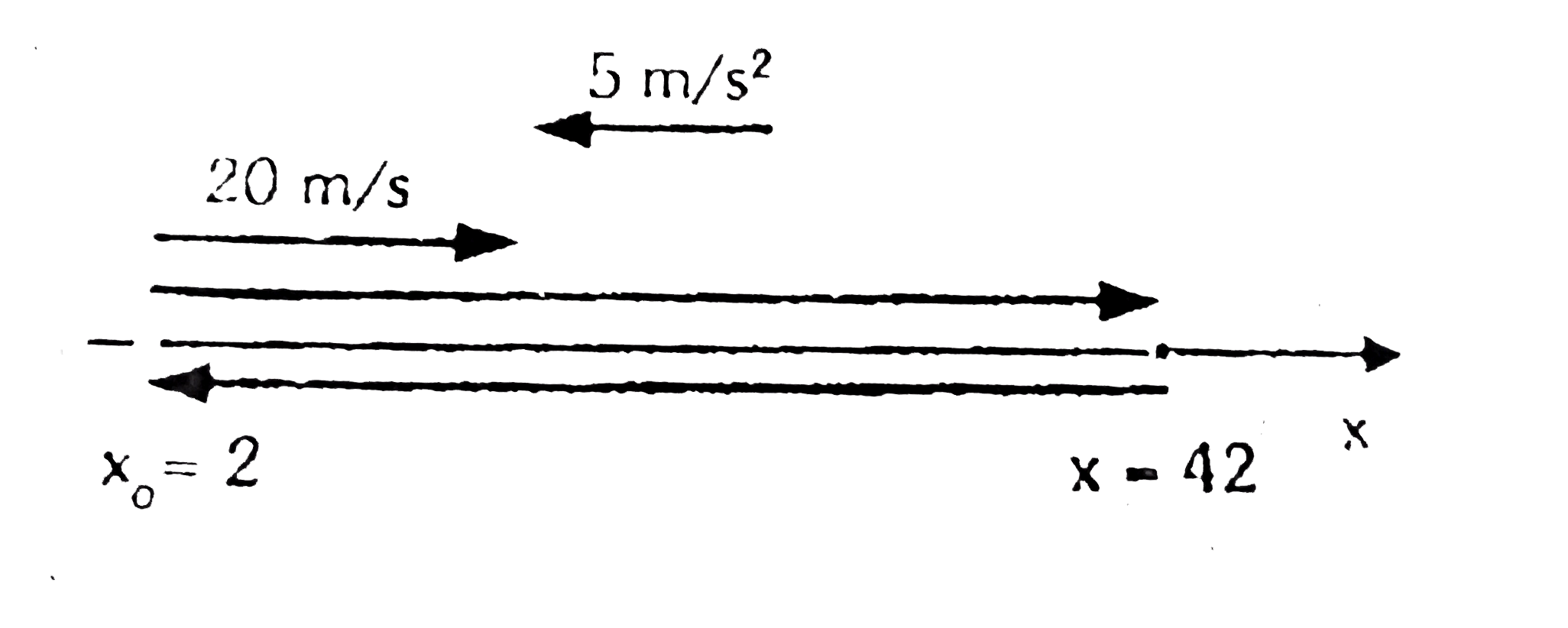
In the adjoining figure the given and required information shown are not to a scale. As motion diagram is a schematic representation only.
(a) Using the third equation of uniform acceleration motion, we have
`v_(t)^(2)=v_(o)^(2)+2a(x_(t)-x_(o))rarr a=(v_(t)^(2)-v_(o)^(2))/(2(x_(t)-x_(o)))=(10^(2)-20^(2))/(2(32-2))=-5 m//s^(2)`

(b) Using second equation of uniform acceleration motion, we have
`x_(t)=x_(o)+v_(o)t+1/2 at^(2) rarr x_(8)=2+20xx8+1/2 (-5)8^(2)=2 m`
Using the first equation of uniform acceleration motion, we have
`v_(t)=v_(o)+at rarr v_(8)=20+(-5)xx8=-20 m//s`
(c) Where the particle returns, its velocity must be zero. Using the third equation of uniform acceleration motion, we have
`v^(@)=v_(o)^(2)+2a(x-x_(o)) rarr x=x_(o)+(v^(2)-v_(o)^(2))/(2a)=2+(0-20^(2))/(2(-5))=42 m`
This location is shown in the adjoining modified motion diagram.
The distance `Deltas` is `Deltas=|x-x_(o)|+|x_(o)-x|=80 m`
Promotional Banner

Topper's Solved these Questions

  • KINEMATICS

    ALLEN |Exercise EXERCISE-01|55 Videos
  • KINEMATICS

    ALLEN |Exercise EXERCISE-02|57 Videos
  • ERROR AND MEASUREMENT

    ALLEN |Exercise Part-2(Exercise-2)(B)|22 Videos
  • KINEMATICS (MOTION ALONG A STRAIGHT LINE AND MOTION IN A PLANE)

    ALLEN |Exercise BEGINNER S BOX-7|8 Videos

Similar Questions

Explore conceptually related problems

a particle moving along a straight line with uniform acceleration has velocities 7 m//s at A and 17 m//s at C. B is the mid point of AC. Then :-

A particle moving with constant acceleration of 2m/ s^(2) due west has an initial velocity of 9 m/s due east. Find the distace covered in the fifth second of its motion.

Acceleration of particle moving along the x-axis varies according to the law a=-2v , where a is in m//s^(2) and v is in m//s . At the instant t=0 , the particle passes the origin with a velocity of 2 m//s moving in the positive x-direction. (a) Find its velocity v as function of time t. (b) Find its position x as function of time t. (c) Find its velocity v as function of its position coordinates. (d) find the maximum distance it can go away from the origin. (e) Will it reach the above-mentioned maximum distance?

A particle moves in straight line in same direction for 20 seconds with velocity 3 m//s and the moves with velocity 4 m//s for another 20 sec and finally moves with velocity 5 m//s for next 20 seconds. What is the average velocity of the particle?

A particle moves in a straight line with a uniform acceleration a. Initial velocity of the particle is zero. Find the average velocity of the particle in first 's' distance.

A particle is projected vertically upwards from ground with velocity 10 m // s. Find the time taken by it to reach at the highest point ?

Acceleration of a particle moving along the x-axis is defined by the law a=-4x , where a is in m//s^(2) and x is in meters. At the instant t=0 , the particle passes the origin with a velocity of 2 m//s moving in the positive x-direction. (a) Find its velocity v as function of its position coordinates. (b) find its position x as function of time t. (c) Find the maximum distance it can go away from the origin.

A body of mass 10kg is moving with a constant velocity of 10m//s . When a constant force acts for 4 seconds on it, it moves with a velocity 2m//sec in the opposite direction. The acceleration produced in it is

An object moving with uniform acceleration covers 40 m in initial 5 seconds and 65 m in next 5 seconds, then its initial velocity is .......

Raindrops are falling vertically with a velocity 10 m//s . To a cyclist moving on a straight road the rain drops appear to be coming with a velocity of 20m//s . The velocity of cyclist is :-

ALLEN -KINEMATICS-EXERCISE-2
  1. A particle moving with uniform acceleration passes the point x=2m with...

    Text Solution

    |

  2. A student performs an experiment to determine how the range of a ball ...

    Text Solution

    |

  3. A student performs an experiment to determine how the range of a ball ...

    Text Solution

    |

  4. A student performs an experiment to determine how the range of a ball ...

    Text Solution

    |

  5. A circus wishes to develop a new clown act. Fig. (1) shows a diagram o...

    Text Solution

    |

  6. A circus wishes to develop a new clown act. Fig. (1) shows a diagram o...

    Text Solution

    |

  7. A circus wishes to develop a new clown act. Fig. (1) shows a diagram o...

    Text Solution

    |

  8. A circus wishes to develop a new clown act. Fig. (1) shows a diagram o...

    Text Solution

    |

  9. A circus wishes to develop a new clown act. Fig. (1) shows a diagram o...

    Text Solution

    |

  10. A circus wishes to develop a new clown act. Fig. (1) shows a diagram o...

    Text Solution

    |

  11. When a particle is undergoing motion, the diplacement of the particle ...

    Text Solution

    |

  12. When a particle is undergoing motion, the diplacement of the particle ...

    Text Solution

    |

  13. When a particle is undergoing motion, the diplacement of the particle ...

    Text Solution

    |

  14. When a particle is undergoing motion, the diplacement of the particle ...

    Text Solution

    |

  15. A projectile is projected with some initial velocity and some initial ...

    Text Solution

    |

  16. A projectile is projected with some initial velocity and some initial ...

    Text Solution

    |

  17. A projectile is projected with some initial velocity and some initial ...

    Text Solution

    |

  18. Fig. 2 (NCT).9 show the x-t plot of a particle in one dimensional mot...

    Text Solution

    |

  19. The position-time(x-t) graphs for two children A and B from their sch...

    Text Solution

    |

  20. A particle moves along x-axis with acceleration a = a0 (1 – t// T) wh...

    Text Solution

    |

  21. A body moving with uniform acceleration, covers a distance of 20 m in ...

    Text Solution

    |