Home
Class 11
PHYSICS
A river of width 'd' with straight paral...

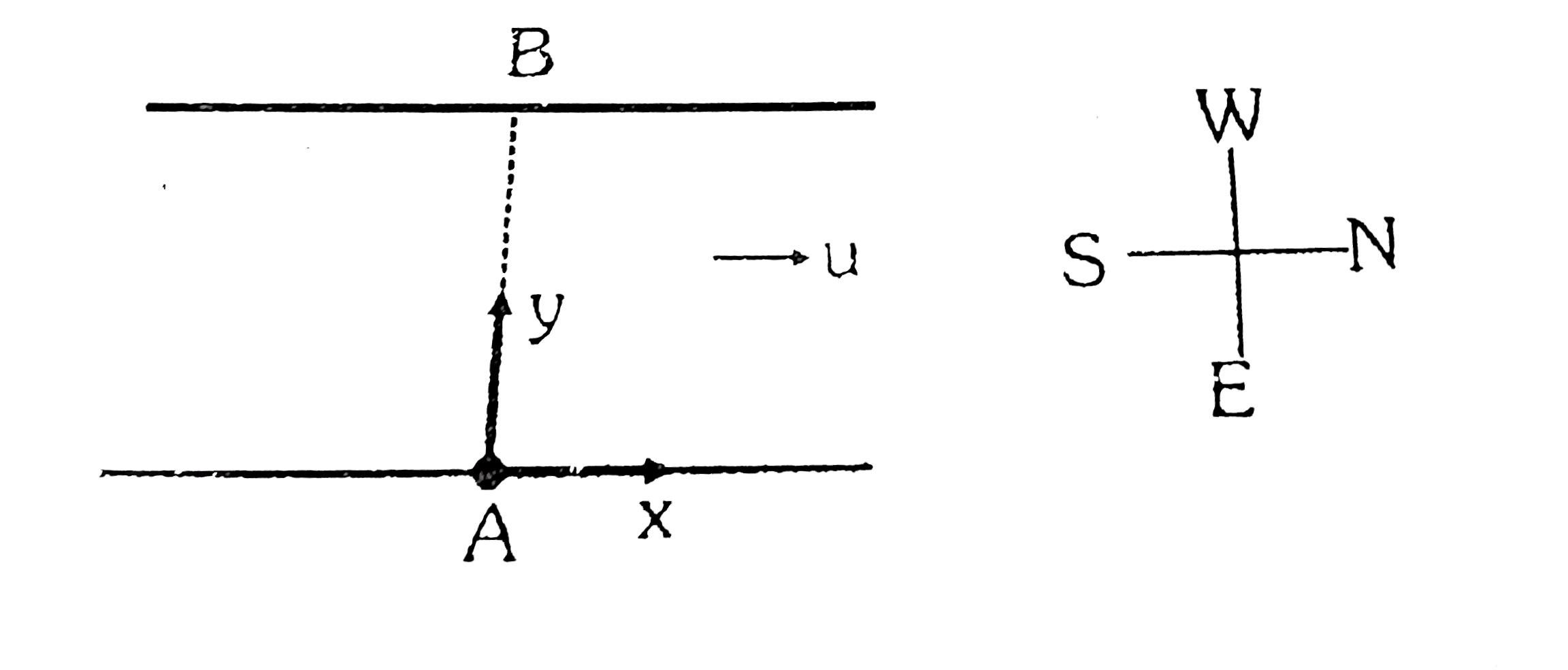
A river of width 'd' with straight parallel banks flows due North with speed u. A boat, whose speed is v relative to water, starts from A and crosses the river. If the boat is steered due West and u varies with y as `u=(y(d-y)v)/d^(2)` then answer the following questions.

Absolute velocity of boat when it reaches the opposite bank is

A

`4/3 v`, towards East

B

v, towards West

C

`4/3 v`, towards West

D

`vec(v)`, towards East

Text Solution

Verified by Experts

The correct Answer is:

B

At `y=d, u=0` so adsolute velocity of boat=v towards West
Promotional Banner

Topper's Solved these Questions

  • KINEMATICS

    ALLEN |Exercise EXERCISE-01|55 Videos
  • KINEMATICS

    ALLEN |Exercise EXERCISE-02|57 Videos
  • ERROR AND MEASUREMENT

    ALLEN |Exercise Part-2(Exercise-2)(B)|22 Videos
  • KINEMATICS (MOTION ALONG A STRAIGHT LINE AND MOTION IN A PLANE)

    ALLEN |Exercise BEGINNER S BOX-7|8 Videos

Similar Questions

Explore conceptually related problems

A river of width 'd' with straight parallel banks flows due North with speed u. A boat, whose speed is v relative to water, starts from A and crosses the river. If the boat is steered due West and u varies with y as u=(y(d-y)v)/d^(2) then answer the following questions. Equation of trajectory of the boat is

A river of width 'd' with straight parallel banks flows due North with speed u. A boat, whose speed is v relative to water, starts from A and crosses the river. If the boat is steered due West and u varies with y as u=(y(d-y)v)/d^(2) then answer the following questions. The time take by boat to cross the river is

A river 400 m wide is flowing at a rate of 2.0 m//s. A boat is sailing at a velocity of 10.0 m//s with respect to the water In a direction perpendicular to the river. (a) Find the time taken by the boat to reach the opposite bank. (b) How far from the point directly opposite to the starting point does the boat reach the opposite bank?

A river is flowing with velocity 5km//hr as shown in the figure. A boat start from A and reaches the other bank by covering shortest possible distance. Velocity of boat in still water is 3km//hr . The distance boat covers is.

A boatman moves his boat with a velocity 'v' (relative to water) in river and finds to his surprise that velocity of river 'u' (with respect to ground) is more than 'v'. He has to reach a point directly opposite to the starting point on another bank by travelling minimum possible distance. Then

A river 4.0 miles wide is following at the rate of 2 miles/hr. The minimum time taken by a boat to cross the river with a speed v=4 miles/hr (in still water) is approximately

A man can swim at a speed 2ms^(-1) in still water. He starts swimming in a river at an angle 150^(@) with direction of flow of water and reaches at the exactly oppsite point on the opposite bank. (a) Find the speed of flowing water. (b) If width of river is 1 km then calculate the time taken also

Two swimmers start a race. One who reaches the point C first on the other bank wins the race. A makes his strokes in a direction of 37^(0) to the river flow with velocity 5km//hr relative to water. B makes his strokes in a direction 127^(0) to the river flow with same relative velocity.River is flowing with speed of 2km//hr and is 100m wide.speeds of A and B on the ground are 8km//hr and 6km//hr respectively.

A boat is travelling in a driver in river with a speed 10 m//s along the stream flowing with a speed 2m//s . From this, boat, a sounjd transmitter is lowered into the river through a right support. The wavelength of the sound emitted from the transmitter inside the water is 14.45 mm . Assume that attention of sound in water and air is negligible. (a) What will be frequency detected by receiver kept inside downstream? (b) The transmitter and the receiver are now pulled up into air. The air is blowing with a speed 5 m//s in the direction opposite the river stream. Determine the frequency of the sound detected by the receiver. (Temperature of the air and water = 20^(@)C , Density of river water = 10^(3) kg//m^(3) . Bulk modulus of the water = 2.088 xx 10^(6) Pa , Gas constant R = 8.31 J//mol-K , Mean molecular mass of air = 28.8 xx 10^(-3) kg//mol , C_(P)//C_(V) for air = 1.4 ).

By the term velocity of rain, we mean velocity with which raindrops fall relative to the ground. In absence of wind, raindrops fall vertically and in presence of wind raindrops fall obliqucly. Moreover raindrops acquire a constant terminal velocity due air resistance very quickly as they fall toward the carth. A moving man relative to himself observes an altered velocity of raindrops. Which is known as velocity of rain relative to the man. It is given by the following equation. vec(v)_(rm)=vec(v)_(r)-vec(v)_(m) A standstill man relative to himself observes rain falling with velocity, which is equal to velocity of the raindrops relative to the ground. To protect himself a man should his umbrella against velocity of raindrops relative to himself as shown in the following figure. Rain is falling vertically with velocity 80 cm/s. (a) How should you hold your umbrella ? (b) You start walking towards the east with velocity 60 cm/s. How should you hold umbrella ? (c) You are walking towards the west with velocity 60 cm/s. How should you hold your umbrella ? (d) You are walking towards the north with velocity 60 cm/s. How should you hold your umbrella? (e) You are walking towards the south with velocity 80 cm/s. How should you hold your umbrella ?

ALLEN -KINEMATICS-EXERCISE-2
  1. A river of width 'd' with straight parallel banks flows due North with...

    Text Solution

    |

  2. A student performs an experiment to determine how the range of a ball ...

    Text Solution

    |

  3. A student performs an experiment to determine how the range of a ball ...

    Text Solution

    |

  4. A student performs an experiment to determine how the range of a ball ...

    Text Solution

    |

  5. A circus wishes to develop a new clown act. Fig. (1) shows a diagram o...

    Text Solution

    |

  6. A circus wishes to develop a new clown act. Fig. (1) shows a diagram o...

    Text Solution

    |

  7. A circus wishes to develop a new clown act. Fig. (1) shows a diagram o...

    Text Solution

    |

  8. A circus wishes to develop a new clown act. Fig. (1) shows a diagram o...

    Text Solution

    |

  9. A circus wishes to develop a new clown act. Fig. (1) shows a diagram o...

    Text Solution

    |

  10. A circus wishes to develop a new clown act. Fig. (1) shows a diagram o...

    Text Solution

    |

  11. When a particle is undergoing motion, the diplacement of the particle ...

    Text Solution

    |

  12. When a particle is undergoing motion, the diplacement of the particle ...

    Text Solution

    |

  13. When a particle is undergoing motion, the diplacement of the particle ...

    Text Solution

    |

  14. When a particle is undergoing motion, the diplacement of the particle ...

    Text Solution

    |

  15. A projectile is projected with some initial velocity and some initial ...

    Text Solution

    |

  16. A projectile is projected with some initial velocity and some initial ...

    Text Solution

    |

  17. A projectile is projected with some initial velocity and some initial ...

    Text Solution

    |

  18. Fig. 2 (NCT).9 show the x-t plot of a particle in one dimensional mot...

    Text Solution

    |

  19. The position-time(x-t) graphs for two children A and B from their sch...

    Text Solution

    |

  20. A particle moves along x-axis with acceleration a = a0 (1 – t// T) wh...

    Text Solution

    |

  21. A body moving with uniform acceleration, covers a distance of 20 m in ...

    Text Solution

    |
