Home
Class 11
PHYSICS
A river of width 'd' with straight paral...

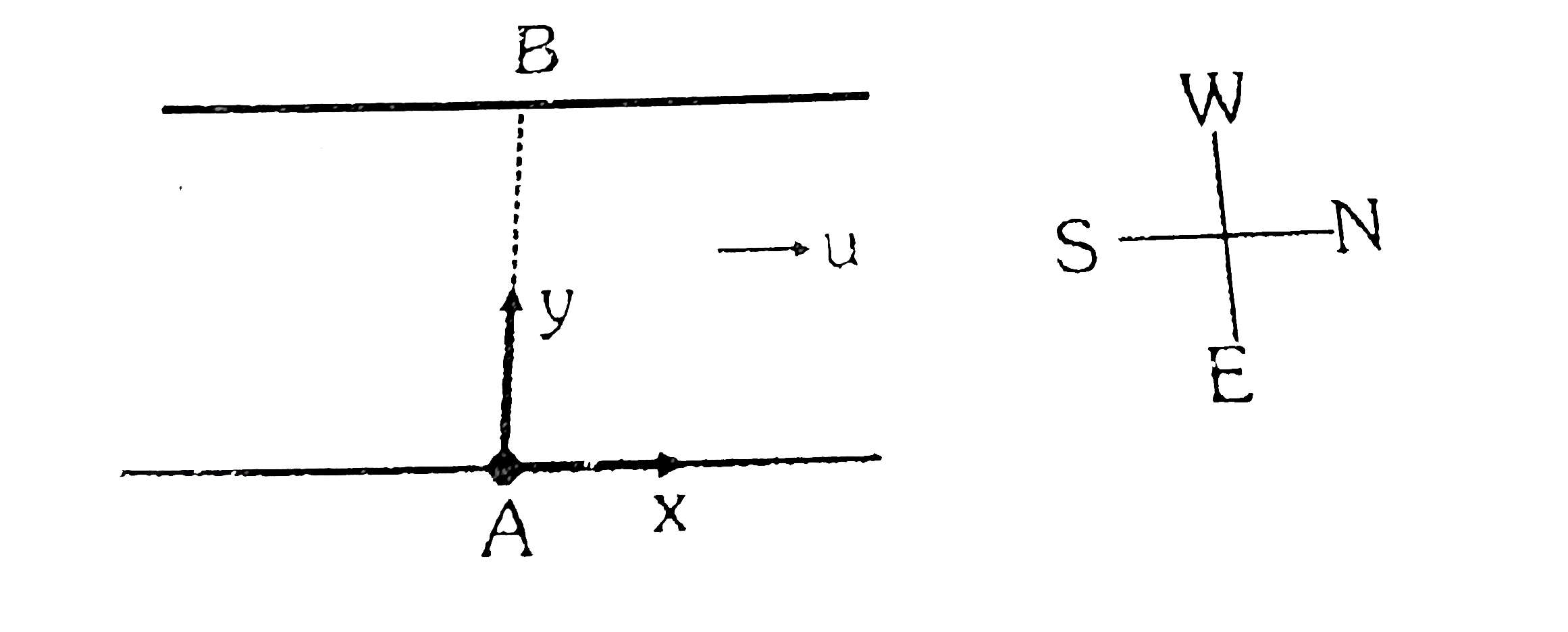
A river of width 'd' with straight parallel banks flows due North with speed u. A boat, whose speed is v relative to water, starts from A and crosses the river. If the boat is steered due West and u varies with y as `u=(y(d-y)v)/d^(2)` then answer the following questions.

Equation of trajectory of the boat is

A

`y=x^(2)/(2d)`

B

`x=y^(2)/(2d)`

C

`y=x^(2)/(2d)-x^(3)/(3d^(2))`

D

`x=y^(2)/(2d)-y^(3)/(3d^(2))`

Text Solution

Verified by Experts

The correct Answer is:

D

For boat (w.r.t. ground) `v_(y)=v, v_(x)=u=(y(d-y))/d^(2)vrArr (dy)/(dt)=v` and `(dx)/(dt)=v=(y(d-y))/d^(2) v`
`rArr (dx)/(dy)=(y(d-y))/d^(2)rArr int_(0)^(x)dx=int_(0)^(y)((yd-y^(2)))/d^(2) dy rArr x=y^(2)/(2d)-y^(3)/(3d^(2))`
Promotional Banner

Topper's Solved these Questions

  • KINEMATICS

    ALLEN |Exercise EXERCISE-01|55 Videos
  • KINEMATICS

    ALLEN |Exercise EXERCISE-02|57 Videos
  • ERROR AND MEASUREMENT

    ALLEN |Exercise Part-2(Exercise-2)(B)|22 Videos
  • KINEMATICS (MOTION ALONG A STRAIGHT LINE AND MOTION IN A PLANE)

    ALLEN |Exercise BEGINNER S BOX-7|8 Videos

Similar Questions

Explore conceptually related problems

A river of width 'd' with straight parallel banks flows due North with speed u. A boat, whose speed is v relative to water, starts from A and crosses the river. If the boat is steered due West and u varies with y as u=(y(d-y)v)/d^(2) then answer the following questions. The time take by boat to cross the river is

A river of width 'd' with straight parallel banks flows due North with speed u. A boat, whose speed is v relative to water, starts from A and crosses the river. If the boat is steered due West and u varies with y as u=(y(d-y)v)/d^(2) then answer the following questions. Absolute velocity of boat when it reaches the opposite bank is

A boat man can row with a speed of 10 km/hr. in still water. The river flow steadily at 5 km/hr. and the width of the river is 2 km. if the boat man cross the river with reference to minimum distance of approach then time elapsed in rowing the boat will be:-

A river 4.0 miles wide is following at the rate of 2 miles/hr. The minimum time taken by a boat to cross the river with a speed v=4 miles/hr (in still water) is approximately

A boat is travelling in a driver in river with a speed 10 m//s along the stream flowing with a speed 2m//s . From this, boat, a sounjd transmitter is lowered into the river through a right support. The wavelength of the sound emitted from the transmitter inside the water is 14.45 mm . Assume that attention of sound in water and air is negligible. (a) What will be frequency detected by receiver kept inside downstream? (b) The transmitter and the receiver are now pulled up into air. The air is blowing with a speed 5 m//s in the direction opposite the river stream. Determine the frequency of the sound detected by the receiver. (Temperature of the air and water = 20^(@)C , Density of river water = 10^(3) kg//m^(3) . Bulk modulus of the water = 2.088 xx 10^(6) Pa , Gas constant R = 8.31 J//mol-K , Mean molecular mass of air = 28.8 xx 10^(-3) kg//mol , C_(P)//C_(V) for air = 1.4 ).

When a jet of liquid strikes a fixed or moving surface, it exerts thrust on it due to rate of change of momentum. F=(rhoAV_(0))V_(0)-(rhoAV_(0))V_(0)costheta=rhoAV_(0)^(2)[1-costheta] If surface is free and starts moving due to thrust of the liquid, then at any instant, the above equation gets modified based on relative change of momentum with respect to surface. Let, at any instant, the velocity of surface be u . Then the above equation becomes F=rhoA(V_(0)-u)^(2)[1-costheta] Based on the above concept, as shown in the following figure, if the cart is frictionless and free to move in the horizontal direction, then answer the following. Given that cross sectional area of jet =2xx10^(-4)m^(2) velocity of jet V_(0)=10m//s density of liquid =1000kg//m^(3) ,mass of cart M=10 kg . Initially ( l=0 ) the force on the cart is equal to

By the term velocity of rain, we mean velocity with which raindrops fall relative to the ground. In absence of wind, raindrops fall vertically and in presence of wind raindrops fall obliqucly. Moreover raindrops acquire a constant terminal velocity due air resistance very quickly as they fall toward the carth. A moving man relative to himself observes an altered velocity of raindrops. Which is known as velocity of rain relative to the man. It is given by the following equation. vec(v)_(rm)=vec(v)_(r)-vec(v)_(m) A standstill man relative to himself observes rain falling with velocity, which is equal to velocity of the raindrops relative to the ground. To protect himself a man should his umbrella against velocity of raindrops relative to himself as shown in the following figure. Rain is falling vertically with velocity 80 cm/s. (a) How should you hold your umbrella ? (b) You start walking towards the east with velocity 60 cm/s. How should you hold umbrella ? (c) You are walking towards the west with velocity 60 cm/s. How should you hold your umbrella ? (d) You are walking towards the north with velocity 60 cm/s. How should you hold your umbrella? (e) You are walking towards the south with velocity 80 cm/s. How should you hold your umbrella ?

Drift is distance along a river a boat covers in crossing the river. If the boat reaches point C, distance BC is called downstream drift and if the boat reaches point D, distance BD is called upstream drift. To cross a river without drift, what should be relation between v_(br) and v_(r) and v_(r) . If a boat crosses a river without drift, in which direction must it be steered.

A physical quantity is a phyical property of a phenomenon , body, or substance , that can be quantified by measurement. The magnitude of the components of a vector are to be considered dimensionally distinct. For example , rather than an undifferentiated length unit L, we may represent length in the x direction as L_(x) , and so forth. This requirement status ultimately from the requirement that each component of a physically meaningful equation (scaler or vector) must be dimensionally consistent . As as example , suppose we wish to calculate the drift S of a swimmer crossing a river flowing with velocity V_(x) and of widht D and he is swimming in direction perpendicular to the river flow with velocity V_(y) relation to river, assuming no use of directed lengths, the quantities of interest are then V_(x),V_(y) both dimensioned as (L)/(T) , S the drift and D width of river both having dimension L. with these four quantities, we may conclude tha the equation for the drift S may be written : S prop V_(x)^(a)V_(y)^(b)D^(c) Or dimensionally L=((L)/(T))^(a+b)xx(L)^(c) from which we may deduce that a+b+c=1 and a+b=0, which leaves one of these exponents undetermined. If, however, we use directed length dimensions, then V_(x) will be dimensioned as (L_(x))/(T), V_(y) as (L_(y))/(T), S as L_(x)" and " D as L_(y) . The dimensional equation becomes : L_(x)=((L_(x))/(T))^(a) ((L_(y))/(T))^(b)(L_(y))^(c) and we may solve completely as a=1,b=-1 and c=1. The increase in deductive power gained by the use of directed length dimensions is apparent. A conveyer belt of width D is moving along x-axis with velocity V. A man moving with velocity U on the belt in the direction perpedicular to the belt's velocity with respect to belt want to cross the belt. The correct expression for the drift (S) suffered by man is given by (k is numerical costant )

Two balls are fired form ground level, a distance d apart. The right one is fired vertically with speed v . You wish to simultancously fire the left one at appropriate velocity u so that collides with the right ball when they reach their highest point. Value of horizontal (u_(x)) and vertical (u_(y)) components of u are respectively :- .

ALLEN -KINEMATICS-EXERCISE-2
  1. A river of width 'd' with straight parallel banks flows due North with...

    Text Solution

    |

  2. A student performs an experiment to determine how the range of a ball ...

    Text Solution

    |

  3. A student performs an experiment to determine how the range of a ball ...

    Text Solution

    |

  4. A student performs an experiment to determine how the range of a ball ...

    Text Solution

    |

  5. A circus wishes to develop a new clown act. Fig. (1) shows a diagram o...

    Text Solution

    |

  6. A circus wishes to develop a new clown act. Fig. (1) shows a diagram o...

    Text Solution

    |

  7. A circus wishes to develop a new clown act. Fig. (1) shows a diagram o...

    Text Solution

    |

  8. A circus wishes to develop a new clown act. Fig. (1) shows a diagram o...

    Text Solution

    |

  9. A circus wishes to develop a new clown act. Fig. (1) shows a diagram o...

    Text Solution

    |

  10. A circus wishes to develop a new clown act. Fig. (1) shows a diagram o...

    Text Solution

    |

  11. When a particle is undergoing motion, the diplacement of the particle ...

    Text Solution

    |

  12. When a particle is undergoing motion, the diplacement of the particle ...

    Text Solution

    |

  13. When a particle is undergoing motion, the diplacement of the particle ...

    Text Solution

    |

  14. When a particle is undergoing motion, the diplacement of the particle ...

    Text Solution

    |

  15. A projectile is projected with some initial velocity and some initial ...

    Text Solution

    |

  16. A projectile is projected with some initial velocity and some initial ...

    Text Solution

    |

  17. A projectile is projected with some initial velocity and some initial ...

    Text Solution

    |

  18. Fig. 2 (NCT).9 show the x-t plot of a particle in one dimensional mot...

    Text Solution

    |

  19. The position-time(x-t) graphs for two children A and B from their sch...

    Text Solution

    |

  20. A particle moves along x-axis with acceleration a = a0 (1 – t// T) wh...

    Text Solution

    |

  21. A body moving with uniform acceleration, covers a distance of 20 m in ...

    Text Solution

    |
