Home
Class 11
PHYSICS
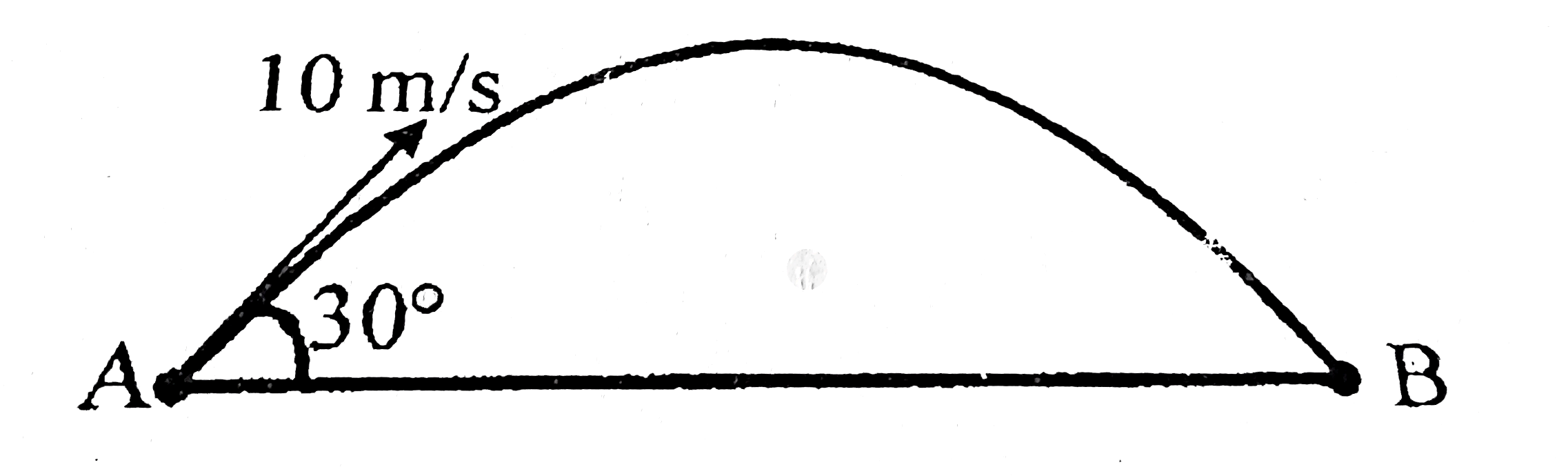
As shown in the figure there is a partic...

As shown in the figure there is a particle of mass `sqrt(3) kg`, is projected with speed `10 m//s` at an angle `30^(@)` with horizontal `("take "g=10 m//s^(2))` then match the following

`{:(,"Column I",,,"Column II"),((A),"Average velocity" ("in " m//s) "during half of the time of flight, is",,(P),1/2),((B),"The time (in sec after which the angle between velocity",,(Q),5/2_(o) sqrt(13)),(,"vector and initial velocity vector becomes " pi//2 is,,,),((C),"Horizonal range (in m), is",,(R),5sqrt(3)),((D),"Change in linear momentum (in N-s) when particle is at",,(S),"At an angle of" tan^(-1)(1/(2sqrt(3)))),(,"highest point, is",,,"from horizontal"),(,,,(T),2):}`

Text Solution

Verified by Experts

The correct Answer is:
`(A) rarr (Q, S); (B) rarr (T); (C) rarr (R); (D) rarr (R)`

For (A) : `v_(av)=sqrt((v_(avx))^(2)+(v_(avy))^(2))=sqrt((10 cos 30^(@))^(2)+((10 sin 30^(@)+0)/2)^(2))=sqrt(75+25/4)=5/2sqrt(13) m//s`
Angle with horizontal `theta=tan^(-1) (v_(avy)/v_(avx))=tan^(-1)((5//2)/(5sqrt(3)))=tan^(-1)(1/(2sqrt(3)))`
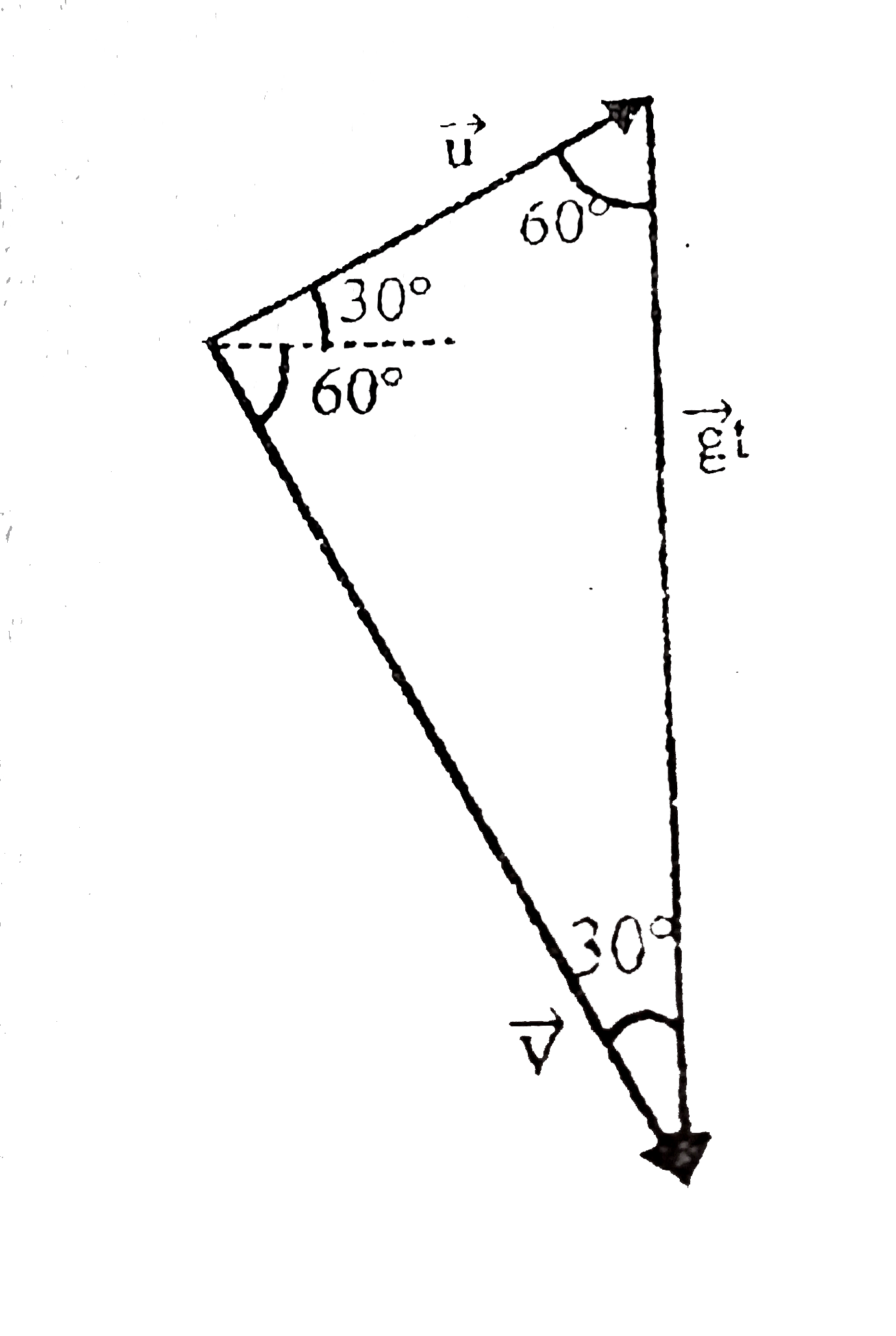
For (B) : By using `vec(v)=vec(u)+vec(a)t` we have `u/(g t)=sin 30^(@)rArr t=10/((10)(1//2))=2`
For (C) : Horizonatl range (R)`=(u^(2) sin 2theta)/(g)=(100xxsqrt(3)//2)/(10)=5sqrt(3) m`
For (D) : Change in linear momentum `=m u_(y)=sqrt(3)xx10 sin 30^(@)=5sqrt(3) N-s`
Promotional Banner

Topper's Solved these Questions

  • KINEMATICS

    ALLEN |Exercise EXERCISE-01|55 Videos
  • KINEMATICS

    ALLEN |Exercise EXERCISE-02|57 Videos
  • ERROR AND MEASUREMENT

    ALLEN |Exercise Part-2(Exercise-2)(B)|22 Videos
  • KINEMATICS (MOTION ALONG A STRAIGHT LINE AND MOTION IN A PLANE)

    ALLEN |Exercise BEGINNER S BOX-7|8 Videos

Similar Questions

Explore conceptually related problems

A particle is projected with a velocity of 30 m//s at an angle 60^(@) above the horizontal on a slope of inclination 30^(@) . Find its time of flight.

A particle is projected with a velocity 10 m/s at an angle 37^(@) to the horizontal. Find the location at which the particle is at a height 1 m from point of projection.

A particle is projected with a speed of 10 m/s at an angle 37^(@) with the vertical. Find (i) time of flight (ii) maximum height above ground (iii) horizontal range.

A particle of mass 50 g is projected horizontally from the top of a tower of height 50 m with a velocity 20m//s . If g=10m//s^(2) , then find the :-

A body is thrown with a velocity of 9.8 m//s making an angle of 30^(@) with the horizontal. It will hit the ground after a time

A particle is rotating in a circle of radius 1m with constant speed 4 m//s . In time 1s, match the following (in SI units) {:(,"Column I",,,"Column II"),((A),"Displacement",,(p),8 sin 2),((B),"Distance",,(q),4),((C),"Average velocity",,(r),2sin 2),((D),"Average acceleration",,(s),4 sin 2):}

Trajectory of particle in a projectile motion is given as y=x- x^(2)/80 . Here, x and y are in meters. For this projectile motion, match the following with g=10 m//s^(2) . {:(,"Column-I",,"Column-II"),((A),"Angle of projection (in degrees)",(P),20),((B),"Angle of velocity with horizontal after 4s (in degrees)",(Q),80),((C),"Maximum height (in meters)",(R),45),((D),"Horizontal range (in meters)",(S),30),(,,(T),60):}

A ball is thrown from the top of 36m high tower with velocity 5m//ss at an angle 37^(@) above the horizontal as shown. Its horizontal distance on the ground is closest to [ g=10m//s^(2) :

In the diamram shown in figure , match the following (g=10m//s^(2))

For the velocity -time graph shown in figure, in a time interval from t=0 to t=6 s , match the following: {:(,"Column I",,,"Column II"),((A),"Change in velocity",,(p),-5//3 SI "unit"),((B),"Average acceleration",,(q),-20 SI "unit"),((C),"Total displacement",,(r),-10 SI "unit"),((D),"Acceleration ay t=3s",,(s),-5 SI "unit"):}

ALLEN -KINEMATICS-EXERCISE-2
  1. As shown in the figure there is a particle of mass sqrt(3) kg, is proj...

    Text Solution

    |

  2. A student performs an experiment to determine how the range of a ball ...

    Text Solution

    |

  3. A student performs an experiment to determine how the range of a ball ...

    Text Solution

    |

  4. A student performs an experiment to determine how the range of a ball ...

    Text Solution

    |

  5. A circus wishes to develop a new clown act. Fig. (1) shows a diagram o...

    Text Solution

    |

  6. A circus wishes to develop a new clown act. Fig. (1) shows a diagram o...

    Text Solution

    |

  7. A circus wishes to develop a new clown act. Fig. (1) shows a diagram o...

    Text Solution

    |

  8. A circus wishes to develop a new clown act. Fig. (1) shows a diagram o...

    Text Solution

    |

  9. A circus wishes to develop a new clown act. Fig. (1) shows a diagram o...

    Text Solution

    |

  10. A circus wishes to develop a new clown act. Fig. (1) shows a diagram o...

    Text Solution

    |

  11. When a particle is undergoing motion, the diplacement of the particle ...

    Text Solution

    |

  12. When a particle is undergoing motion, the diplacement of the particle ...

    Text Solution

    |

  13. When a particle is undergoing motion, the diplacement of the particle ...

    Text Solution

    |

  14. When a particle is undergoing motion, the diplacement of the particle ...

    Text Solution

    |

  15. A projectile is projected with some initial velocity and some initial ...

    Text Solution

    |

  16. A projectile is projected with some initial velocity and some initial ...

    Text Solution

    |

  17. A projectile is projected with some initial velocity and some initial ...

    Text Solution

    |

  18. Fig. 2 (NCT).9 show the x-t plot of a particle in one dimensional mot...

    Text Solution

    |

  19. The position-time(x-t) graphs for two children A and B from their sch...

    Text Solution

    |

  20. A particle moves along x-axis with acceleration a = a0 (1 – t// T) wh...

    Text Solution

    |

  21. A body moving with uniform acceleration, covers a distance of 20 m in ...

    Text Solution

    |

