Home
Class 11
PHYSICS
When a particle is undergoing motion, th...

When a particle is undergoing motion, the diplacement of the particle has a magnitude that is equal to or smaller than the total distance travelled by the particle. In many cases the displacement of the particle may actually be zero, while the distance travelled by it is non-zero. Both these quantities, however depend on the frame of reference in which motion of the particle is being observed. Consider a particle which is projected in the earth's gravitational field, close to its surface, with a speed of `100sqrt(2) m//s`, at an angle of `45^(@)` with the horizontal in the eastward direction. Ignore air resistance and assume that the acceleration due to gravity is `10 m//s^(2)`.
" A third observer (C) close to the surface of the reports that particle is initially travelling at a speed of `100sqrt(2) m//s` making on angle of `45^(@)` with the horizontal, but its horizontal motion is northward". The third observer is moving in :-

A

The south-west direction with a speed of `100 sqrt(2) m//s`

B

The south-east direction with a speed of `100 sqrt(2) m//s`

C

The north-west direction with a speed of `100 sqrt(2) m//s`

D

The north-east direction with speed of `100 sqrt(2) m//s`

Text Solution

Verified by Experts

The correct Answer is:
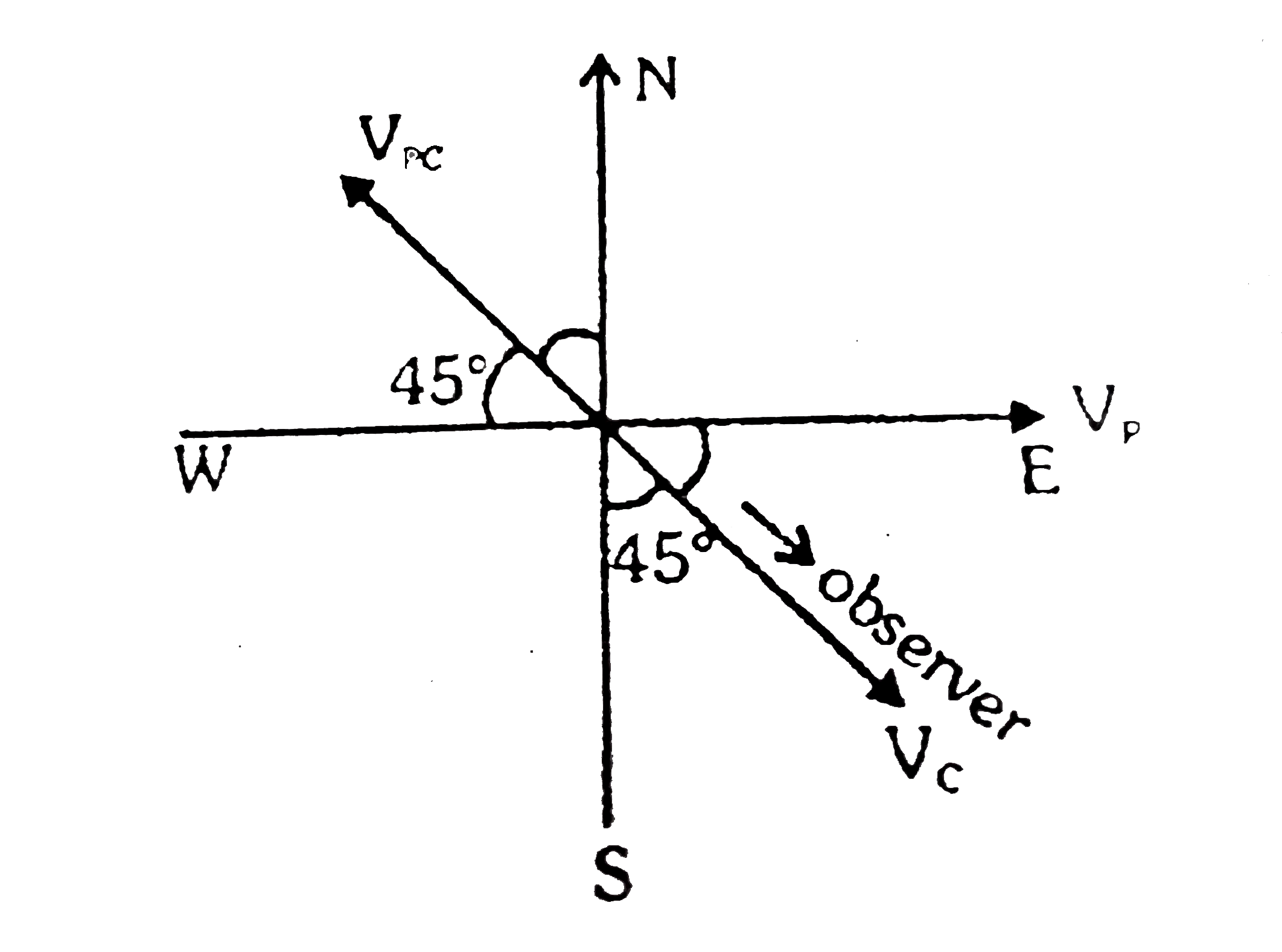
B

As observer observes that particle moves north-wards.
Promotional Banner

Topper's Solved these Questions

  • KINEMATICS

    ALLEN |Exercise Comprehension#7|3 Videos
  • KINEMATICS

    ALLEN |Exercise EXERCISE-04[A]|35 Videos
  • KINEMATICS

    ALLEN |Exercise Comprehension#5|6 Videos
  • ERROR AND MEASUREMENT

    ALLEN |Exercise Part-2(Exercise-2)(B)|22 Videos
  • KINEMATICS (MOTION ALONG A STRAIGHT LINE AND MOTION IN A PLANE)

    ALLEN |Exercise BEGINNER S BOX-7|8 Videos

Similar Questions

Explore conceptually related problems

When a particle is undergoing motion, the diplacement of the particle has a magnitude that is equal to or smaller than the total distance travelled by the particle. In many cases the displacement of the particle may actually be zero, while the distance travelled by it is non-zero. Both these quantities, however depend on the frame of reference in which motion of the particle is being observed. Consider a particle which is projected in the earth's gravitational field, close to its surface, with a speed of 100sqrt(2) m//s , at an angle of 45^(@) with the horizontal in the eastward direction. Ignore air resistance and assume that the acceleration due to gravity is 10 m//s^(2) . There exists a frame (D) in which the distance travelled by the particle is minimum. This minimum distance is equal to :-

When a particle is undergoing motion, the diplacement of the particle has a magnitude that is equal to or smaller than the total distance travelled by the particle. In many cases the displacement of the particle may actually be zero, while the distance travelled by it is non-zero. Both these quantities, however depend on the frame of reference in which motion of the particle is being observed. Consider a particle which is projected in the earth's gravitational field, close to its surface, with a speed of 100sqrt(2) m//s , at an angle of 45^(@) with the horizontal in the eastward direction. Ignore air resistance and assume that the acceleration due to gravity is 10 m//s^(2) . The motion of the particle is observed in two different frames: one in the ground frame (A) and another frame (B), in which the horizontal component of the displacement is always zero. Two observers locates in these frames ill agree on :-

When a particle is undergoing motion, the diplacement of the particle has a magnitude that is equal to or smaller than the total distance travelled by the particle. In many cases the displacement of the particle may actually be zero, while the distance travelled by it is non-zero. Both these quantities, however depend on the frame of reference in which motion of the particle is being observed. Consider a particle which is projected in the earth's gravitational field, close to its surface, with a speed of 100sqrt(2) m//s , at an angle of 45^(@) with the horizontal in the eastward direction. Ignore air resistance and assume that the acceleration due to gravity is 10 m//s^(2) . Consider an observer in frame D (of the previous question), who observes a body of mass 10 kg acelerating in the upward direction at 30 m//s^(2) (w.r.t. himself). The net force acting on this body, as observed from the ground is :-

If distance travelled by particle is zero then its displacement is …... .

How motion of any particle is described ?

The displacement of a particle is given by x = (t-2)^(2) where x is in metre and t in second. The distance covered by the particle in first 4 seconds is

Which of the following is true for displacement ? (a) It cannot be zero. (b) Its magnitude is greater than the distance travelled by the object.

Velocity time graph for a particle moving in a line is given. Calculate the displacement of the particle and distance travelled in first 4 seconds.

Velocity time graph for a particle moving in a line is given. Calculate the displacement of the particle and distance travelled in first 4 seconds.

