Home
Class 11
PHYSICS
An object A is kept fixed at the point ...

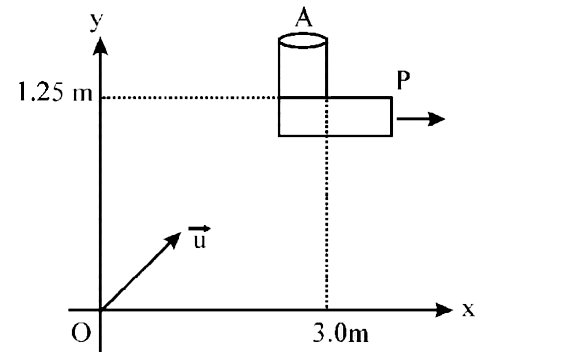
An object `A` is kept fixed at the point ` x= 3 m` and `y = 1.25 m` on a plank `p` raised above the ground . At time ` t = 0 ` the plank starts moving along the `+x` direction with an acceleration ` 1.5 m//s^(2) `. At the same instant a stone is projected from the origin with a velocity `vec(u)` as shown . A stationary person on the ground observes the stone hitting the object during its downward motion at an angle ` 45(@)` to the horizontal . All the motions are in the ` X -Y `plane . Find ` vec(u)` and the time after which the stone hits the object . Take ` g = 10 m//s`

Text Solution

Verified by Experts

The correct Answer is:
`u=7.29 ms^(-1), t=1s`

Let 't' be the time after which the stone hits the object and `theta` be the abgle which the velocity vector `vec(u)` makes with horizontal. According to question, we have following three conditions.
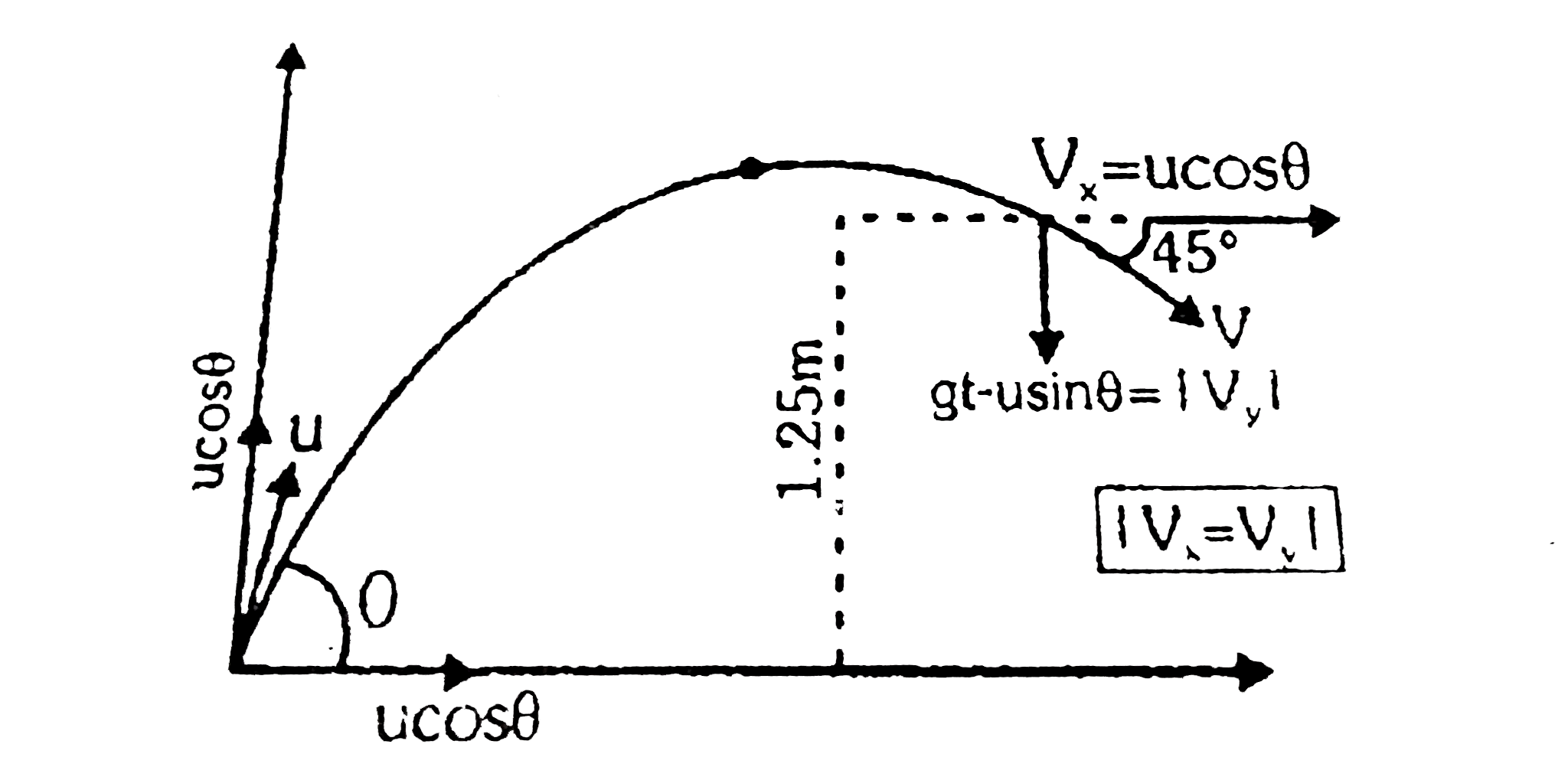
(i) Vertical displacement of stome is `1.25 m`
`:' 1.25=(u sin theta)t-1/2 g t^(2)` where `g=10 m//s^(2)`
`rArr (u sin theta)t=1.25+5t^(2)` ...(i)
(ii) horizontal displacement of stone
`=3 +` dispplacement of object A.
Therefore `(u cos theta)t=3 +1/2 at^(2)`
where `a=1.5 m//s^(2) rArr (u cos theta)t=3 +0.75 t^(2)` ...(ii)
Horizontal component of velocity (of stone)
`=` vertical component (because velocity vector is inclined) at `45^(@)` with horizontal.
Therefore `(u cos theta)=g t-(u sin theta)` ...(iii)
The right hand side is written `g t-u sin theta` because the stone is in its downward motion.
Therefore, `g t gt u sin theta`
In upward motion `u sin theta gt g t`
Multiplying equation (iii) with t we can write,
`(u cos theta) t+(u sin theta)t=10 t^(2)` ...(iv)
Now `(iv)-(ii)-(i)` gives `4.25 t^(2)-4.25=0` or `t=1 s`
Substituting `t=1s` in (i) and (ii) we get
`u sin theta=6.25 m//s`
`rArr u_(y)=6.25 m//s` and `u cos theta=3.75 m//s`
`rArr u_(x)=3.75 m//s` therefore `vec(u)=u_(x)hat(i)+u_(y)hat(j)`
`rArr vec(u)=(3.75hat(i)+6.25hat(j)) m//s`
Promotional Banner

Topper's Solved these Questions

  • KINEMATICS

    ALLEN |Exercise Integer Type Question|3 Videos
  • KINEMATICS

    ALLEN |Exercise PHY|60 Videos
  • KINEMATICS

    ALLEN |Exercise MCQ with one or more than one correct Question|1 Videos
  • ERROR AND MEASUREMENT

    ALLEN |Exercise Part-2(Exercise-2)(B)|22 Videos
  • KINEMATICS (MOTION ALONG A STRAIGHT LINE AND MOTION IN A PLANE)

    ALLEN |Exercise BEGINNER S BOX-7|8 Videos

Similar Questions

Explore conceptually related problems

A balloon starts rising from the ground with an acceleration of 1.25 m//s^(2) . A stone is released from the balloon after 10s. Determine (1) maximum height of ston from ground (2) time taken by stone to reach the ground

The acceleration of a particle moving along x-direction is given by equation a=(3-2t) m//s^(2) . At the instant t=0 and t=6 s , it occupies the same position. (a) Find the initial velocity v_(o) (b) What will be the velocity at t=2 s ?

At time t=0 s a car passes a point with velocity of 16 m//s and thereafter slows down with acceleration a=-0.5t m//s^(2) ,where t is in seconds. It stops at the instant t=

a particle moving along a straight line with uniform acceleration has velocities 7 m//s at A and 17 m//s at C. B is the mid point of AC. Then :-

A particle is projected vertically upwards from ground with velocity 10 m // s. Find the time taken by it to reach at the highest point ?

A body is projected upwards with a velocity u . It passes through a certain point above the ground after t_(1) , Find the time after which the body passes through the same point during the journey.

A stone is thrown horizontally with the velocity v_(x) = 15m//s . Determine the normal and tangential accelerations of the stone in I second after begins to move.

Acceleration of a particle moving along the x-axis is defined by the law a=-4x , where a is in m//s^(2) and x is in meters. At the instant t=0 , the particle passes the origin with a velocity of 2 m//s moving in the positive x-direction. (a) Find its velocity v as function of its position coordinates. (b) find its position x as function of time t. (c) Find the maximum distance it can go away from the origin.

An elevator car (lift) is moving upward with uniform acceleration of 2 m//s^(2) . At the instant, when its velocity is 2 m/s upwards a ball thrown upward from its floor. The ball strikes back the floor 2s after its projection. Find the velocity of projection of the ball relative to the lift.

