Home
Class 12
PHYSICS
If the lower spring is cut, find acceler...

If the lower spring is cut, find acceleration of the blokcs, immediately after cutting the spring.

Text Solution

Verified by Experts
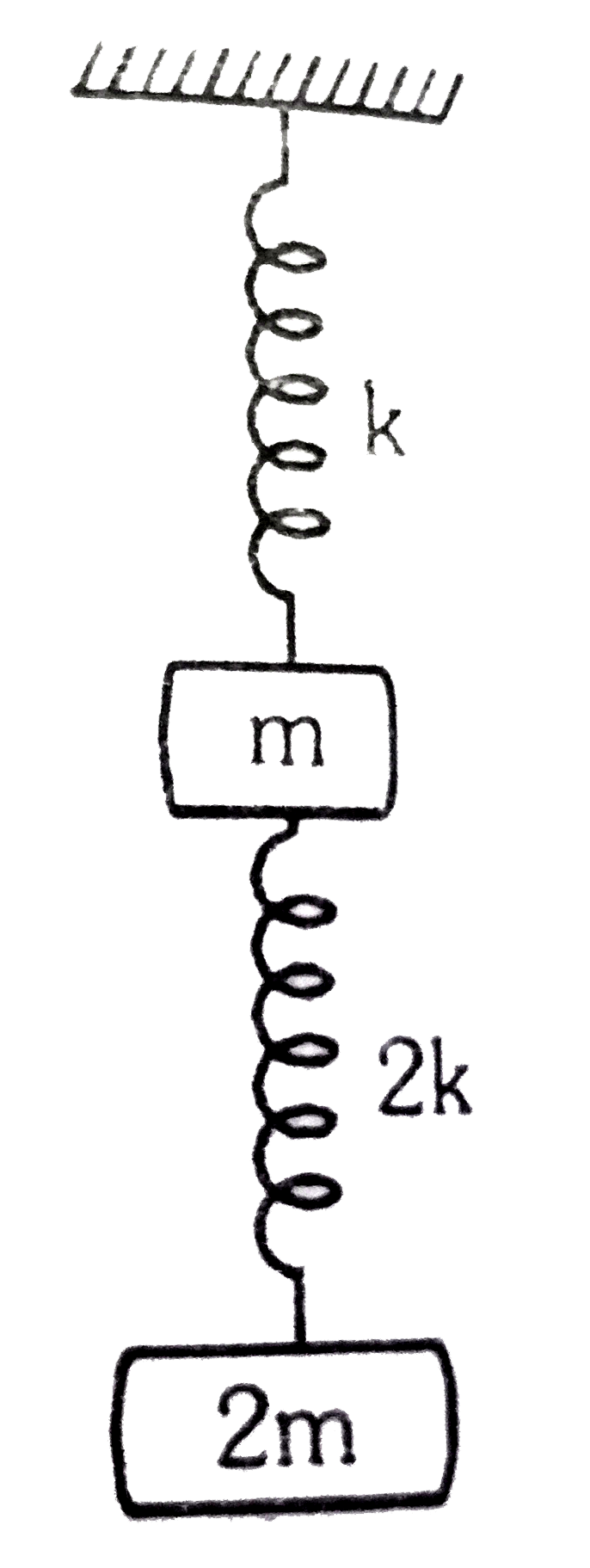
Initial stretches `x_("upper")=(3mg)/(k)& x_("lower")=(mg)/(k)`
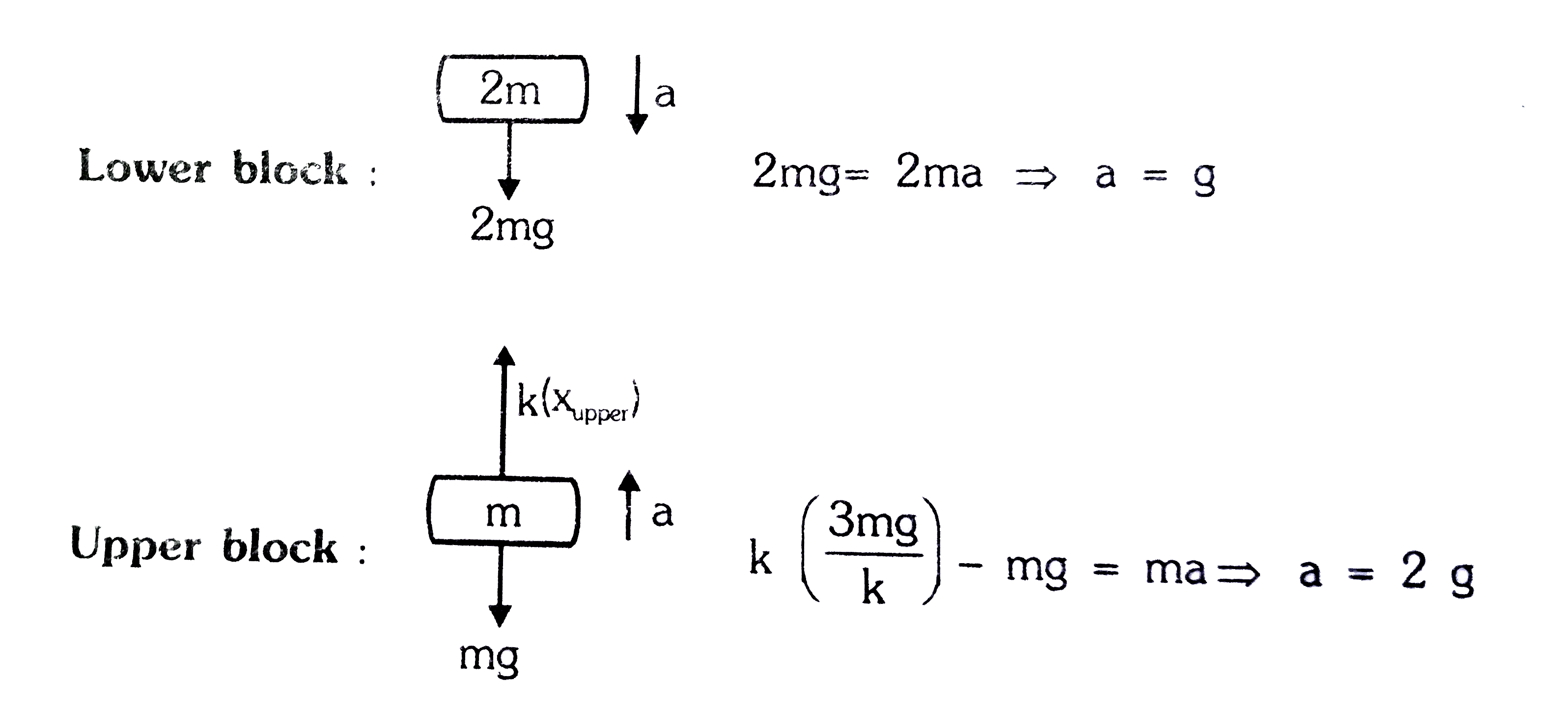
On cutting the lower spring, by virture of non-impulsive nature of pring the stretch in upper spring remains same. Thus,
Lower block :
Promotional Banner

Topper's Solved these Questions

  • NEWTONS LAWS OF MOTION

    ALLEN |Exercise SWOE|44 Videos
  • NEWTONS LAWS OF MOTION

    ALLEN |Exercise EXERCISE-I|52 Videos
  • NEWTON'S LAWS OF MOTION & FRICTION

    ALLEN |Exercise EXERCISE (JA)|4 Videos
  • RACE

    ALLEN |Exercise Basic Maths (Wave Motion & Dopplers Effect) (Stationary waves & doppler effect, beats)|25 Videos

Similar Questions

Explore conceptually related problems

A block tied between two identical springs is in equilibrium. If upper spring is cut then the acceleration of the block just after cut is 6m//s^(2) downwards. Now, if instead of upper spring, lower spring is being cut then the acceleration of the block just after the cut will be.

The system shown in the figure is initially in equilibrium. A is of mass 2 m and B,C D and E are of mass m Certain actions are performed on the system. Every action has been taken individually when the system is intact. Find the direction and magnitude of acceleration of the blocks after each action of the following actions has been taken {:((i)"Spting 1 is cut",(ii)"Spring 2 is cut"),((iii)"String between C and D is cut.",(iv)"String between B and C is cut."):}

A spring of force constant k is kept in the compressesd condition between two blocks masses m and M on the smooth surface of a table as shown in figure .When the spring is released , both the blocks move in opposite directions .When the spring attains the orginal (normal ) position . both blocks lose the constacts with the spring . If x is the intial compression of the spring find the speeds of block while getting detached from the spring .

The system shown adjacent is in equilibrium. Find the acceleration of the blocks A,B &C all of equal masses m at the instant when (Assume springs to be ideal) (i) The spring between celling & A is cut. (ii) The spring (inextensible) between A&B is cut. (iii) The speing between B & C is cut. Also find the tension in the string when the system is at rest and in the above 3 cases.

Two blocks each of mass m, connected by an un-stretched spring are kept at rest on a frictionless horizontal surface. A constant force F is applied on one of the blocks pulling it away from the other as shown in figure. (a)Find accelaration of the mass center. (b) Find the displacement of the centre of mass as function of time t. (c) If the extension of the spring is X_(0) at an instant t, find the displacements of the two blocks relative to the ground at this instant.

In the system shown in figure all surface are smooth, string in massless and inextensible. Find: (a) acceleration of the system (b) tensionin the string and (c ) ectension in the spring if force constant of spring is k = 50 N/m (Take g = 10 m//s^(2) )

In the given figure both the bocks have equal mass. When the thread is cut, which of the following statements give correct discription immediately after the thread is cut?

If the spring is cut in two equal piece the spring constant of every piece decreases.

A spring has spring constant k and l. If it cut into piece spring in the proportional to alpha : beta : gamma then obtain the spring constant of every piece in term of spring constant of original spring (Here, alpha, beta " and "gamma are integers).

The time period of mass suspended from a spring is T. If the spring is cut into four equal parts and the same mass is suspended from one of the parts, then the new time period will be…….

ALLEN -NEWTONS LAWS OF MOTION-EXERCISE-III
  1. If the lower spring is cut, find acceleration of the blokcs, immediate...

    Text Solution

    |

  2. Assertion: The driver in a vechicle moving with a constant speed on a ...

    Text Solution

    |

  3. Assertion: Frictional forces are conservative forces. Reason: Potent...

    Text Solution

    |

  4. Assertion: A man in a dosed cabin falling freely does not experience g...

    Text Solution

    |

  5. Assertion : Angle of repose is equal to angle of limiting friction. ...

    Text Solution

    |

  6. Assertion: On a rainy day, it is difficult to drive a car or bus at h...

    Text Solution

    |

  7. Assertion: Force of friction depends on the actual area of contact. ...

    Text Solution

    |

  8. Assertion: Static frictional force is a self adjusting force. Reason...

    Text Solution

    |

  9. Assertion : A body can be at rest even when it is under the action of ...

    Text Solution

    |

  10. Assertion: Frictional force is the component of contact force parallel...

    Text Solution

    |

  11. Assertion: Newton's first law can be derived from the second law. Re...

    Text Solution

    |

  12. These questions consists of two statements each printed as Assertion a...

    Text Solution

    |

  13. Assertion: Pseudo force is an imaginary force which is recongnised on...

    Text Solution

    |

  14. Assertion: A table cloth can be pulled from a table without dislodding...

    Text Solution

    |

  15. Assertion: Friction is a self-adjusting force. Reason: A block on th...

    Text Solution

    |

  16. Assertion: The apparent weight of a person standing in a lift which mo...

    Text Solution

    |

  17. Assertion: A body of weight 10N (W) is at rest on an inclined plane (m...

    Text Solution

    |

  18. Assertion: When a force vecF attempts to slide a body along a surface,...

    Text Solution

    |

  19. Assertion: Mass is a property of one object alone, whereas weight resu...

    Text Solution

    |

  20. Assertion: When brakes are applied on a wet road, a car is likely to s...

    Text Solution

    |

  21. Assertion : The force of tension on a body always act away from the bo...

    Text Solution

    |