Home
Class 12
PHYSICS
A passenger on a large ship sailing in a...

A passenger on a large ship sailing in a quiet sea hangs a ball from the celling of her cabin by means of a long thread. Whenever the ship acceleration when the pendulum stands at an angle of `5^(@)` to the vertical ?

Text Solution

Verified by Experts
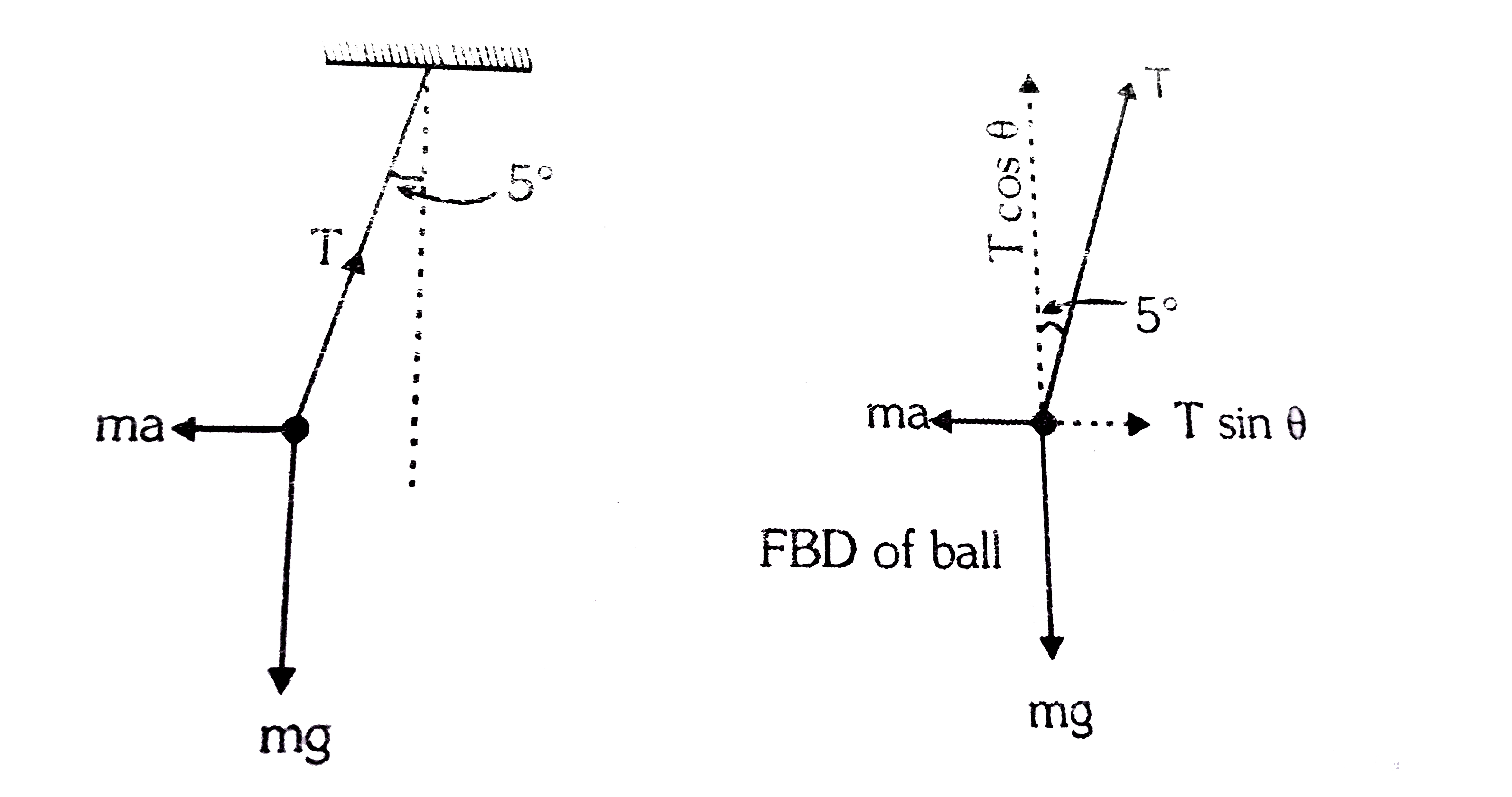
The ball is accelerated by the force `T sin5^(@)`
Therefore `T sin5^(@)=ma`
Vertical component `sumF=0,` so `T cos5^(@)=mg`
By solving `a=g tan 5^(@)=0.0875g`
`=0.86ms^(-2)`
Promotional Banner

Topper's Solved these Questions

  • NEWTONS LAWS OF MOTION

    ALLEN |Exercise SWOE|44 Videos
  • NEWTONS LAWS OF MOTION

    ALLEN |Exercise EXERCISE-I|52 Videos
  • NEWTON'S LAWS OF MOTION & FRICTION

    ALLEN |Exercise EXERCISE (JA)|4 Videos
  • RACE

    ALLEN |Exercise Basic Maths (Wave Motion & Dopplers Effect) (Stationary waves & doppler effect, beats)|25 Videos

Similar Questions

Explore conceptually related problems

A ball is suspended by a thread of length L at the point O on a wall which in indeed to the vertical by alpha . The thread with the ball is displaced by a small angle beta away from the vertical and also away from the wall. If the ball is released, the period of observation of the pendulum when beta gt alpha will be...........

A ladder, 5 meter long, standing on a horizontal floor, leans against a vertical wall. If the top of the ladder slides downwards at the rate of 10 cm/sec, then the rate at which the angle between the floor and the ladder is decreasing when lower end of ladder is 2 metres from the wall is ............

A circus wishes to develop a new clown act. Fig. (1) shows a diagram of the proposed setup. A clown will be shot out of a cannot with velocity v_(0) at a trajectory that makes an angle theta=45^(@) with the ground. At this angile, the clown will travell a maximum horizontal distance. The cannot will accelerate the clown by applying a constant force of 10, 000N over a very short time of 0.24s . The height above the ground at which the clown begins his trajectory is 10m . A large hoop is to be suspended from the celling by a massless cable at just the right place so that the clown will be able to dive through it when he reaches a maximum height above the ground. After passing through the hoop he will then continue on his trajectory until arriving at the safety net. Fig (2) shows a graph of the vertical component of the clown's velocity as a function of time between the cannon and the hoop. Since the velocity depends on the mass of the particular clown performing the act, the graph shows data for serveral different masses. If the angle the cannot makes with the horiaontal is increased from 45^(@) , the hoop will have to be

A circus wishes to develop a new clown act. Fig. (1) shows a diagram of the proposed setup. A clown will be shot out of a cannot with velocity v_(0) at a trajectory that makes an angle theta=45^(@) with the ground. At this angile, the clown will travell a maximum horizontal distance. The cannot will accelerate the clown by applying a constant force of 10, 000N over a very short time of 0.24s . The height above the ground at which the clown begins his trajectory is 10m . A large hoop is to be suspended from the celling by a massless cable at just the right place so that the clown will be able to dive through it when he reaches a maximum height above the ground. After passing through the hoop he will then continue on his trajectory until arriving at the safety net. Fig (2) shows a graph of the vertical component of the clown's velocity as a function of time between the cannon and the hoop. Since the velocity depends on the mass of the particular clown performing the act, the graph shows data for serveral different masses. From figure 2, approximately how much time will it take for clown with a mass of 60 kg to reach the safety net located 10 m below the height of the cannot?

A circus wishes to develop a new clown act. Fig. (1) shows a diagram of the proposed setup. A clown will be shot out of a cannot with velocity v_(0) at a trajectory that makes an angle theta=45^(@) with the ground. At this angile, the clown will travell a maximum horizontal distance. The cannot will accelerate the clown by applying a constant force of 10, 000N over a very short time of 0.24s . The height above the ground at which the clown begins his trajectory is 10m . A large hoop is to be suspended from the celling by a massless cable at just the right place so that the clown will be able to dive through it when he reaches a maximum height above the ground. After passing through the hoop he will then continue on his trajectory until arriving at the safety net. Fig (2) shows a graph of the vertical component of the clown's velocity as a function of time between the cannon and the hoop. Since the velocity depends on the mass of the particular clown performing the act, the graph shows data for serveral different masses. If a clown holds on to hoop instead of passing through it, what is the position of the cable so that he doesn't hit his head on the ceiling as he swings upward?

A circus wishes to develop a new clown act. Fig. (1) shows a diagram of the proposed setup. A clown will be shot out of a cannot with velocity v_(0) at a trajectory that makes an angle theta=45^(@) with the ground. At this angile, the clown will travell a maximum horizontal distance. The cannot will accelerate the clown by applying a constant force of 10, 000N over a very short time of 0.24s . The height above the ground at which the clown begins his trajectory is 10m . A large hoop is to be suspended from the celling by a massless cable at just the right place so that the clown will be able to dive through it when he reaches a maximum height above the ground. After passing through the hoop he will then continue on his trajectory until arriving at the safety net. Fig (2) shows a graph of the vertical component of the clown's velocity as a function of time between the cannon and the hoop. Since the velocity depends on the mass of the particular clown performing the act, the graph shows data for serveral different masses. If the clown's mass is 80 kg , what initial velocity v_(0) will have as he leaves the cannot?

A circus wishes to develop a new clown act. Fig. (1) shows a diagram of the proposed setup. A clown will be shot out of a cannot with velocity v_(0) at a trajectory that makes an angle theta=45^(@) with the ground. At this angile, the clown will travell a maximum horizontal distance. The cannot will accelerate the clown by applying a constant force of 10, 000N over a very short time of 0.24s . The height above the ground at which the clown begins his trajectory is 10m . A large hoop is to be suspended from the celling by a massless cable at just the right place so that the clown will be able to dive through it when he reaches a maximum height above the ground. After passing through the hoop he will then continue on his trajectory until arriving at the safety net. Fig (2) shows a graph of the vertical component of the clown's velocity as a function of time between the cannon and the hoop. Since the velocity depends on the mass of the particular clown performing the act, the graph shows data for serveral different masses. If the mass of a clown doubles, his initial kinetic energy, mv_(0)^(2)//2 , will :-

A circus wishes to develop a new clown act. Fig. (1) shows a diagram of the proposed setup. A clown will be shot out of a cannot with velocity v_(0) at a trajectory that makes an angle theta=45^(@) with the ground. At this angile, the clown will travell a maximum horizontal distance. The cannot will accelerate the clown by applying a constant force of 10, 000N over a very short time of 0.24s . The height above the ground at which the clown begins his trajectory is 10m . A large hoop is to be suspended from the celling by a massless cable at just the right place so that the clown will be able to dive through it when he reaches a maximum height above the ground. After passing through the hoop he will then continue on his trajectory until arriving at the safety net. Fig (2) shows a graph of the vertical component of the clown's velocity as a function of time between the cannon and the hoop. Since the velocity depends on the mass of the particular clown performing the act, the graph shows data for serveral different masses. The slope of the line segments plotted in figure 2 is a figure constant. Which one of the following physical quantities does this slope represent?

ALLEN -NEWTONS LAWS OF MOTION-EXERCISE-III
  1. A passenger on a large ship sailing in a quiet sea hangs a ball from t...

    Text Solution

    |

  2. Assertion: The driver in a vechicle moving with a constant speed on a ...

    Text Solution

    |

  3. Assertion: Frictional forces are conservative forces. Reason: Potent...

    Text Solution

    |

  4. Assertion: A man in a dosed cabin falling freely does not experience g...

    Text Solution

    |

  5. Assertion : Angle of repose is equal to angle of limiting friction. ...

    Text Solution

    |

  6. Assertion: On a rainy day, it is difficult to drive a car or bus at h...

    Text Solution

    |

  7. Assertion: Force of friction depends on the actual area of contact. ...

    Text Solution

    |

  8. Assertion: Static frictional force is a self adjusting force. Reason...

    Text Solution

    |

  9. Assertion : A body can be at rest even when it is under the action of ...

    Text Solution

    |

  10. Assertion: Frictional force is the component of contact force parallel...

    Text Solution

    |

  11. Assertion: Newton's first law can be derived from the second law. Re...

    Text Solution

    |

  12. These questions consists of two statements each printed as Assertion a...

    Text Solution

    |

  13. Assertion: Pseudo force is an imaginary force which is recongnised on...

    Text Solution

    |

  14. Assertion: A table cloth can be pulled from a table without dislodding...

    Text Solution

    |

  15. Assertion: Friction is a self-adjusting force. Reason: A block on th...

    Text Solution

    |

  16. Assertion: The apparent weight of a person standing in a lift which mo...

    Text Solution

    |

  17. Assertion: A body of weight 10N (W) is at rest on an inclined plane (m...

    Text Solution

    |

  18. Assertion: When a force vecF attempts to slide a body along a surface,...

    Text Solution

    |

  19. Assertion: Mass is a property of one object alone, whereas weight resu...

    Text Solution

    |

  20. Assertion: When brakes are applied on a wet road, a car is likely to s...

    Text Solution

    |

  21. Assertion : The force of tension on a body always act away from the bo...

    Text Solution

    |

