Home
Class 12
PHYSICS
A 12 kg monkey climbs a light rope as sh...

A 12 kg monkey climbs a light rope as shown in figure. The rope passes over a pulley and is attached to a 16 kg bunch of bananas. Mass and friction in the pulley are negligible so that the pulley's only effect is to reverse the direction of the rope. What is the maximum acceleration the monkey can have without lifting the bananas?

Text Solution

Verified by Experts
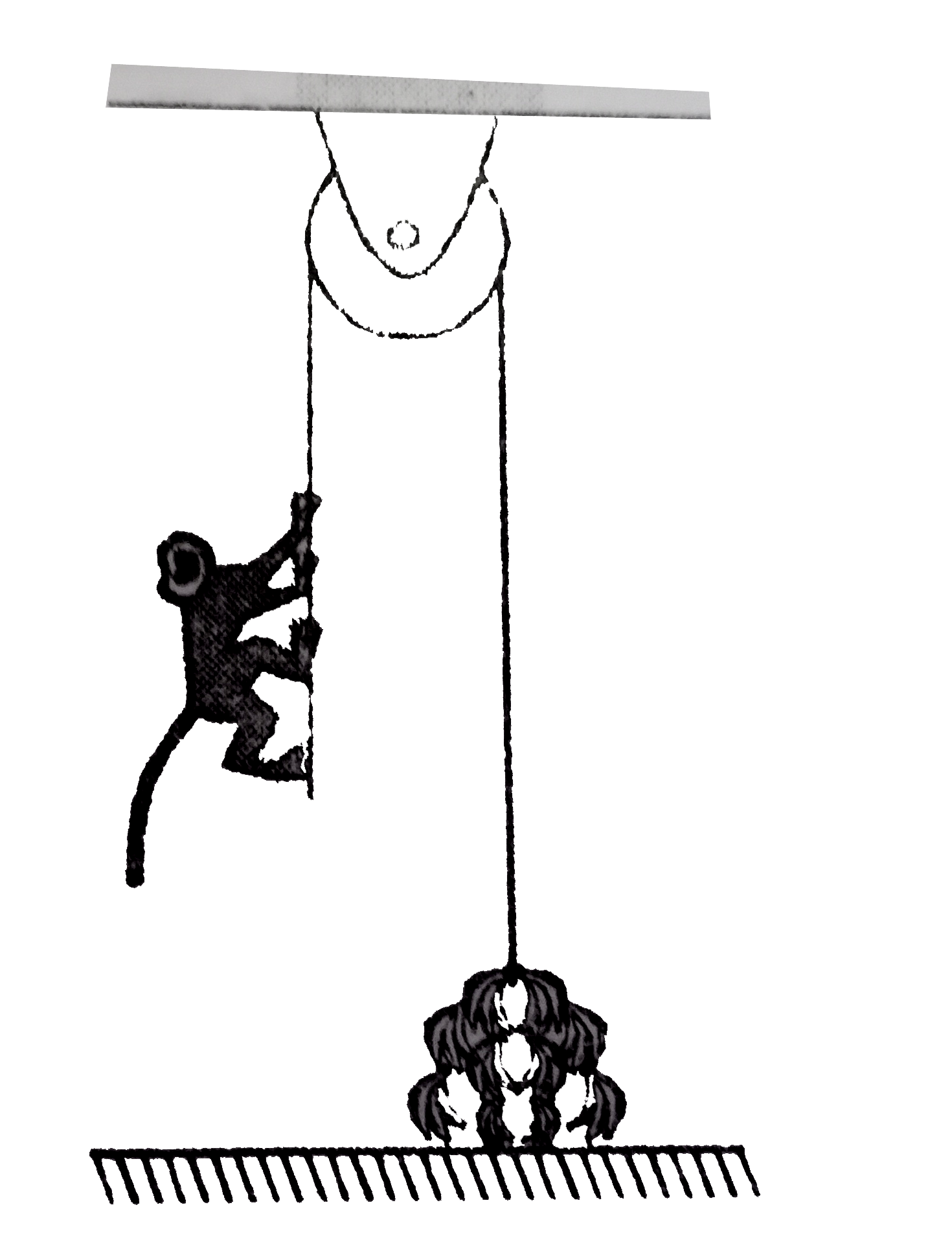
As monkey is lifint upward so effective weight of monkey `W_(m)=M_(m)(g+a)`
As per given condition `W_(m)=W_(b)rArrM_(m)(g+a)=M_(b)g`
`rArra=((M_(b)-M_(m))g)/(M_(m))=((16-12)/(12))xx9.8=(9.8)/(3)=3.26 m//s^(2)`
Promotional Banner

Topper's Solved these Questions

  • NEWTONS LAWS OF MOTION

    ALLEN |Exercise SWOE|44 Videos
  • NEWTONS LAWS OF MOTION

    ALLEN |Exercise EXERCISE-I|52 Videos
  • NEWTON'S LAWS OF MOTION & FRICTION

    ALLEN |Exercise EXERCISE (JA)|4 Videos
  • RACE

    ALLEN |Exercise Basic Maths (Wave Motion & Dopplers Effect) (Stationary waves & doppler effect, beats)|25 Videos

Similar Questions

Explore conceptually related problems

A man of mass 30 kg uses a rope of climb which bears only 450 N. What is the maximum acceleration with which he can climb safely

As shown in figure a monkey of 20g mass is holding a light rope that passes over a frictionless pulley. A bunch of bananas of the same mass is tied to the other end of rope. Inorder to get access to the bunch the monkey starts climbing the rope. The distance between the monkey and the bananas is

A 40 kg boy climbs a rope that passes over an ideal pulley. The other end of the rope is attached to a 60 kg weight placed on the ground. What is the maximum upward acceleration the boy can have without lifting the weight ? If he climbs the rope with upward acceleration 2 g, with what acceleration the weight will rise up ?

A monkey weighing 10 kg climbing up a light rope and frictionless pulley attached to 15 kg mass at other end as in figure. In order to raise the 15 kg mass off the ground the monkey must climb-up

Block A of mass m//2 is connected to one end of light rope which passes over a pulley as shown in fig. A man of mass m climbs the other end of rope with a relative acceleration of g//6 with respect to rope. Find the acceleration of block A and tension in the rope.

Two masses of 1 kg and 5 kg are attached to the ends of a massless string passing over a pulley of negligible weight. The pulley itselt is attached to a light spring balance as shown in figure. The masses start moving during this interval, the readcing of spring balance will be-

A monkey of mass 20kg is holding a vertical rope. The rope will not break when a mass of 25kg is suspended from it but will break it the mass exeeds 25kg . What is the maximum acceleration with which the monkey can climb up along the rope? (g=10m//s^(2)) .

A man of mass m stands on a frame of mass M. He pulls on a light rope, which passes over a pulley. The other end of the rope is attached to the frame. For the system to be in equilibrium, what force must the man exert on the rope?

One end of a long string of linear mass density 8.0 xx 10^(-3) kg m^(-1) is connected to an electrically driven tuning fork of frequency 256Hz. The other end passes over a pulley and is tied to a pan containing a mass of 90kg. The pulley end absorbs all the incoming energy so that reflected waves at this end have negligible amplitude. At t=0, the left end (fork end) of the string x=0 has zero transverse displacement (y=0) and is moving along positive y-direction. The amplitude of the wave is 5.0 cm. Write down the transverse displacement y as function of x and t that describes the wave on the string.

ALLEN -NEWTONS LAWS OF MOTION-EXERCISE-III
  1. A 12 kg monkey climbs a light rope as shown in figure. The rope passes...

    Text Solution

    |

  2. Assertion: The driver in a vechicle moving with a constant speed on a ...

    Text Solution

    |

  3. Assertion: Frictional forces are conservative forces. Reason: Potent...

    Text Solution

    |

  4. Assertion: A man in a dosed cabin falling freely does not experience g...

    Text Solution

    |

  5. Assertion : Angle of repose is equal to angle of limiting friction. ...

    Text Solution

    |

  6. Assertion: On a rainy day, it is difficult to drive a car or bus at h...

    Text Solution

    |

  7. Assertion: Force of friction depends on the actual area of contact. ...

    Text Solution

    |

  8. Assertion: Static frictional force is a self adjusting force. Reason...

    Text Solution

    |

  9. Assertion : A body can be at rest even when it is under the action of ...

    Text Solution

    |

  10. Assertion: Frictional force is the component of contact force parallel...

    Text Solution

    |

  11. Assertion: Newton's first law can be derived from the second law. Re...

    Text Solution

    |

  12. These questions consists of two statements each printed as Assertion a...

    Text Solution

    |

  13. Assertion: Pseudo force is an imaginary force which is recongnised on...

    Text Solution

    |

  14. Assertion: A table cloth can be pulled from a table without dislodding...

    Text Solution

    |

  15. Assertion: Friction is a self-adjusting force. Reason: A block on th...

    Text Solution

    |

  16. Assertion: The apparent weight of a person standing in a lift which mo...

    Text Solution

    |

  17. Assertion: A body of weight 10N (W) is at rest on an inclined plane (m...

    Text Solution

    |

  18. Assertion: When a force vecF attempts to slide a body along a surface,...

    Text Solution

    |

  19. Assertion: Mass is a property of one object alone, whereas weight resu...

    Text Solution

    |

  20. Assertion: When brakes are applied on a wet road, a car is likely to s...

    Text Solution

    |

  21. Assertion : The force of tension on a body always act away from the bo...

    Text Solution

    |

