Home
Class 12
PHYSICS
A particle of mass m rests on a horizont...

A particle of mass m rests on a horizontal floor with which it has a coefficient of static friction `mu`. It is desired to make the body move by applying the minimum possible force F. Find the magnitude of F and the direction in which it has to be applied.

A

`tan^(-1)mu,(mumg)/sqrt((1+mu^(2)))`

B

`tan^(-1)mu,(mg)/sqrt((1+mu^(2)))`

C

`tan^(-1)mu,(mumg)/sqrt((1-mu^(2)))`

D

`tan^(-1)mu,(mg)/sqrt(1-mu^(2))`

Text Solution

Verified by Experts

The correct Answer is:
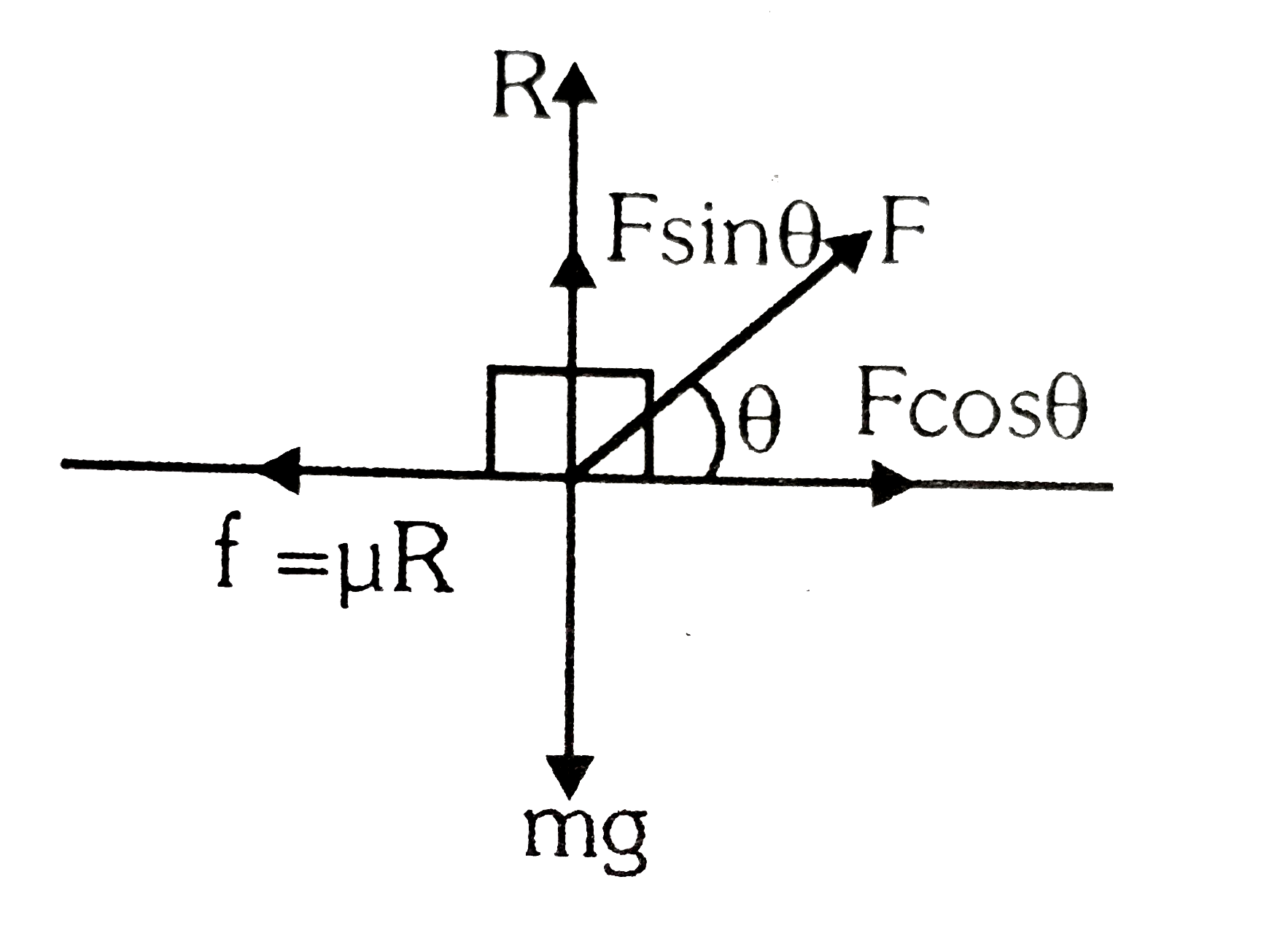
A


`R=Fsin theta=mg`
`R=mg-F sin theta`
Force of friction, `f=muR=mu (mg-F sin theta)`
The block will move, when
`F cos ge f`
`F cos theta ge mu (mg-sin theta)`
`Fge(mu mg)/(cos theta+mu sin theta)` ....(i)
F will be minimum, when
`cos theta+ mu sin theta=` maximum , for which
`(d)/(d theta)(cos theta + mu sin theta)=0`
or `-sin theta+ mu cos theta=0` or `mu cos theta=sin theta`
or `tan theta=mu` or `theta=tan^(-1)(mu)`
`therefore sin theta=(mu)/sqrt(1+mu^(2))` and `cos theta=(1)/sqrt(1+mu^(2))`
From (ii),
`Fge(mumg)/((1)/sqrt(1+mu^(2))+(mu^(2))/sqrt(1+_mu^(2)))`
`Fge(mumg)/sqrt(1+mu^(2)) thereforeF_("min")=(mumg)/sqrt(1+mu^(2))`
Promotional Banner

Topper's Solved these Questions

  • NEWTONS LAWS OF MOTION

    ALLEN |Exercise EXERCISE-II|112 Videos
  • NEWTONS LAWS OF MOTION

    ALLEN |Exercise EXERCISE-III|28 Videos
  • NEWTONS LAWS OF MOTION

    ALLEN |Exercise SWOE|44 Videos
  • NEWTON'S LAWS OF MOTION & FRICTION

    ALLEN |Exercise EXERCISE (JA)|4 Videos
  • RACE

    ALLEN |Exercise Basic Maths (Wave Motion & Dopplers Effect) (Stationary waves & doppler effect, beats)|25 Videos

Similar Questions

Explore conceptually related problems

A block of mass 2 kg is kept on a rough horizontal floor an pulled with a force F. If the coefficient of friction is 0.5. then the minimum force required to move the block is :-

A body of mass M is kept on a rough horizontal surface (friction coefficient = mu ). A person is trying to pull the body by applying a horizontal force but the body is not moving. The force by the surface on the body is,

A block of mass 0.1 is held against a wall applying a horizontal force of 5N on block. If the coefficient of friction between the block and the wall is 0.5, the magnitude of the frictional force acting on the block is:

A block of mass m rests on a rough horizontl surface as shown in figure (a) and (b). Coefficient of friciton between block and surface is mu . A force F-mg acting at an angle theta with the vertical side of the block. Find the condition for which block will move along the surface.

A block of mass 1kg is at rest on a rough horizontal surface having coefficient of static friction 0.2 and kinetic friciton 0.15, find the frictional forces if a horizontal force, (a) F=1N (b) F=1.96N (c) F=2.5N is applied on a block

A block A of mass 2 kg rests on another block B of mass 8 kg which rests on a horizontal floor. The coefficient of friction between A and B is 0.2 while that between B and floor is 0.5. when a horizontal force of 25 N is applied on the block B. the force of friction between A and B is

A block of mass 2 kg is placed on the floor . The coefficient of static friction is 0.4 . If a force of 2.8 N is applied on the block parallel to floor , the force of friction between the block and floor is : (Taking g = 10 m//s^(2) )

A block rest on a rough inclined plane as shown in fig. A horizontal force F is applied to it (a) Find out the force of reaction, (b) Can the force of friction be zero if yes when? And (c) Assuming that fricition is not zero find its magnitude and direction of its limiting value.

A block of mass m is on an inclined plane of angle theta . The coefficient of friction between the block and the plane is mu and tanthetagtmu . The block is held stationary by applying a force P parallel to the plane. The direction of force pointing up the plane is taken to be positive. As P is varied from P_1=mg(sintheta-mucostheta) to P_2=mg(sintheta+mucostheta) , the frictional force f versus P graph will look like

ALLEN -NEWTONS LAWS OF MOTION-EXERCISE-I
  1. A 150 g tenins ball coming at a speed of 40m/s is hit straight back by...

    Text Solution

    |

  2. Three solids of masses m(1),m(2) and m(3) are connected with weightles...

    Text Solution

    |

  3. Two blocks of masses M(1)=4 kg and M(2)=6kg are connected by a string ...

    Text Solution

    |

  4. Three masses M(1), M(2) and M(3) are lying on a frictionless table. Th...

    Text Solution

    |

  5. In Newton's second vecF=mveca (for constant mass m), veca is the accel...

    Text Solution

    |

  6. A man of mass 90kg is standing in an elevator whose cable broke sudden...

    Text Solution

    |

  7. A force vecF=(6hati-8hatj+10hatk)N produces acceleration of 1 ms^(-2) ...

    Text Solution

    |

  8. Two bodies A and B of masses 10kg and 15kg respectively kept on a smoo...

    Text Solution

    |

  9. Ten one-rupee coins are put on top of each other on a table, Each coin...

    Text Solution

    |

  10. A block of mass m is in contact with the cart C as shown in The coeffi...

    Text Solution

    |

  11. A gramphone record is revolving with an angular velocity omega. A coin...

    Text Solution

    |

  12. A man, of mass 60kg, is riding in a lift. The weights of the man, when...

    Text Solution

    |

  13. A person of mass 940 kg and presses the button on control panel. Then ...

    Text Solution

    |

  14. A body mass M hits normally a rigid wall with velocity v and bounces b...

    Text Solution

    |

  15. Three blocks of masses m, 3m and 5m are connected by massless strings ...

    Text Solution

    |

  16. A particle of mass m rests on a horizontal floor with which it has a c...

    Text Solution

    |

  17. A car of mass 1000kg negotiates a banked curve of radius 90m on a fict...

    Text Solution

    |

  18. In the figure given, the system is in equilibrium. What is the maximum...

    Text Solution

    |

  19. Four blocks of the same mass m connected by cords are pulled by a forc...

    Text Solution

    |

  20. A 140g ball, in horizontal flight with a speed v(1) of 39.0 m/s. is st...

    Text Solution

    |

