Home
Class 12
PHYSICS
Two blocks each of mass M are resting on...

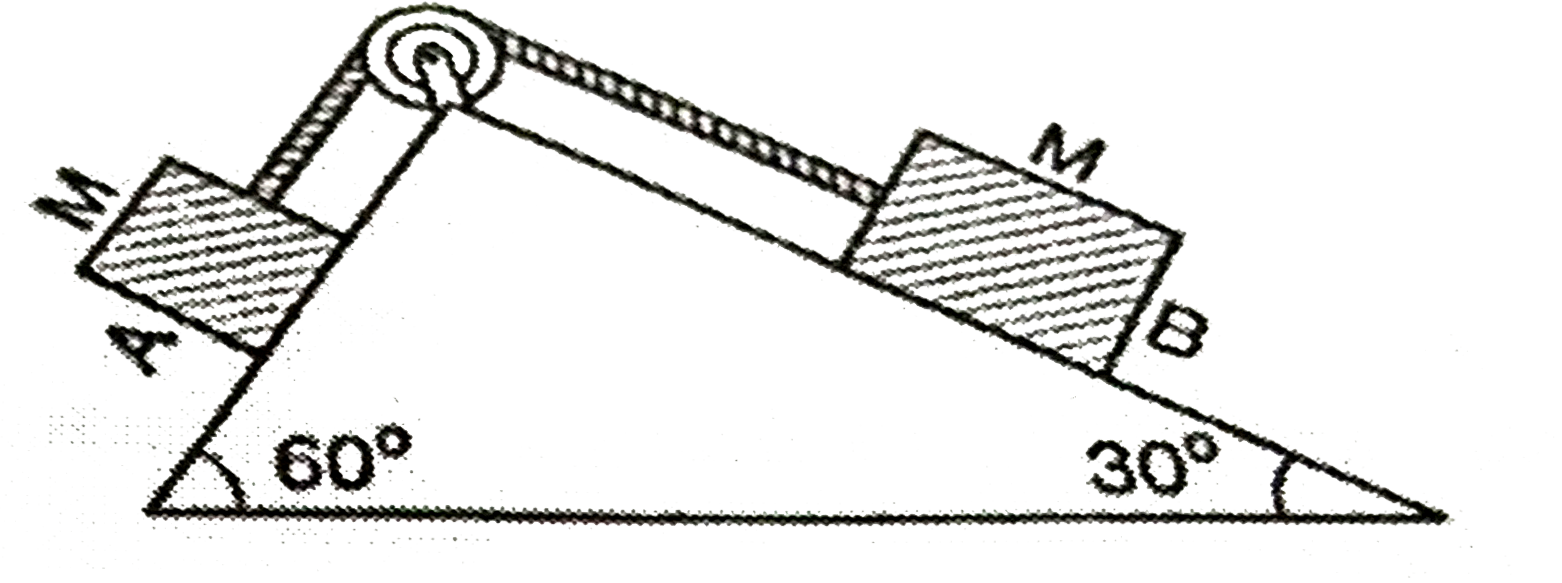
Two blocks each of mass M are resting on a frictionless inclined plane as shown in fig then:

A

The block A moves down the plane

B

The block B moves down the plane

C

Both the blocks down the plane

D

Both the blocks remains down the plane.

Text Solution

Verified by Experts

The correct Answer is:

A

Block A has higher value of ` Mg sin theta`
Promotional Banner

Topper's Solved these Questions

  • NEWTONS LAWS OF MOTION

    ALLEN |Exercise EXERCISE-III|28 Videos
  • NEWTONS LAWS OF MOTION

    ALLEN |Exercise EXERCISE-I|52 Videos
  • NEWTON'S LAWS OF MOTION & FRICTION

    ALLEN |Exercise EXERCISE (JA)|4 Videos
  • RACE

    ALLEN |Exercise Basic Maths (Wave Motion & Dopplers Effect) (Stationary waves & doppler effect, beats)|25 Videos

Similar Questions

Explore conceptually related problems

A block of mass 15 kg is resting on a rough inclined plane as shown in figure ,The block is tied by a horizontal string which has a tension 50 N The coefficient of friction of contact is

A block of mass 3kg is at rest on a rough inclined plan as shown in the Figure. The magnitude of net force exerted by the surface on the block will be

Two blocks of masses 6 kg and 4 kg are connected with rope of mass 2 kg are resting on a frictionless floor as shown in the following figure: If a constant force of 60N is applied to 6 kg block then the tension in the rope at points A,B and C are respectively given by :

Four massless springs whose force constants are 2k, 2k, k and 2k respectively are attached to a mass M kept on a frictionless plane (as shown in figure). If the mass M is displaced in the horizontal direction.

Two springs are connected to a block of mass M is placed on a frictionless surface as shown in figure. If both springs have a spring constant k, the frequency of oscillation of the block is………

A small block of mass M move on a frictionless surface of an inclimed from as down is figure . The engle of the inclime suddenly change from 60^(@) to 30^(@) at point B . The block is initally at rest at A Assume the collsion between the block and the incline are totally inclassic (g = 10m//s^(2) ) If collision between the block and the incline is completely elestic , then the vartical (apward) component of the of the block at point B immediatly after it stricess the scond indine is -

A small block of mass M move on a frictionless surface of an inclimed from as down is figure . The engle of the inclime suddenly change from 60^(@) to 30^(@) at point B . The block is initally at rest at A Assume the collsion between the block and the incline are totally inclassic (g = 10m//s^(2) ) The speed of the block at point C immediately before is leaves the second incline is

A small block of mass M move on a frictionless surface of an inclimed from as down is figure . The engle of the inclime suddenly change from 60^(@) to 30^(@) at point B . The block is initally at rest at A Assume the collsion between the block and the incline are totally inclassic (g = 10m//s^(2) ) The speed of the block at point B immedutaly after it strikes the second inclime is -

In a body A of mass tn slides on plane inclined at angle theta_(1) , to the horizontal and p is the coefficent of friction between A and the plane. A is connected by a light string passing over a frictionless pulley to another body B, also of mass m, sliding on a frictionless plane inclined at an angle theta_(2) to the horizontal. Which of the following statements are true ?

Two blocks of masses 2kg and M are at rest on an inclined plane and are separated by a distance of 6.0m as shown. The coefficient of friction between each block and the inclined plane is 0.25 . The 2kg block is given a velocity of 10.0m//s up the inclined plane. It collides with M, comes back and has a velocity of 1.0m//s when it reaches its initial position. The other block M after the collision moves 0.5m up and comes to rest. Calculate the coefficient of restitution between the blocks and the mass of the block M. [Take sintheta=tantheta=0.05 and g=10m//s^2 ]

ALLEN -NEWTONS LAWS OF MOTION-EXERCISE-II
  1. Two bodies of masses 5 kg and 4 kg are arranged in two possition as sh...

    Text Solution

    |

  2. Three equal weights of mass 2 kg each are hanging on a string passing ...

    Text Solution

    |

  3. Two blocks each of mass M are resting on a frictionless inclined plane...

    Text Solution

    |

  4. A small sphere is suspended by a string from the ceiling of a car. If ...

    Text Solution

    |

  5. A pendulum is suspended from the roof of a rall road car. When the car...

    Text Solution

    |

  6. Drums of oil are carried in a truck. If a constant accleration is appl...

    Text Solution

    |

  7. A boy sitting on the top most berth in the compartment of a train whic...

    Text Solution

    |

  8. A ball weighing 10g hits a hard surface vertically with a speed of 5m/...

    Text Solution

    |

  9. A force-time graph for the motion of a body is shown in fig. change in...

    Text Solution

    |

  10. Newton's II law of motion connects:

    Text Solution

    |

  11. The distance x covered in time t by a body having initial velocity v(0...

    Text Solution

    |

  12. Working of rocket or jet is based on:-

    Text Solution

    |

  13. When a horse pulls a wagon, the force that causes the horse to move fo...

    Text Solution

    |

  14. A man is at rest in the middle of a pond on perfectly smooth ice. He c...

    Text Solution

    |

  15. A body A mass m(1) exerts a force on another body B of mass m(2) . If ...

    Text Solution

    |

  16. There are three Newton's laws of motion namely I, II and III : we can ...

    Text Solution

    |

  17. What would happen if gravity suddenly disappears?

    Text Solution

    |

  18. Two bodies of masses 4 kg and 5kg are acted upon by the same force. If...

    Text Solution

    |

  19. A jet water, whose cros section is 'a' strikes a wall making an angle ...

    Text Solution

    |

  20. Action and reaction:- (For a given system) (a) Act on the two diffe...

    Text Solution

    |
