Home
Class 12
PHYSICS
Two identical glass bulbs are interconne...

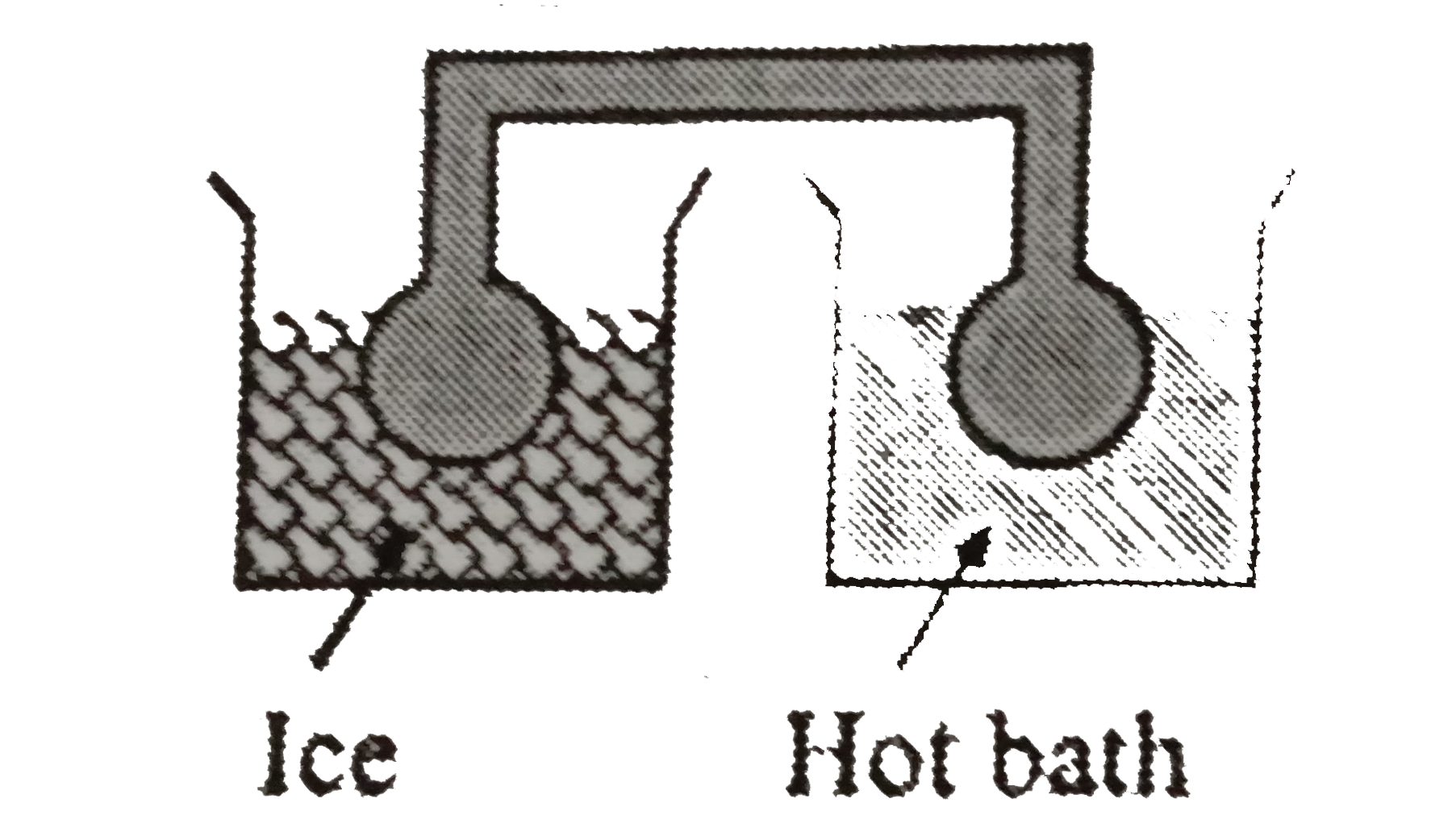
Two identical glass bulbs are interconnected by a thin glass tube. A gas is filled in these bulbs at `N.T.P.` If one bulb is placed in ice and another bulb is placed in hot bath, then the pressure of the gas becomes `1.5` times. The temperature of hot bath will be

A

`100^(@)C`

B

`182^(@)C`

C

`256^(@)C`

D

`546^(@)C`

Text Solution

Verified by Experts

The correct Answer is:

D

Number of moles remain constant
`n_(1) + n_(2) = n_(1)' + n_(2)' implies (P_(1)V_(1))/(RT_(1)) + (P_(2)V_(2))/(RT_(2)) = (P_(1)'V_(1)')/(RT_(1)') + (P_(2)'V_(2)')/(RT_(2)')`
` implies T = 273 xx 3K = (273 xx 3 - 273) "^(@)C = 546^(@)C`
Promotional Banner

Topper's Solved these Questions

  • GEOMETRICAL OPTICS

    ALLEN |Exercise EXERCISE -02|82 Videos
  • GEOMETRICAL OPTICS

    ALLEN |Exercise EXERCISE -03|11 Videos
  • GEOMETRICAL OPTICS

    ALLEN |Exercise SOME WORKED OUT EXAMPLES|84 Videos
  • CURRENT ELECTRICITY

    ALLEN |Exercise EX.II|66 Videos
  • GRAVITATION

    ALLEN |Exercise EXERCISE 4|9 Videos

Similar Questions

Explore conceptually related problems

Two glass bulbs of equal volume are connected by a narrow tube and are filled with a gas at 0^@C and a pressure of 76cm of mercury. One of the bulbs is then placed in melting ice and the other is placed in a water bath maintained at 62^@C . What is the new value of the pressure inside the bulbs? The volume of the connecting tube is negligible.

A container with insulating walls is divided into two equal parts by a partition fitted with a valve. One part is filled with an ideal gas at a pressure P and temperature T, whereas the other part is completely evacuated . If the valve is suddenly opened, the pressure and temperature of the gas will be

The rectangular box shown in Fig has partition which can slide without friction along the length of the box. Initially each of the two chambers of the box has one mole of a mono-atomic ideal gas (lambda=5//3) at a pressure P_0 , volume V_0 and temperature T_0 . The chamber on the left is slowly heated by an electric heater. The walls of the box and the lead wires of the heater is negligible. The gas in the left chamber expands pushing the partition until the final pressure in both chambers becomes 243P_0//32 . Determine (i) the final temperature of the gas in each chamber and (ii) the work done by the gas in the right chamber.

Two moles of an ideal monoatomic gas are confined within a cylinder by a massless and frictionless spring loaded piston of cross-sectional area 4 xx 10^(-3)m^(2) . The spring is, initially in its relaxed state. Now the gas is heated by an electric heater, placed inside the cylinder, for some time. During this time, the gas expands and does 50J of work in moving the piston through a distance 0.10m . The temperature of the gas increases by 50K . Calculate the heat supplied by the heater. P_(atm) = 1 xx 10^(5)N//m^(2)R = 8.314 J//mol-K

Two identical thin plano-convex glass lenses (refractive index 1.5) each having radius of curvature of 20 cm are placed with their convex surface in contact at the centre. The intervening space is filled with oil of refractive index 1.7. The focal length of the combination is :

A cylinder of cross-section area. A has two pistons of negligible mass separated by distances l loaded with spring of negligible mass. An ideal gas at temperature T_(1) is in the cylinder where the springs are relaxed. When the gas is heated by some means its temperature becomes T_(2) and the springs get compressed by (l)/(2) each . if P_(0) is atmospheric pressure and spring constant k= (2P_(0)A)/(l) , then find the ratio of T_(2) and T_(1) .

A weightless piston divides a thermally insulated cylinder into two parts of volumes V and 3V. 2 moles of an ideal gas at pressure P = 2 atmosphere are confined to the part with volume V =1 litre. The remainder of the cylinder is evacuated. The piston is now released and the gas expands to fill the entire space of the cylinder. The piston is then pressed back to the initial position. Find the increase of internal energy in the process and final temperature of the gas. The ratio of the specific heats of the gas, gamma =1.5 .

A container having base area A_(0) . Contains mercury upto a height l_(0) . At its bottom a thin tube of length 4l_(0) and cross-section area A(AltltA_(0) ) having lower end closed is attached . Initially the length of mercury in tube is 3l_(0) . in reamining part 2 mole of a gas at temperature T is closed as shown in figure . Determine the work done (in joule) by gas if all mercury is displaced from tube by heating slowly the gas in the rear end of the tube by means of a heater. (Given : density of mercury = rho , atmospheric pressure P_(0) = 2l_(0)rhog, C_(v) of gas = 3//2 R, A = (3//rho)m^(2), l_(0) = (1//9) m , all units is S.I. )

Each phase of a material can exits only in certain regions of pressure and temperature . P-T phase diagrams, in which pressure is plotted versus temperature, show the regions corresponding to various phases and phase transformations . P-V diagrams, on the other hand , can be used to study pressure volume relationship at a constant temperature. If the liquid and gaseous phases of a pure substances are heated together in a closed container, both the temperature and the vapor pressure will increase until a point is reached at which the two phases can no longer be distinguished from one another. The temperature and pressure at which this occurs are called the critical temperature and pressure. Exceeding either of these parameters, by itself ,will cause the "gas"//"liguid" phase transition to disappear. if the other variable is then changed as well, while the first variable is maintained above its critical point , a gradual transition will occur between the gaseous and liquid phases, with no clear boundary.(The liquid and solid phases, on the other hand , maintain a distinct boundary at all pressure above the triple point). Shown in figure is a combined P-T phase diagram for material A and B . If heat is added to solids A and B , each in a container that is open to the atmosphere :-

Each phase of a material can exits only in certain regions of pressure and temperature . P-T phase diagrams, in which pressure is plotted versus temperature, show the regions corresponding to various phases and phase transformations . P-V diagrams, on the other hand , can be used to study pressure volume relationship at a constant temperature. If the liquid and gaseous phases of a pure substances are heated together in a closed container, both the temperature and the vapor pressure will increase until a point is reached at which the two phases can no longer be distinguished from one another. The temperature and pressure at which this occurs are called the critical temperature and pressure. Exceeding either of these parameters, by itself ,will cause the "gas"//"liguid" phase transition to disappear. if the other variable is then changed as well, while the first variable is maintained above its critical point , a gradual transition will occur between the gaseous and liquid phases, with no clear boundary.(The liquid and solid phases, on the other hand , maintain a distinct boundary at all pressure above the triple point). Shown in figure is a combined P-T phase diagram for material A and B . Which is true about the substance in figure?

ALLEN -GEOMETRICAL OPTICS-EXERCISE -01
  1. Air is filled at 60^(@)C in a vessel of open mouth. The vessle is heat...

    Text Solution

    |

  2. One mole of an ideal gas undergoes a process p=(p(0))/(1+((V(0))/(V))...

    Text Solution

    |

  3. Two identical glass bulbs are interconnected by a thin glass tube. A g...

    Text Solution

    |

  4. As shown , a piston chamber pf cross section area A is filled with ide...

    Text Solution

    |

  5. A gas has volume V and pressure p. The total translational kinetic ene...

    Text Solution

    |

  6. A mixture of n(1) moles of monoatomic gas and n(2) moles of diatomic g...

    Text Solution

    |

  7. Four containers are filled with monoatomic ideal gases. For each conta...

    Text Solution

    |

  8. 10^(23) molecules of a gas strike a target of area 1 m^(2) at angle 45...

    Text Solution

    |

  9. From the following V-T diagram we can conclude:-

    Text Solution

    |

  10. The density in grams per litre of ethylene (C(2)H(4)) at STP is :-

    Text Solution

    |

  11. A gas is expanded from volume V(0) = 2V(0) under three different proce...

    Text Solution

    |

  12. Some of the thermodynamic parameters are state variables while some ar...

    Text Solution

    |

  13. For an ideal gas PT^(11) = constant then volume expansion coefficient ...

    Text Solution

    |

  14. The internal energy of a gas is given by U= 5 + 2PV. It expands from V...

    Text Solution

    |

  15. When water is heated from 0^(@)C to 4^(@)C and C(P) and C(V) are its s...

    Text Solution

    |

  16. The molar specific heat of the process V alpha T^(4) for CH(4) gas at...

    Text Solution

    |

  17. 5"n", n and 5"n" moles of a monoatomic, diatomic and non-linear polyat...

    Text Solution

    |

  18. The relation between U, p and V for an ideal gas in an adiabatic proce...

    Text Solution

    |

  19. What would be the efficiency of the heat engine diagramed as shown bel...

    Text Solution

    |

  20. An ideal Carnot heat engine with an efficiency of 30%. It absorbs heat...

    Text Solution

    |
